
The Stack: Indiana’s Redistricting Fight Could Decide Control of Congress
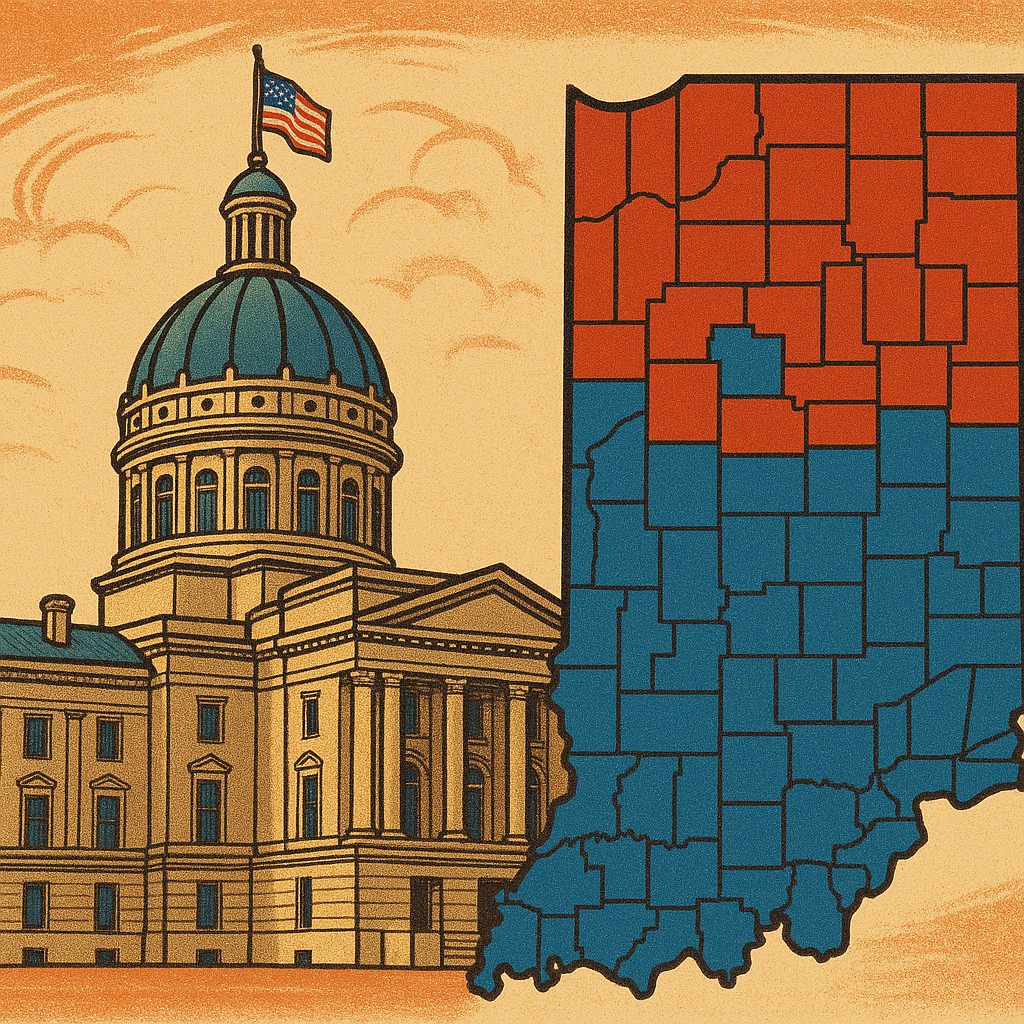
Indiana’s redistricting fight isn’t about lines on a map — it’s about whether Hoosiers continue surrendering political power to an increasingly radical Washington establishment. On today’s show, Todd cuts through the emotional theatrics to explain why redistricting isn’t some dark political trick, but a constitutional responsibility the state can no longer afford to ignore.
While critics shout about “lost representation,” the reality is simple: every Hoosier will still have a member of Congress. What’s at stake is whether Indiana keeps accidentally propping up national Democrat leadership that advances policies completely out of step with Indiana values.
From open-border chaos to runaway inflation, cultural extremism to federal overreach, Todd explains how decisions made in D.C. ripple straight into Hoosier homes. And when blue states have aggressively locked in their power for decades, Indiana refusing to act isn’t moral superiority — it’s political malpractice.
Todd also looks ahead to the Turning Point Action event at the Statehouse, where lawmakers are being urged to do their job, stand firm, and protect Indiana’s voice in Washington. This moment will shape Indiana’s influence in Congress well beyond 2026.
🎧 Listen to Today’s Episode
📰 Stack Links

🛒 Shop The Official Todd Huff Show Store

Patriot style meets practical comfort. This camo trucker hat is ready for any backyard cookout, range day, or road trip — and it’s built to last. Adjustable snapback, breathable mesh, and the Todd Huff Show crest front and center.
Because real conservatives don’t hide — even in camo.
📝 Transcript: Indiana’s Redistricting Fight Could Decide Control of Congress
The Todd Huff Show – December 5, 2025
Host: Todd Huff
Special Guest: Paul Lagemann
Todd Huff: Well, my friends, we are down to the nitty gritty. The final stretch here as Indiana has this fight come to a conclusion? Between now and Monday. On this redistricting fight, which is critically important. Listen, I know for those of you that are not in Indiana, this may seem like all that matters is Indiana this week, and I know it matters because it's my state. But listen, this has national implications.
Todd Huff: We've talked about this. We'll get into this today. In fact, I've got a special guest who's going to be joining us here in a minute from Heritage Action, and we'll introduce him here in just a moment, my friends. But this battle impacts Congress. This battle impacts the fight that we're in, and we're in a cold civil war. Make no mistake about it.
Todd Huff: For political control and victory in this country, and we've got to beat these radical leftists, and it starts in Indiana with this fight over redistricting. So we'll get to that in just a moment, friends. But, you know, one of the biggest challenges that we as conservatives have is finding ways to ensure our values align with the way that we live our lives — the job that we have, whether or not the places that we do business with are supporting conservative principles.
Todd Huff: Are they empowering radical leftists? And that also includes the way that we invest our money. That's why I love what Four Eight Financial is doing. They specialize in biblically responsible investing, and that means that they go to find companies — the level that those companies align with your faith and your values. They do all this heavy lifting for you.
Todd Huff (Sponsor): All you have to do is complete a short assessment. I did it. You can as well. Visit four8financial.com/Todd to take that quick and easy assessment, four8financial.com/Todd, because your money should work for, not against, your values.
Todd Huff: All right. That being said, my friends, I'd like to welcome to the program today a special guest from Heritage Action. His name is Paul Logaman. He is the State Advocacy Manager for Heritage Action. Paul, welcome to the program today. How are you?
Paul Lagemann: Guys, it is great to be on the program. It's a beautiful morning in Indiana, as I'm en route to the Statehouse. We have a huge event that we're partnering with Turning Point on. And when we talk about Turning Point, not only can we talk about the organization, but hopefully we can talk about the position that we are all in in Indiana as we are very close to seeing a mid-decade redistricting happen, so this is pretty exciting times.
Paul Lagemann: This isn't just about Indiana, as you mentioned. This is about keeping Congress red and not seeing that change over as we wrap up the last two years of the Trump administration. That's right. That has unbelievable ramifications. If Democrats get in control, of course we know we'll see lawfare, we'll see the weaponization of government, and all sorts of crazy radical ideas — the end of Trump's agenda and all of that.
Todd Huff: But I want to stop and spend a little time talking about this. As I just listened to what you say here, I think it's a great thing, Paul, to hear Heritage and Turning Point partnering. One of the things — I've been doing this for ten years — and I think a lot of times we kind of get, even well-meaning conservative groups, we get into our own little lanes and little bubbles, and sometimes we're not working together as we should.
Todd Huff: So I want to commend you for that. Maybe talk a little bit about that partnership and why this matters so much.
Paul Lagemann: Sure. And I hate to diverge too much from the redistricting conversation, but I gotta tell you the story, because I think it really is relevant. Just a few months ago, we're all in — our staff team is in Washington — and we're working through staff issues. We're doing planning for the legislative sessions that are coming up in January across the country.
Paul Lagemann: And working through all that, we had the horrible news about Charlie Kirk. And I can tell you, the entire building shut down. We stopped everything collectively in our groups. Collectively as a building of 300-and-some PhDs and lawyers and lobbyists and all the rest of us, we prayed. And I'll tell you, the difference between that kind of workspace and a corporate workspace — you just can't compare it.
Paul Lagemann: Since then, I've been a fan of Charlie's work. I love to listen to him and hear how he spoke to kids on campuses. So it was heartbreaking for me, just really from afar. We had a lot of folks who were really close to him, who knew him personally, very directly. And to see kind of how the building as a whole, the whole enterprise, was affected — and how we responded — was really special to me.
Paul Lagemann: And it really reinforced that I'm in the right place at the right time. So I had to start there. When we talk about Turning Point, it certainly makes this relationship — this level of engagement with Turning Point — all the more important. Because that legacy, that Charlie Kirk legacy, is absolutely critical to carry on.
Paul Lagemann: We've got to have that honest, engaging dialogue with folks of all ages. And I'm excited to be at the Statehouse with the Turning Point folks today, because I know there's going to be hundreds of students there. I think it's going to be a great rally and to really begin to talk and have Heritage be part of that dialogue with young people who are in college or younger or just a little out of college.
Paul Lagemann: I think it's a really cool step in the right direction for Heritage, and I am so excited that our senior leadership was really focused on making this happen.
Todd Huff: Well, I've been a fan of your work, of the Heritage Foundation, of course — Heritage Action, the other, I guess, sister organization there as well. You guys do very important work, and I commend you for what you're doing. Let's talk a little bit about what's happening at the Statehouse today.
Todd Huff: I'll be speaking there. Governor Braun will be speaking there, Lieutenant Governor Mike and Beckwith, Todd Rokita speaking. I'm forgetting somebody. There's a state representative — I don't have the list in front of me — but the bottom line is, you mentioned having a conversation, how Charlie Kirk was doing that with students, engaging with students who sometimes didn't know what they thought.
Todd Huff: Sometimes who had really, really bad ideas. Sometimes these kids had it together and had it figured out and just wanted to exchange some ideas and thoughts with Charlie and all that. The need for conversation about this is critical, and it's hard. It's hard to have that conversation, Paul, because there's so much screaming.
Todd Huff: In fact, as we fill that Rotunda today at the Statehouse, as I've prepared my remarks, I've thought about all the yelling and the chanting and the anger and the rage that's been in there this week from the other side — and they're free to do that, don't misunderstand me — but man, it is really hard to communicate the rationale and the reasons for wanting to support this.
Todd Huff: Because they simply — they don't want to hear it. They don't want to engage in that conversation. So in the event that you do get someone who is just legitimately — they don't know where they stand on this issue of redistricting, or maybe they're even against it, but they're open to at least hearing you out — what do you say to them? What are the reasons that you're in favor of Indiana redistricting?
Paul Lagemann: Well, it's interesting you ask that, because usually the conversation begins one of a couple of ways. But most often it begins with the concerns that people have about redistricting. And by the way, the issue of civil discourse today — it's so critical.
Paul Lagemann: And to be able to do this, and to have you participate in this, and to have the kinds of conversations that you have on your show, I have to commend you for it because I think it's too infrequent. And there's too much, as you've mentioned, yelling and screaming and noise. And the marketplace of ideas needs more folks like you to really get them out.
Paul Lagemann: So thanks for what you do. So really, it comes around a couple of ways. Some of the questions that I've been asked is, okay, so Texas kicks this off — why should Indiana be part of this fight? Texas picked the fight. California responded. Washington, Indiana, get involved.
Paul Lagemann: My response to that is: well, that's not exactly true. So when you look at kind of how the Democratic Party over the decades has handled redistricting and handled drawing these lines, it goes back to Elbridge Gerry. Okay, so all the way back to 1810 to 1812. Right.
Paul Lagemann: And he's governor between 1810 and 1812 in Massachusetts. And Governor Gerry — as a member of the Democratic-Republicans — okay, so by the time you get to the 1820s, late 1820s, they've lost the “Republican” part of the Democratic-Republicans. But that is the legacy and the direct lineage of the Democratic Party. So they wrote the book on this — literally.
Paul Lagemann: In fact, they got the name. They were named for writing the book on this. The redistricting in places like Massachusetts, which I think is a textbook, right? It is textbook for a 9–0 series of congressional seats — right? All Democrat, no Republicans.
Paul Lagemann: And if you look at Massachusetts, the numbers aren't that different from Indiana in terms of, “Hey, how many Democrats do we have in Indiana? How many Republicans do they have in Massachusetts?” It's about the same. And right now we're at 7–2, and they're at 9–0.
Paul Lagemann: So this isn't as if we've done something that is all that different from more than 100 years of Democratic legacy.
Todd Huff: Let me jump in here real fast. So Gerry—mandering, which is what you're referencing here, going back to the 1810s — 1812 — I remember I studied political science at Butler years ago, and gerrymandering when I was there meant a deliberate attempt where you went way out of your way to draw some odd shapes.
Todd Huff: And I believe that district in Massachusetts was referred to as a “Gerry-mander” because it resembled a salamander or some such thing. That’s correct. But it doesn't mean to make a decision where I draw the line — I still have to decide as a state legislature where the lines are drawn.
Todd Huff: And just because I put them in a place that is maybe politically advantageous for me — that is just part of the political process, Paul. This is baked into it. If you don't like the maps, you can hold your state legislature responsible, but it is the prerogative of the state legislature to put these lines where they think they should be.
Todd Huff: I mean, tell me — talk about that.
Paul Lagemann: Yes, and that is absolutely right. And that is exactly how Representative Ben Smaltz spoke about this. He's the author of HB 1032, which is the redistricting bill that contains all the maps, and he was very clear about it. He said, “These — you know, we made these decisions strictly on a political basis.”
Paul Lagemann: And, you know, the only things that we took into consideration were the geography and the politics. Those are the only two things we took into consideration. And so, as he laid it out — yes, that is a political… this is a purely political process, with the intent of gaining political seats. Right? Yes.
Paul Lagemann: And so, this is not — and he didn't sugarcoat it. He didn't say, “We’re trying to be fair.” He just said, “We were trying to win.” And the reason I bring up Elbridge Gerry back all the way to 1810 to 1812 is because they’ve been doing it since then.
Paul Lagemann: Okay. And so the other issue that I hear, or the other question that I hear is: “What about fairness?” And so the other side is saying, “Hey, you're cheating.” And what I want to say about Indiana specifically — and in Texas, for that matter — neither Indiana nor Texas nor Missouri nor North Carolina had to alter their process in any substantial way.
Paul Lagemann: They didn't have to change their constitution. They didn't have to completely alter their process and system. But both Virginia and California did. Right? So Virginia is on the front end of this. California has already done it. Both of them have had to have a referendum to alter their constitution to get rid of their independent redistricting commission.
Paul Lagemann: And eliminate that and shift to a political process. Right? And so when people say, “Hey, you're cheating. You're breaking the rules,” my answer is: look, this is a fight for Congress. It's a fight for control of the next two years in our legislative body — the fight for the House.
Paul Lagemann: So yes, this is a political process. But when you say, “Hey, did you cheat? Are you cheating to get this done?” No. And in fact, we are working completely within the existing laws of the state of Indiana, as they did in Texas, as they did in Missouri, as they did in North Carolina.
Paul Lagemann: And on the other side, they have to alter their constitutions, for good sakes, to make it work. They're breaking their own rules. And so if there’s any cheating going on, it's not on our side of the aisle.
Todd Huff: So I don't think it's cheating. I don't think it's unfair. I think it is — I think it reflects the people of our Hoosier State. Right? And so if you look across the state, you say, okay, every elected statewide official is Republican.
Todd Huff: You've got massive supermajorities in the House and even more massive in the Senate. Right? You've got almost every county organization — almost every county council, county commission — is Republican in the state of Indiana. And yet we say it's only fair if we have seven Republican congressmen and two Democratic congressmen?
Todd Huff: That doesn't make any sense whatsoever. It doesn't reflect the nature of the state. Let's talk about “fair.” I tell my kids, by the way, not to use the four-letter F-word — “fair” — because it is such a-. And listen, I'm a guy that appreciates what I would call justice. We need to seek that.
Todd Huff: But what is “fair”? This drives me absolutely bonkers. What is it that's fair? I've seen these leftists. I've seen them on social media come after me wanting to say, “Indiana: 60% Republican or 60% Trump supporter, 40% Democrat,” whatever. So there should be — if we had ten districts — it should be 6–4.
Todd Huff: Who comes up with this thinking? This is not the way that works. I did some research. In the 1960s the World Series was between the Pittsburgh Pirates and the — I think — the New York Yankees. And the New York Yankees lost the series 4 to 3, but they scored twice as many runs as the Pittsburgh Pirates.
Todd Huff: To me, this is exactly the point. We're not looking at the World Series champion to say, “Who had the most runs over seven games?” You have to win individual games, just like you have to win individual districts. This stuff, to me, is so cut and dry, black and white.
Todd Huff: But talk about fairness. What does that even mean in this practical sense — that the Democrats get two seats? Who says so? Why do they have the right to those? How do we even know how people are going to vote? I mean, they can run people in all nine districts, Paul, and if they change their ideas a little bit and not embrace this radical left bullcrap we've been dealing with…
Todd Huff: Then maybe they could win some of these races. So what does that all mean to begin with? What is fair? This stuff is mind-boggling to me.
Paul Lagemann: Yes. I really appreciate that, and I think the key word here isn't fairness — it is honesty. And I can tell you, when I sat through literally hours of committee hearing on Tuesday, it was all about honesty.
Paul Lagemann: And there were no bones about it. Representative Smaltz says, “These are political decisions. We've based it purely on that.” The idea is to get more — to get more runs than our opponent. Right? I mean, we're in a head-to-head fight here to get more districts than our opponent, and that's how we've designed it.
Paul Lagemann: We're in power. We have the opportunity to do it. And the nation is in balance. Right? This isn't just about Hoosiers. It's about a bigger picture. I think the way Indiana has handled this — pretty direct honesty.
Paul Lagemann: Even the ranking member on the Democrat side on the Elections and Apportionment Committee on Tuesday said to Representative Smaltz, “I appreciate you being purely honest about what you're trying to do.” And I think that's the right thing.
Paul Lagemann: I think that's exactly how we should — we shouldn't veil it in anything other than what it is. Exactly. Which is: this is a fight for our nation, and we intend to win, and here's how we're going to do it.
Paul Lagemann: We came to the current maps in the same way. There might have been a different give and take, ebb and flow there, but it's the same stinking thing that said, “Well, we think Democrats should be, I guess, competitive in these two districts.”
Paul Lagemann: It's just mind-boggling to me. Especially when you factor, Paul, things like how illegal immigration affects the census. I mean, you know that Biden's administration — they counted illegal aliens in the census, and they allocate federal funds, and they allocate representation to states based upon those tallies.
Paul Lagemann: We know that that's impacted it, and I've seen some that said that it's multiple districts that have been assigned, and those also translate into electoral votes. I mean, this is a massive problem, and it's diluting the voice of Hoosiers. Talk about that.
Paul Lagemann: You’re absolutely right. And I have got to make a shameless plug for a piece of model legislation that we're introducing in Indiana and probably about 15 other states, and I'm so excited about. And it is state-sponsored census.
Paul Lagemann: And in the state-redistricting model bill, you don't count folks who aren't eligible. You don't count non-citizens. If you're not eligible to vote as a citizen, you're not counted. Okay? That will change lines, and it even could potentially have an impact of reducing the number of congressional districts in the state.
Paul Lagemann: So there could be some negative impact to it, but it's an honest response to a dishonest problem. And right now, as we say, okay, it's got to be 790,000 per congressional district — which is kind of the right number as we look at each congressional district — then how we count that number of people just includes all the people that are there.
Paul Lagemann: It doesn't matter if they're citizens, if they're eligible as a citizen to vote or not. So that is problematic, and that's why we at Heritage have come up with an alternative. Now, it could be kind of expensive for states…
Todd Huff: Yes, sir. Let's pick up there. I'm getting to the end of my segment. I'm sorry. Let's pick up there. Let's talk about this on the other side of the break. Before I take that break, my friends, let's face it — living with discomfort can be tough.
Todd Huff (Sponsor): And prescription medications can help you sometimes, but those often come with a long list of side effects, not to mention the risk of dependency. That's why a lot of people are exploring natural options like Kratom. Now, I know Kratom has a bad reputation out there, but that's because of the synthetic junk that has chemicals that's not managed the right way.
Todd Huff (Sponsor): You can work with Christopher’s Organic Botanicals. You can work with a family-run company that does things the right way. They work directly with Indonesian farmers. They lab test every batch to make sure that you're getting a product that is good and properly handled, my friends.
Todd Huff (Sponsor): So Christopher’s Organic Botanicals keeps it real. They keep it clean. They keep you informed. You can research it — and I encourage you to research it. You can go to their website or do it on your own. But christophersorganicbotanicals.com.
Todd Huff (Sponsor): If you decide that this is something you want to give a try, start with the Kratom Starter Pack. Use code ToddHuff — you'll save 10%. christophersorganicbotanicals.com. My friends: truth, transparency, tradition. Time out for me. Be back in just a minute.
Paul Lagemann: So, the bill that Heritage is pushing around the country — and we're working on about 15 or 16 state legislatures this year, in the coming year, in the ’26 cycle — is state-sponsored census. So it puts the state in the hands of the states so they can control it.
Paul Lagemann: They can eliminate non-citizens and get an actual honest count. And the one thing you do find is, particularly in urban areas, it will affect those spaces because that's normally where you end up with, you know, more folks that are here that don't have the ability to vote.
Paul Lagemann: So whether they're here legally as a non-citizen that can't vote, or illegally as a non-citizen that can't vote — they shouldn't be counted in terms of what the design and what the size and what the parameters are of a congressional district, a state legislative district, a county council district, or any such thing.
Todd Huff: Let me ask this, Paul. But the expense — that sounds great, and that makes a lot of sense in certain ways. So does the U.S. — does the federal government still… would they be conducting the U.S. Census overall? In this legislation, would states try to take that over completely? How does that work?
Paul Lagemann: It wouldn't eliminate the federal census. The federal government has the ability to do whatever they want to do, right? However, for the purpose of creating political subdivisions and districts, it would use the state numbers as opposed to the federal.
Todd Huff: Okay. So if a state had its own number that differed from the federal government's census numbers, would that impact the number of congressional seats that would be allocated, or how does that…?
Paul Lagemann: That comes from the federal census. The number of seats probably can't change unless there is a federal law change. Right? But it would certainly alter the potential dimensions and the look and feel of many of these congressional districts.
Paul Lagemann: And at that point, really — if we say, “Okay, well, the feds say we have to have nine in Indiana,” we just divide them up based on legal citizens. And instead of 790,000, it might be 760,000 for each district. But then that alters the way that this looks.
Todd Huff: Got you. Well, I've seen some testimony, ironically, in Congress recently about the census. And sometimes you get in the weeds on some of this stuff. But I gotta tell you — listening to the testimony of people that are experts on the census, and it is mind-boggling.
Todd Huff: I mean, they're basically admitting: “We’re just guessing on numbers in a lot of ways.” I mean, I saw a panel of four or five people, and they all basically said, “We don't know.” At some point there's algorithms and mathematical estimates.
Todd Huff: And you factor in the illegal alien count being in there, and it's a recipe for disaster. How did we get here, Paul? How did we get to the point where we're defying all sorts of common sense to avoid what's the obvious thing, which is: you count citizens.
Todd Huff: And if you don't count them — if they don't exist — you don't just guess and make up a number. I mean, how did we get to this point?
Paul Lagemann: Well, I have to admit, I'm a state government guy as opposed to a federal government guy. So I have a bias that I'm going to disclose. I think the states can do this sort of thing better. I think the problem is that we've handed this off to the federal government.
Paul Lagemann: We have said to the states, “So much for federalism and being the petri dish of democracy — we're going to do it our way,” says the federal government. Right? And we end up with systems that could be a lot better.
Paul Lagemann: The beauty of having 50 states really kind of govern this process — and govern it and create it and improve it the way that states do when they're really free to make policy decisions — I think you get a much better product overall.
Paul Lagemann: And I think shifting and believing in federalism and letting it work is definitely the way. And we argue — we have conversations about internally in the building — sort of the state versus federal: the pace of how work goes and that sort of thing.
Paul Lagemann: When we talk to our analysts and the folks on the foundation side who are really doing the deep thinking about policy, and we're saying, “Hey, we need this literally tomorrow,” they don't even understand it because they're so used to working with a glacial federal government.
Paul Lagemann: They don't understand the speed of states and the engagement level in states. And I really firmly believe that this is where the action is and this is where things are headed.
Paul Lagemann: And I think a bill like this sort of begins to put that pressure on the feds and says, “Hey, let loose that iron grip that you have on all of these issues. Let the states do it better.”
Todd Huff: So, let's get returned specifically to where we are in Indiana today with redistricting. Do you have a gauge on where some of these senators stand? I know that I spoke with Brett from Turning Point earlier this week.
Todd Huff: He had a list of senators — we think there were eight or nine of them — that he said were on the fence, that people should reach out to and call. Do you have any gauge of where these senators are, as to where they're going to come down?
Todd Huff: Are there people that can still be persuaded? What's your understanding of what's going to happen next in the Senate?
Paul Lagemann: Well, I think the fact that the Senate is having a special session at all after voting on Organization Day not to do it says that they're moving in the right direction. Okay? So the vote on Organization Day was a surprise to everyone — including the Speaker.
Paul Lagemann: I think it sort of shocked the House that they did it. No one really anticipated it. And then all of a sudden you have this vote on whether or not to do a special session, whether or not to redistrict. So it was a surprise to everyone.
Paul Lagemann: So I think you can somewhat discount that vote overall and look at where the yeses and nos are. I think we're about five. I think if we shift five votes, we win. And so, that's about where we are.
Paul Lagemann: And I can tell you, in the conversations I've had with state senators and state House members who are getting tons of calls on this — if it's coming from Peoria, Illinois, or Kansas City, or someplace like that, they're pretty much disregarding it.
Paul Lagemann: If it's coming from within their districts, they're not only taking the call — they're having a real conversation. We've said to our team — our Sentinel base, the grassroots network that we have across the state of Indiana — we've said:
Paul Lagemann: “Hey, this is a polite conversation. They need to know that if they make the decision for redistricting, that you're going to support them not only in the primary but in future races. That this is a pivotal decision. And that you're encouraging them and standing with them in making the right call here.”
Paul Lagemann: As opposed to — and I can tell you, a lot of the members have just gotten sworn at, they've been yelled at. That stuff just isn't helpful. Civil discourse, right? I think we’re about five off in the Senate.
Paul Lagemann: As you know, yesterday we moved off a second reading in the House. It came out of committee on Tuesday. Second reading yesterday. Third reading’s today. It'll get voted on in the House — presumably passed out. The votes are there.
Paul Lagemann: It'll go over to the Senate on Monday. We are hearing that a hearing will happen Monday — so in the afternoon. So it's going to move quicker. And that's not even on the calendar yet. But that's what we understand, is it'll be a Monday afternoon hearing.
Paul Lagemann: And a committee hearing. And so this is going to move pretty quickly, potentially, in the Senate. I would have guessed at the beginning of the week it would have the same cadence as it's had in the House.
Paul Lagemann: That doesn't seem to be true. They're moving it a little bit quicker. So my sense is, too, that it'll get out of committee, it'll go through the same process with a potential series of amendments that would happen on second reading.
Paul Lagemann: My guess is most of those will die — probably all of them die. And then we just see where we're at on third, to see if this thing will pass. Remember though, too, we do have in the Senate the Lieutenant Governor who can break a tie.
Paul Lagemann: We know where he stands. So if we're that close, at least we can break the tie. Okay? So that's where we're sitting. I believe it's about five votes that have to shift, and we feel optimistic that many of those folks are headed in the right direction.
Todd Huff: Paul, can you stay around for our last segment? It's about six minutes. I hate to put you on the spot like that, but would you be able to—?
Paul Lagemann: Yes, sir.
Todd Huff: Okay, let's wrap up on the other side of the break. I gotta take a quick timeout, though. You're listening here to Conservative Not Bitter Talk, my friends. Talking with Paul Logaman of Heritage Action — he's the State Advocacy Manager there. Quick timeout. Back in just a minute.
Todd Huff: Welcome back, my friends. Last segment here. I know it's a tough time of the week — this is the last time you're going to hear this program until Monday. It's been a busy, busy week for sure. Friends, let's be honest: when your financial world starts getting a little more complicated, you need more than one-size-fits-all advice.
Todd Huff (Sponsor): That's where Full Suite Wealth shines. Jason and his team specialize in working with families and individuals at your level, offering personalized guidance that goes far beyond the basics — from private equity and private credit to options strategies and coordinated legal planning.
Todd Huff (Sponsor): Full Suite Wealth helps you see the big picture and make confident decisions about your legacy. It's all about having a dedicated team guide you every step of the way so you can focus on what matters most — your family, your goals, your future.
Todd Huff (Sponsor): If you want real confidence in your financial life, visit fullsuitewealth.com — that's fullsuitewealth.com. Build your legacy. Secure your future.
Todd Huff: I'm on the phone here, been talking today with Paul Logaman. He is the State Advocacy Manager of Heritage Action. And during the break, I shared with Paul — I didn't tell him before this — that my representative, my senator in this state, is Senator Rod Bray, leader in the Senate.
Todd Huff: And I've shared with Paul, but I've shared with you in this audience as well: I've reached out to Rod Bray many times. Email. I've tagged him in social media posts. We're friends on Facebook — well, we were. I'm not sure now. But I've tagged him on posts.
Todd Huff: I've called and left voicemails. I know him a little bit. I've never had any problem with Rod or whatever. Listen, he can even decide that redistricting is the wrong thing. But as a representative — as a senator — with constituents, he owes it not to me as a talk show host, but to us as constituents, to share his position.
Todd Huff: And I've not gotten that. Now, I don’t mean that to be inflammatory. I'm just telling you the realities of the situation. Paul was saying — and Paul, you can chime in here — that a lot of senators are being more engaging.
Todd Huff: Who were the ones that you find are maybe the critical ones to sway, for folks to reach out to? And maybe give some tips — if they do reach out, what should that interaction sound like?
Paul Lagemann: Sure. I think, first of all, Senator Mitchell is an interesting one. He didn't vote on the original vote on Organization Day. He wasn't there. I don't know if that was planned or if it just worked out that way.
Paul Lagemann: He's not publicly made a statement. Senator Mishler writes the budget for the state, for all intents and purposes, from the Senate side. And so — a lot of influence. I think that is a critical district that's up around the Warsaw area in northern Indiana.
Paul Lagemann: You've got Senator Good in the Terre Haute area — another influential senator that is, I think, more and more open to the issue. Had been a “no” and is beginning to shift. And I think because of constituent pressure.
Paul Lagemann: And these guys are listening. So I would say the key to it is — we talk about civil discourse. To get on the phone with them and yell at them doesn’t really help. Nobody wants that. Nobody wants to be all that.
Paul Lagemann: I think: make the case. Get on the phone. Make the case. And the most important thing is to say, “Hey, I'm not in Peoria, Illinois. I'm not in Southern California. I'm a Hoosier. I'm in your district. I see you when you go to the grocery store.”
Paul Lagemann: “And when you come back here — because we have a part-time legislature — I want to be supportive of you. I really think this is one of the most important votes that you'll make in your career. And we need you to be there.”
Paul Lagemann: I think that kind of sentiment — those kinds of conversations — are the most productive.
Todd Huff: Well, it's interesting, too. I know as a principled conservative, it can be maddening. It's maddening to me sometimes. But this is a process — I've said on this program, this is not going away. This fight that we have.
Todd Huff: Reagan said, “Freedom is always just one generation away from extinction. We don't pass it along to the next generation in their bloodstream.” In our bloodstream. We have to basically educate the next generation, make sure they understand what they've got.
Todd Huff: And then build upon that and improve upon that — make sure it's passed along to the next generation. And so we can't expect some of these folks — there's a lot of pressures, there's a lot of viewpoints. But these are important. This battle is critically important.
Todd Huff: And we're not going to find a perfect senator or representative, but we need to be moving in the right direction, and it's imperative that Indiana do this. Paul, I’ve got about a minute left. Closing thoughts as we go into this rally today and into this final vote next week?
Paul Lagemann: Well, I would say: if your senator anywhere in the state has said yes — you need to call them and thank them. I think that's really important, too, because a lot of times we get to the yes and then we walk away and we forget about them.
Paul Lagemann: We need to say thanks. I can tell you, Senator Johnson from the Fort Wayne area has really been pivotal in this process, and I've got to say a public thank-you to Senator Tyler Johnson. But do that also in this process.
Paul Lagemann: And I think as we roll into next week, pressure on your state senator is going to be critical. So be on the phones. Send emails. Get in touch any way you can. Freedom is at stake — and now is the time.
Todd Huff: Well, Paul, I appreciate you being on the program. I appreciate what you do at Heritage. I appreciate the partnership with Turning Point. It's been a pleasure, sir, to have you on. This is a critically important thing.
Todd Huff: Thank you for sharing your insight and expertise on this matter.
Paul Lagemann: My pleasure, and thank you for all you do. And I'll look you up today as I get to the Statehouse, and we'll introduce ourselves. So it's a pleasure to have you.
Todd Huff: Looking forward to it. That is Paul Logaman. He is the Heritage Action State Advocacy Manager. Music telling me it's time to wrap it up for the day, folks. Have a great weekend. SDG.