
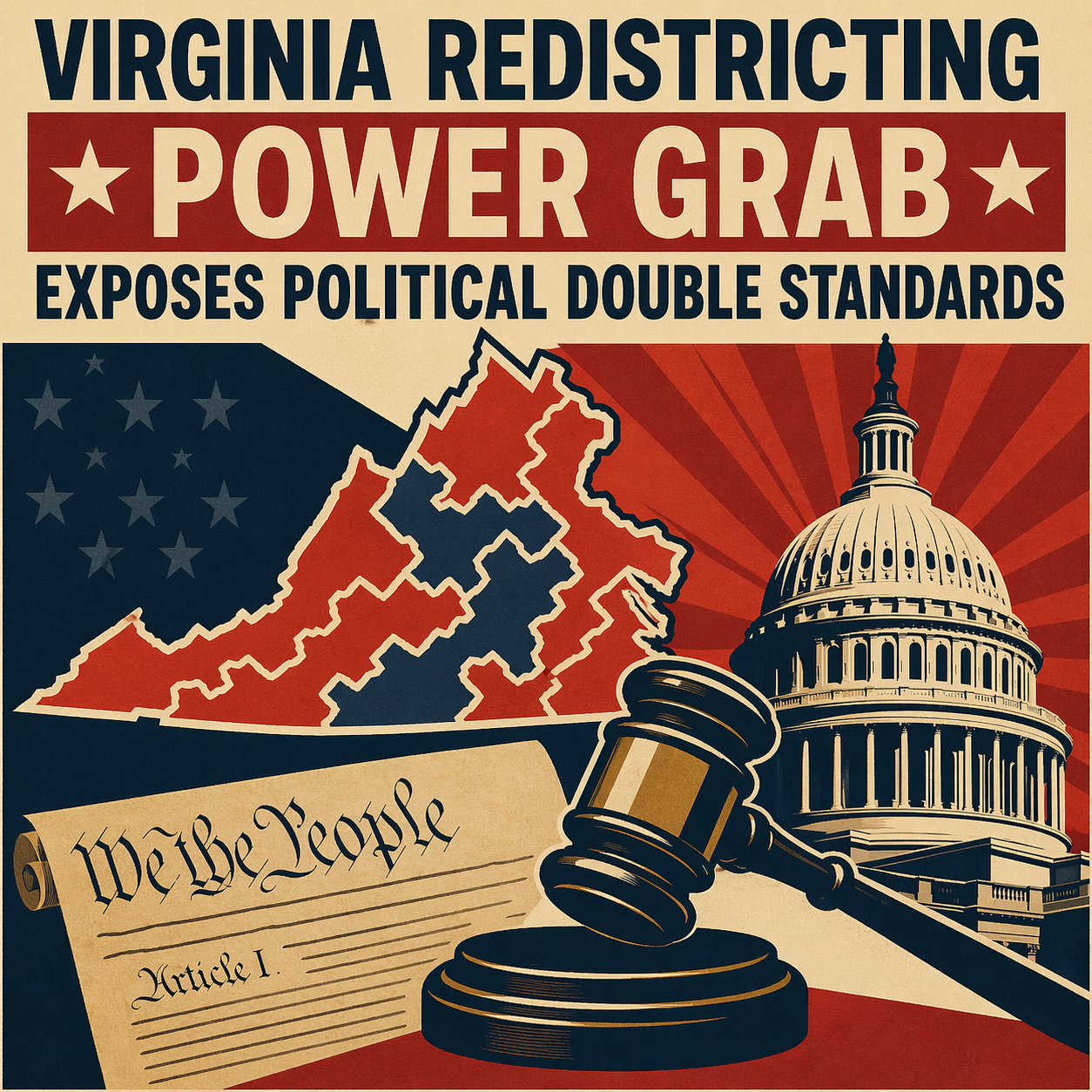
The Stack: Virginia Redistricting Power Grab Exposes Political Double Standards
The narrative surrounding Iran’s nuclear ambitions is beginning to unravel—and even legacy media is acknowledging it. A recent report confirms that Iran is believed to possess enough highly enriched uranium (HEU) to produce up to 10 nuclear weapons, a reality that sharply contradicts political claims that no credible threat exists.
Todd Huff breaks down the dangerous gap between political messaging and geopolitical reality. While some leaders dismiss the risk, Iran’s enrichment levels—far beyond civilian needs—raise serious concerns among global watchdogs and security experts.
This episode also revisits the lessons of 9/11, questioning whether the West has forgotten the nature of ideological threats. Todd argues that misunderstanding regimes like Iran leads to dangerous complacency, especially as negotiations, military tensions, and nuclear capabilities collide.
At stake is more than politics—it’s a clear-eyed understanding of national security in a world where denial and spin can have catastrophic consequences.
🎧 Listen to Today’s Episode
📰 Stack Links
2026 Constitutional Amendment Brochure - Redistricting—Redist-ENG.pdf
Hakeem Jeffries Invokes Scripture to Support Virginia Redistricting Effort
Virginia voters approve Democrats’ redistricting plan amid nationwide battle
Virginia voters narrowly approve measure to boost Democrats in midterms
Want to get Stack links and content delivered to your inbox each weekday?
Subscribe to The Inner Circle. It’s free
📝 Transcript: Virginia Redistricting Power Grab Exposes Political Double Standards
The Todd Huff Show – April 22, 2026
Host: Todd Huff
Todd Huff: Where is the outrage my friends where is the screaming and crying and overly dramatic responses out there from people who told me. Who told me that redistricting. In a midterm election year. Halfway through the decade was the most egregious offensive thing known to man this I was told this by both Republicans. And Democrats Democrats of course screaming from the rooftops hissing at me when I made a speech at the state house here back in December in support of Republicans redistricting. And of course Republicans thinking they somehow found some moral high ground by allowing the people. Allowing the people who are destroying this country ruining families. Who are.
Todd Huff: Well presenting ideas and promoting policies that are downright dangerous my friends absolutely harmful to people things like the trans agenda and everything else. Where are the people I'm waiting for them to tell me what Virginia did yesterday was completely inexcusable and it is worth mourning over taking days off of work and crying and lamenting. This turn of events. I want to talk about this my friends. Want to talk about the redistricting that happened. In. Virginia the state of Virginia. And I want to well. I want to go through. And show how consistent I actually am. And how inconsistent these pretenders. And these folks who want to be seen as virtue signaling to people in our country. I want to I want to compare and contrast this with what happened here in my state of Indiana I told you more of this was coming. When we talked about this at the end of last year and earlier this year. And now. Now they now it's here the chickens says Jeremiah Wright would say Obama's pastor America's chickens have come home to roost I guess so anyway. That's where we're headed today my friends let's talk about something here off the top that's important what we're going to talk about is important but this is also important that your money you worked hard for it.
Todd Huff (Sponsor): But is your money working hard for you? In the form of your investments and is it working hard for what you believe in listen it is easy to say it's easy to say that we believe in a particular principle or idea or whatever. But one of the beautiful things. About God creating a material physical universe for us to live in is that we can prove what we believe by what we do. And at 48 financial they specialize in what they call biblically responsible investing that means they screen out companies that don't align with your faith and your values. And they help for a financial helps create a plan that helps fit your goals and purpose and also keeps you from investing in companies that are antithetical the opposite of your faith and values. And the starting point is to do a quick assessment just to see to what degree your current investments align with your beliefs and values. And it's easy to do. You'll head on over to https://48financial.com/Todddo that now 48financial.com Todd take the quick and easy assessment. And then 48 financial will give you the results for a financial helping you align your money with your mission okay.
Todd Huff: So. Let's go a little bit back in time and let me say this if you want to hear what I was saying about redistricting efforts in the state of Indiana you can go back to November December go on the website look in the podcast archive November December you will see that that is when we were talking about this early December I also went to the state house and spoke at a turning point action event. And along with Governor Braun and Lieutenant Governor Micah Beck with other representatives who were fighting for redistricting the actual. Strong Republican leaders understood the folks who understood what we're up against what we're fighting against. They actually stood in. Up there on stage as well and spoke and tried to rally the troops there were of course some notable absences including the my own state senator here Rod Bray didn't show up to work that day.
Todd Huff: Wouldn't respond to me by email I showed up in in person I called and left messages. Nothing literally nothing they pretended like they didn't get my messages until months later it's just it's pure sophistry and nonsense I thought about using carrier pigeons and smoke signals as well. But of course the fix was in Rod Bray didn't want this to even be on the agenda and he did everything in his power I believe to stop this from happening there's of course even reports that he was working with the leader of the Maryland Senate as sort of a. Compromise here you don't redistrict in Maryland we won't redistrict here in Indiana bottom line is there were. What was it. I think the final vote was I think there were around 20. Who voted to redistrict here in Indiana roughly that half a Republicans didn't.
Todd Huff: And now this by the way if you're in Indiana I know this this program has heard all around the country this is I'm going to talk a little bit about Indiana but I'm talking primarily about Virginia. Because that changes the calculus on what's going to happen as it pertains to congressional districts and who potentially will control the House of Representatives in the next Congress which we vote on here in the general election in November but here in my state of Indiana you can vote now you can early vote and you can also this is the primary and you can vote these knuckleheads I say it with love and respect these these folks out who did not support redistricting Trump has come out Lieutenant Governor Micah Beckwith has come out turning point action has come out and they've all endorsed the opposition people to be primaried.
Todd Huff: Where there's someone on the ballot who voted against redistricting turning point. Trump. Micah Beckwith they've all said we're endorsing the the the Challenger basically to primary these people and I would like to see as many of these people primaried as possible look some of them may be really good people maybe most of them who maybe all of them for that matter this is not. About that this is this is understanding what's at stake this is understanding the game this is understanding your role as a legislator your job is to. Well when you have the votes to use the political power at your fingertips that is actually a constitutional use of power see power my friends it's it's wild to me power that's not prescribed by the Constitution is bad power that is assigned to whether it's the executive branch the legislative branch the judicial branch power being exercised within the confines of the Constitution is just politics it's the way that it's designed to work you have to have some power somewhere in our system of government or nothing could ever get done.
Todd Huff: Nothing could ever get done at all. And so the founders knew this and they said look we don't necessarily want the exercise of power to be easy we certainly don't want it to be concentrated in one particular branch or a small group of people or in an individual's hands but what we do want is we want to be able to say that this is the responsibility these these things are the responsibility of this particular branch and determining congressional districts is absolutely unequivocally a constitutional responsibility of the state legislatures and our state legislature here in Indiana dropped the ball bigly last what November well I guess it was December. January I guess is when they finally had the vote when they voted against this and I think there should be political consequences to pay for those who didn't that's what I think you can think the opposite you can think the people that voted for it should have to pay that's politically that's just life and I think you're wrong actually I know you're wrong but that's okay.
Todd Huff: We can have these disagreements so I'm remarkably consistent on this what you're not going to hear me come on here to do that today is what other conservatives are out there doing they're decrying the fact that Virginia did this now let me. Preface this preface what I just said by adding this there are rules that each state has we have 50 nifty United States or if you prefer Obama's account there are 57 states but whatever your count there are states that have their autonomous they're autonomous we have 50 states that have come together it's even in the name of our country the United States of America states came together and united to form a federal government with certain powers that had been allocated to the various branches the three branches of. Of our government and there's a loose agreement right an agreement I say loose agreement it's it's a firm agreement in what the government should do.
Todd Huff: But there's a lot of power that's reserved for the state so you can manage your state as you see fit and that's the beauty of this you know when I was in school studying political science we talked about these things I remember taking a state and local government course and we talked about something called the laboratory of the states where states would be able to implement their own ideas and policies and the idea is that other states would be watching what each other. Did or does and they could replicate the things that seem to to do well they could get rid of the things and learn from the mistakes of others when things didn't go so well. And that was the idea and so you don't want mandatory. Federal control of most things because well multiple reasons but one of them is the laboratories of the states the other is that when you have state and local control people's voices people's voices are actually more powerful plus there's different interests and needs and wants we're all human beings but there's different priorities in different parts of the country.
Todd Huff: Different different states. State is going to be different. We have this system that's federalism which reserves to the states the rights not enumerated in the Constitution and given to the federal government. And so states control how the let so the Constitution says state legislatures are responsible for drawing congressional districts, their congressional maps. Then there are each state gets that responsibility and the Congress, the legislature may have done any number of things. In handling this. For example. In my state it's pretty much there weren't many rules. It's simply the state legislature can do this. And it says it must do it every 10 years but because that's in. That's because of the census every 10 years the districts have to be at least looked at based upon the population changes and so forth. So you have to do it every 10 years, but it doesn't mean you can't do it at other times.
Todd Huff: Listen Indiana did exactly what they should do except they came up short because of wimpy Republicans or dare I say Republicans who don't grasp what we're up against the reality of politics. They didn't maybe know these things. They may have thought it was cheating. I don't know. They should have been listening to this program undoubtedly. But but my friends. Each state has its own. Prerogative. Some states do the opposite. Some states the legislature gets together and says look we want this to be unbiased and nonpartisan. So we're going to appoint a commission to be involved in drawing our districts and so forth. Silly as I think that is fine. Do your commission. It's amazing to me how people who are you know the average voter out there often is hoodwinked into this stuff. Oh it's a commission. They're they're politically neutral. Tell me someone who's politically neutral. Today. I'm not saying someone can't be can't be fair objectively fair or as close to that as humanly possible. But tell me someone who's truly neutral in this political environment. Everything is political today. These commissions it doesn't do anything. It just passes the buck to another group of people that aren't directly elected.
Todd Huff: Regardless states can do this. Some states and this gets to Virginia some states have a constitutional amendment. Talking about how they are going to handle the redistricting process because you have to redistrict every 10 years. And that is because of a couple of things. It's because the seats in Congress, the Congressional districts are allocated to states proportionally based upon their population. And so that's why you have Indiana having nine congressional districts, California having what do they have now 54 some such thing. And everybody else in between Wyoming having only one Congress, I think only one congressional district. I think they may be the only state. I could be wrong on this. That has more senators than. Representatives. Anyway. So this is just the way that it works in states can do what they please. But in Virginia had a constitutional amendment that basically prevents them from redistricting right now. I'm giving you the simplified version. By the way, if you want more of the details that I just don't have time to get into on this program today, the best way to do that. I've shared this with you before is to join the inner circle. It is free, but you'll get the email with the background links.
Todd Huff: You'll get the email that summarizes some things gives additional. Articles and insight from yours truly here behind the microphone. And of course the links to the articles where you can do your research yourself. You can forward these things on to other people. It's it's kind of the. I'm going to say physical but the digitally physical version of this program that lets you dive deeper into that. If you want to get that again, it's free. Just text the word truth. T r u t h truth. To 317 7851030. But anyway, so Virginia's got the constitutional amendment. So the only way that they could change this is by amending or changing the constitutional amendment. So so so so. That's what they did. And yesterday yesterday was the day that they had the vote on the referendum. By the way a referendum is when there's a direct vote by the citizens on a proposed law or a constitutional amendment. Or some public question. And if something goes to referendum. The result becomes law if approved. For example you might find that there is. A referendum that your school district is trying to get passed where they are able to get some. Additional moneys to maybe build a building or whatever if they're in financial difficulties. They can just have a referendum for operating expenses. But that goes directly to the citizens. You vote on this. At the ballot box.
Todd Huff: Which by the way, I just want to mention this. Let me read to you the verbiage. On the this is actual this is actually how this was written. On the Virginia ballot. This is unbelievable to me. So tell me if this seems like a neutral way of presenting this. To the constituents for referendum. Here it is. The referendum is as follows. Again, this was approved. The people voted in favor of this. But here's what it said. Should the Constitution of Virginia be amended to allow the General Assembly to temporarily adopt new congressional districts to restore fairness in the upcoming elections. While ensuring Virginia's standard redistricting process resumes for all future redistricting after the 2030 census. So it literally says in there, do you want to basically vote for something that is designed to restore fairness in the upcoming elections? You have to be kidding me. Whose definition of fairness here? What is going on? What does this have to do with anything? This is political war that we're in my friends.
Todd Huff: This isn't about restoring fairness. That's about narratives. How this got onto a ballot like this is mind boggling to me. And I'm not an attorney nor do I play one on this program. But I have to think that an insane world there are massive problems with this. Referendum as phrased on the ballot. And there's actually other problems for this as well, which we'll get to. Here in due course. So the present law is this Virginia's 11 congressional district are drawn once every 10 years by the Virginia redistricting commission, a legislative body made up of eight legislators and eight citizens with an equal number of Republicans and Democrats, Virginia's congressional districts were last redrawn in 2021 and will next be redrawn in 2031. So that's, this is how this was explained in the, I don't know, the pamphlets or the official. The official explanation on the state's website or whatever.
Todd Huff: The proposed law, which again passed says this, the proposed amendment would, well, this is a summary, would give the General Assembly the authority to redraw one or more of Virginia's congressional districts before 2031 in limited circumstances. In the event that another state redraws its own congressional districts before 2031 without being ordered by a court to do so. The General Assembly would then be able to redraw Virginia's congressional districts. The general assembly's power to do so would continue until October 31st of 2030. And the Virginia redistricting commission would reassume the responsibility of drawing their congressional districts in 2031. The proposed district map had been approved by the General Assembly when take effect only if the constitutional amendment is approved by the voters. So anyway, that's kind of a synopsis of what they were doing. I read you the ballot initiative or the referendum itself. Which is wild that that makes its way into. The onto the actual ballot. Certainly not an objective way of looking at that. But that's. That's where we are. I've got to pause and take a break here. Really quickly. My friends, if you're dealing with discomfort or you're just tired of living off prescriptions and managing the side effects, you're not alone.
Todd Huff (Sponsor): A lot of folks are looking for something natural they can trust. That's why I want you to check out Christopher's organic Botanicals. They're a family run, natural kratom company rooted in truth, tradition and transparency. They partner directly with farmers in Indonesia. They lab test everything before it ever reaches your hands. No hype, no synthetics, no funny business, just the real deal. Done. Right. So after you do your research and if you think this is something you want to try, you can start with their kratom starter pack. Use coupon code Todd huff. Make sure you include my last name there. Todd Huff. That's all one word though. Save 10% if you use that coupon code on your first purchase. Christopher's organic Botanicals.com truth tradition transparency timeout for me my friends back in just a minute.
Todd Huff: Welcome back my friends. So to summarize what we've covered so far, the state of Virginia. Commonwealth of Virginia. Regardless, they passed. A constitutional amendment via referendum. Last night that allows them, as I said last segment, to redist, to redraw their districts. They're currently, as of right now. The state of Virginia is six Democrat, five Republican. They have 11 districts. It is projected again. This comes down to votes. And when you, as I said here, again, remarkable consistency you'll find on this program. You're not going to hear me say Virginia can't do this. Now, I am going to hold that as a caveat. Hold out as a caveat. The rules that they have and whether or not they violated those rules, which a court may be. Speaking out on here pretty soon. But Virginia can do what they want. The legislature can within the rules that they've set for themselves. That's basically how it works, just like Indiana could have in Indiana should have. Indiana's path to redistricting was much easier. Than Virginia's. We didn't need to change the Constitution, go to referendum. All we had to do was have a majority of senators. Actually, well, have the backbone. To vote this thing through. And they didn't.
Todd Huff: They were guilted and they were shamed in. They fell prey to the narrative and the silly argument presented by the left, which by the way, I haven't heard anything about. I haven't heard any of the crying and wailing here that Virginia is about to do this. As I set off the top, I'm consistent in what I'm saying about this. For those who thought it was atrocious for Indiana to do this, I had better hear you. I'd better hear you respond to me. You can text me. The number I get 317-785-1030. Tell me how distraught you are today. Or you can email Tata Toddoffshow.com. Or you can go to social media. And put it out. I haven't seen these things like I saw in Indiana. I didn't see people talking about how disappointed they were. It's remarkable how that works. It's remarkable how that works my friends. But they passed this referendum. And again, I've compared and contrasted with Indiana. I thought Indiana should have redistricted. I've gone through this. I'm not going to go through it again because I spent a lot of time talking about this. And, you know, I just don't want to do that right at the moment because there's lots to get to here with Virginia. But suffice it to say my argument is that it's the prerogative of the state legislatures notwithstanding the particular rules that a state has said in fourth by their legislature determining how districts will be drawn, when they can be redrawn and all that sort of thing.
Todd Huff: It's remarkable to me, the people on the left, the media who say at least Virginia wants to send it to the people to vote Indiana, has had its senators, Congress, the state house members, the House and the Senate vote on this. Well, that was the rules. Those were the rules in Indiana. They didn't have, we didn't have a constitutional amendment that required changing and the process for updating a constitutional amendment. We didn't have that. So it's just preposterous the way that these people think. Again, it's an inch deep and a mile wide. The level of. Commentary out there and how these people think that they know what's going on when they really don't. And people, the way that this has been framed as responding. To Republican efforts, people saying Republicans started this. Trump started this. No, that's just simply not true. Trump may have started the latest round of this. But redistricting, well districting, drawing district lines. That's something that happens every year since every 10 years since the founding of this nation. And so I talked about this before until I was blue in the face. What constitutes a fair district? What makes it right say in my state for Republicans to say we should have a majority, the ability to win seven seats and you should have an advantage in two of those seats. Why does that make any sense?
Todd Huff: What's the shape of a congressional district? Should they be squares? Can't be squares because congressional districts have to have approximately the same number of people. And if you draw squares across the state of Indiana that are of equal size, you're not going to have equal representation. So you can't do that. So how do you decide this? Should you stick with counties? Should you stay with cities? What are we trying to do? Are we trying to say that people that live in rural communities across a larger swath of a state have more in common than people that live in a city, a small town? When does a small town become a city? When does suburbia become all these questions? Tell me where are the clear lines on this? There's not any. And that's the bottom line. This comes down to political will. Yes, I understand. Gerrymandering. And gerrymandering, by the way, is not what Indiana did. Gerrymandering is when districts are drawn into really absurd shapes. To put groups of people together that are inclined to vote one way or the other. Gerrymandering isn't illegal. Well, the Supreme Court might weigh in from time to time based upon things that are being challenged right now by in the courts. So all this stuff is kind of, we don't know where this is going to all end up.
Todd Huff: But I do know this. I do know this. Gerrymandering came in the 1810, 1812. I believe there was a governor in the state of Massachusetts. His last name was Jerry. Jay, excuse me, G-E-R-R-Y. And one of the districts, as he, when he was governor, was drawn in Massachusetts to reflect something that was roughly the shape of a salamander. And so people started using the phrase Jerry to refer to his time in office. As governor, which is when this happened. And then salamander. They can combine those. And it was meant to say drawing odd shapes. And if you look, the states that are gerrymandered, I challenge you to do this. I'm not going to say that there's not any gerrymandered Republican district or whatever. Or in a Republican state. But it is largely in blue states. And no, this proportional representation thing doesn't make sense either. I've shared all this. It's not the way races work. You can't say 40% of the state's Republican, therefore 40% of the seats in Congress have to be Republican. That's just not the way that that works. It's also an oversimplified way of looking at things.
Todd Huff: I mean races come down to Canada. You think the founders really had in mind that we would only have two political parties. I mean, this whole thing, and I understand that George Washington was really against political parties. One of the reasons I admire him so much. But it's just none of it makes sense. We're just the starting point is that what we had was what we should have had. And my question is why? Why were those so much better than what we're doing now? This is a political fight. And it must be fought out in the political process. Democrats are prepared to have the fight. Republicans are not. That's the lesson here. Democrats will fight tooth and nail. Republicans will not even fight. Not even on the surface. My friends. Republicans are wimps. Democrats are shrewd. And they're willing to do whatever it takes. And then of course they've got their friends in the media. Who reframe this and make it sound like Virginia had no option here. They had to do it because other states had done it. But see, the problem is blue states had pretty much maximized their congressional districts. And then when Republican states started doing the same, they got upset and they said, let's draw, let's have a truce. Let's have no more redistricting.
Todd Huff: Right? That's what happened. And by the way, Trump's out there doing this publicly. Usually these conversations are had behind closed doors where there's a layer of plausible deniability and people don't see how the metaphorical sausage gets made and all that sort of stuff. But Trump Trump had these conversations in the open. He said, yeah, I called Governor Abbott of Texas and told him we need to try to redistrict to get to get more votes. The future of the house of the represent House of Representatives next term. This midterm election may hinge on how we have these seats are potentially changed. Republicans in Indiana dropped the ball massively. Democrats in Virginia. They actually. Did. I mean, listen politically what they should have done. The problem is, the problem is they may have done some things that. Are inconsistent with the law.
Todd Huff: And I want to talk about that. In fact, Ken Cuccinelli has a tweet out, a post on X, I guess is what I'm supposed to say now. And I'm going to talk about this. I'm going to talk about this. This is, by the way, in the stack of stuff that you'll find in the inner circle, if you want to get that, just text truth 317. 85 1030. And you'll get that for free every day. But I'm going to reference it here. You can look it up on X as well. That's what we're going to talk about next. Because this is not over yet. It's the vote has been had, but there are four reasons. That this particular vote may be struck down by the court. And that's what we'll get to next, my friends. But maybe you've reached that stage. We're managing your money feels more like juggling than it feels like you're just dealing with numbers and math. You've got things like tax planning, estate work, investment choices, and a whole lot more.
Todd Huff (Sponsor): If that's you. That's when family office services can really make a difference. Full Suite Wealth brings all those pieces together. Into one cohesive strategy. Their family office services give you access to a coordinated team with advanced option strategies, private equity, private credit, legal expertise, all those things. Under one roof. It's about simplifying your financial life. And planning for the future so that you can make sure your legacy stays strong for generations to come. If you're ready for the next level of support, visit fullsweetwealth.com again, that's fullsweet wealth.com build your legacy. Secure your future timeout for me. Back in just a minute.
Todd Huff: Welcome back my friends yes I know there are developments in Iran in fact I just. Saw a headline here Iranian forces say they have seized two cargo ships according to state media. We'll talk about these things undoubtedly in the days to come I can't do that at the moment however. So I will tell you that these are the occasionally in the inner circle. We. Often have additional content things that we don't have time to get to sometimes it's other issues other topics besides what we've talked about on the program and again to get that just text truth it's free text the word truth to 785 excuse me 317785 1030. But before the break I told you Ken Cuccinelli posted this tweet I'm going to read this to you. He posted this last well let's see. Last night April 21st 9 31 p.m. He says this the yes vote has one Virginia's redistricting referendum but the legal fight is just beginning. For Virginia constitutional challenges are now teed up. Three challenges to the amendment process itself number one listen carefully here. First passage was invalid the amendment was taken up during a special session convened in 2024 for budget purposes the General Assembly's own call to the governor under article four section eight excuse me section six and article five section five.
Todd Huff: And its governing resolution hjr6001 limited the session's scope. Expanding it to include constitutional amendment on redistricting required a two-thirds vote that never occurred. A tazewell that's the name of a county judge found this action. Void basically. So they didn't follow the rules potentially that's the allegation here that's just one of the ways there's there's three more problems with this so they had a special session in 2024 for budget purposes. It was supposed to be a limited session just dealing with the budget. Dealing with the constitutional amendment on redistricting required a two-thirds vote and that vote never to never occurred. That's a big problem. Legally number two here Ken Cuccinelli says article 12 section one requires that after first passage a proposed amendment be quote referred to the general assembly at its first regular session held after the next general election of members of the house of delegates end quote an election must intervene between first and second passage here first passage occurred during an election cycle not before an intervening one so that's that's again legalese and all that basically what it means is the process for passing an amendment in Virginia says you you vote on it it's called the first passage you vote on it.
Todd Huff: With say a particular you know a Congress right and then there and so so they vote on it with that particular Congress then there is a an election. Because you could say hey I don't like how my representative voted on that amendment I want to get someone else in there. Or I like how they voted whatever and so then once the new Congress is in. There's an election then they vote on the second passage that's not what happened here. Because the election was already underway because of early voting so it didn't pass on its own in its own time and then an election happened the election was happening as this was going on and that's not. According to the interpretation of the amendment. Or the amendment process that's not how that's supposed to happen. Third point that coochinelli writes your article seven section one requires the amendment be submitted to voters not sooner than 90 days after final passage. By the General Assembly the timeline for second passage. To the April 21 April 21st vote did not satisfy this requirement.
Todd Huff: So in other words they say you know you have your first vote your first passage on the on the amendment then you have an election then you have your second vote on the amendment if it passes you have to wait at least 90 days at least 90 days before it's voters in the form of a referendum. So now they they've there's three problems with this and these are. Again as I understand it these are the facts these are the facts. And this this may cause all this to unwind again. It's the state's responsibility to draw their districts but you got to follow your own rules. That listen hey that that shouldn't be that complicated anyway the last point that he makes here. This is a challenge to the actual proposed maps says this. Article two section six requires that every electoral district shall be composed of contiguous and compact territory. The proposed Congressional Maps violate this.
Todd Huff: Contiguity is that how I say that? Requirement rather badly that's what Ken Cuccinelli. Claims anyway I'm going to pull up a map I've looked at it. Bear with me. But again it's. It it's. It's different than what it is today obviously and I would say it. It looks it definitely. If you want to say something is gerrymandered. I mean it's. I'm looking at it there's a lot of districts I've talked about this before now that I'm seeing this but there's a lot of districts that get real thin as you get to the Washington DC area where all the liberals are so they all get a slice of that but anyway I've got to run I'm out of time thanks for listening SDG.