The Stack: Reasons for Realistic Optimism as the Political Ground Shifts

As the political landscape continues to shift, it’s easy to swing between despair and overconfidence. Todd Huff argues there’s a better approach: realistic optimism grounded in observable change. In this episode, he walks through several developments that would have seemed unlikely just a decade ago — from voters no longer panicking over government shutdown threats, to the collapse of taxpayer-funded political media, to major fraud schemes finally being exposed at the state level.
Rather than declaring victory, Todd explains why these moments matter as signs of momentum. The left’s reliance on fear, identity shields, and government-funded narratives is losing effectiveness, while transparency and accountability are beginning to take hold. The fight for liberty is never finished, but awareness is growing, and old tactics are failing. These are not reasons for complacency — but they are strong reasons for cautious, clear-eyed optimism as the political ground continues to shift.
🎧 Listen to Today’s Episode
📰 Stack Links
Trump Says California More Corrupt Than Minnesota Amid Federal Fraud Investigation
Democrats Know They Lost the Shutdown Fight
Massive Cover-Up Underway in Washington State to Stop Reporting on Somali Daycare Fraud
Hegseth: America’s Military Already Surpassing Last Year’s Recruiting Figures
Maduro’s Capture Could Be the Beginning of the End for Cuba’s Communist Regime
🛒 Shop The Official Todd Huff Show Store
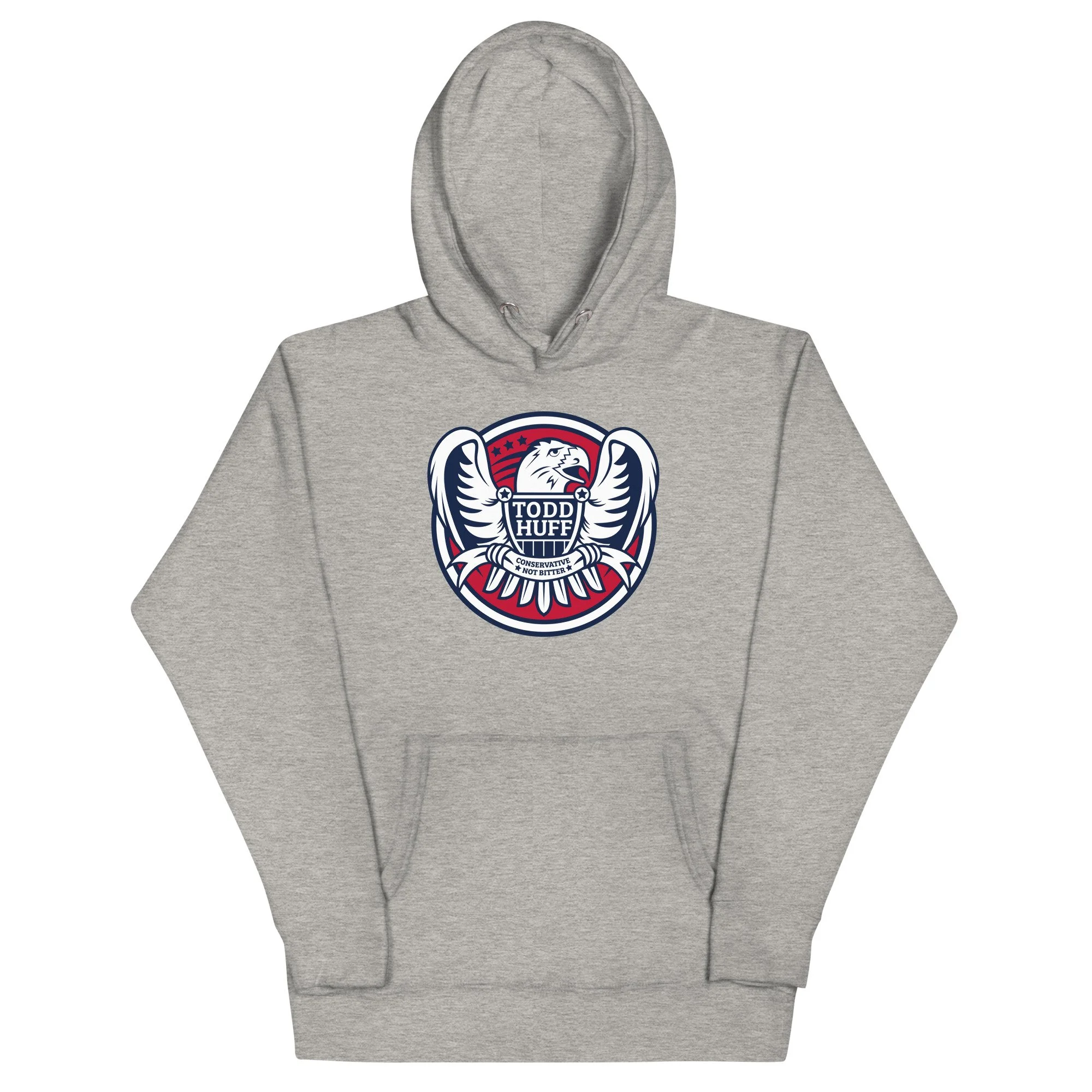
Wrap yourself in warmth and a little bit of wit. This ultra-soft hoodie feels like your favorite blanket but looks sharp enough for your next freedom-loving outing.
Kangaroo pocket, sturdy drawstrings, and the proud Todd Huff Show crest front and center. It’s comfort with conviction.
📝 Transcript: Reasons for Realistic Optimism as the Political Ground Shifts
The Todd Huff Show – January 7, 2025
Host: Todd Huff
Todd Huff: I don't want to be overly optimistic here. I can be. I'm an optimistic kind of guy. I don't want to be overly optimistic. I want to be realistic here. As we hit the new year and we look at what's happening and what's going to be happening here with the midterm elections, I know that the odds are stacked against Republicans just in a historical sense because they're the party in power. But I have to tell you that there are a lot of good things happening out there, and I want to talk about some of those today.
There are some good things happening that, in some respects, if you go back in time a decade, you might have a hard time envisioning these things even happening. And when I say that, one of the first things that always comes to mind is the Roe v. Wade decision and how that was effectively overturned. That’s happened in the past, of course, but I remember when that decision was made. I remember going to listen to people running for office speak and hearing them talk about overturning Roe v. Wade.
Todd Huff: I remember having a conversation with a friend about that, and he found it laughable. Not because he didn’t want Roe v. Wade overturned, but because it seemed so unlikely. It seemed like one of those things that politicians talked about, but that was never actually going to happen. And yet, it did happen. Of course, that was several years ago now, but my point in mentioning it is to say that there are other things happening today that are similar to that.
There are things happening now, in real time, or at least the stage is being set for them to happen, that could lead to outcomes that would have seemed impossible not that long ago. My goodness, would that be fantastic. And while none of these things are as significant as the defense of innocent human life — nothing really comes close to that — there are other areas where we’ve needed radical transformation in a positive direction. And we’re starting to see that.
That’s what I want to talk about today, my friends.
Todd Huff (Sponsor): But before we do that, you know that your investments are like seeds. You plant them, they grow, they multiply. But are those seeds bearing the kind of fruit that you want? At 48 Financial, they believe your money should reflect your values. They specialize in wealth management and biblically responsible investing. They screen out companies that do not align with your faith. It’s all part of their purpose-centered financial planning, helping you live a life of meaning and purpose.
If you want to see to what degree your investments align with your values, all you have to do is take a quick and easy assessment at 48financial.com/todd. That’s 48financial.com/todd. I completed this assessment, and you can too. It’s very quick and very easy. Once you do it, they’ll tell you whether or not your investments align with your values. 48 Financial is here to worry about your money so you don’t have to, my friends.
Todd Huff: Okay, so let’s go through a few of these things. And again, to be clear, I’m not here to declare victory. That’s not where we are. We’re not anywhere near that. In fact, the proper way to look at this — and I’ve said this before — is that the fight we’re in is never going to end.
You know, if you think about sports, one of the things that happens when you watch a football game, for example, is that you might be pulling for one team to win, but you’re going to find out the outcome after sixty minutes of play, or maybe there’s overtime. You don’t have to wait days or weeks or months or years.
But in politics, particularly when it comes to defending liberty and freedom, we are never going to see absolute victory. This is never going to be fully achieved. In fact, I would argue that one of the problems we’ve had over the course of time is that we mistakenly believed the job was done. We thought, “Hey, it’s in the Constitution. We elect people, they tell us what we want to hear, they’ve got it covered. We don’t need to pay attention.”
Todd Huff: My friends, that is a naive way of looking at things. And I know that many Americans, prior to recent years, did look at things that way. But this is a lifelong battle. And in a sense, you’re never going to see the end of the game. You’re never going to see the final score.
Now interestingly, you will see the score if you lose. You’ll see it when free speech is taken away, when prosperity is gone. And we’ve actually seen some of these things happen over the course of time. But we are righting the ship, and that is what I want to talk about today.
One thing I want to start with is the way the left, the lovers of big government, have used government shutdowns for years now. They’ve used shutdowns to instill panic and to use them politically to get what they want, to try to gain votes.
And now, there is evidence suggesting that this tactic is no longer effective.
You may remember that at the end of last year — just a couple of weeks ago — I did a show about what to expect in 2026. I said to expect the very real possibility of a shutdown. I still think that’s possible. But if you listen to the rhetoric coming out of Washington, D.C., especially from Democrats, the tone is different than it was just a couple of months ago.
Todd Huff: They’re talking more about the importance of passing spending bills. They’re talking more about Congress determining how money is spent instead of Trump and his administration controlling spending during a shutdown. That tells me something. It suggests that they may have learned that shutdowns no longer work politically the way they used to.
Now, with the left, there’s always a hidden agenda, so I’m not taking this entirely at face value. But it is certainly possible that they felt the political impact of the last shutdown. You may recall that back in November, the government was shut down for forty-three days — the longest shutdown we’ve ever had.
What happened during that shutdown? Democrats made it clear, simply by changing their votes, that they were the ones who shut it down in the first place. And when they reopened the government, they didn’t get meaningful concessions. All they really did was temporarily pause things in Washington, D.C., and they paid a political price for it.
That was a bizarre thing to watch unfold. And maybe — just maybe — they’ve learned from it. Not because they’ve had some moral awakening, but because they don’t want to politically harm themselves, especially in a midterm election year.
And if that’s true, my friends, that’s a good thing.
Todd Huff: Wouldn’t it be great if the tactic of threatening a government shutdown simply stopped working on voters? Wouldn’t it be great if voters stopped panicking and instead realized that our government is not nearly as essential as we’ve been led to believe? That the government shutting down for a week is not the end of the world. Now, of course, it should be avoided, but wouldn’t it be best to avoid it by actually having our government do what it is constitutionally authorized to do — and nothing more?
That would be what’s best for this country. Which then raises another question: are Republicans once again going to kick the can down the road when it comes to actual spending cuts? You might recall that there are nine spending bills that have to be passed. Three of them were already passed for the full fiscal year back in November. That leaves six that still need to be passed by the end of the month — January 30th, I believe — or there will be another shutdown.
So we’ll see what happens. But the tension here, the real tension, is between people like you and me — the vast majority of Americans — who want to see real, substantial cuts in spending, versus the games that Washington always plays. Not cutting spending growth slightly. Not lowering the rate of increase. None of those gimmicks. Actual spending cuts.
Todd Huff: We have a spending problem in this country. We do not have a revenue problem. We do not have too little money coming in. We have far too much money going out. And this problem is not confined to Washington, D.C. We see it at the state level as well.
Look at what has happened in Minnesota with the alleged daycare fraud. I’ll talk about that in more detail in a moment. But we’ve already seen one major consequence of that exposure: Tim Walz announced on Monday that he is not running for reelection as governor of Minnesota. That is another positive development.
Now the question becomes, who are they going to put up to replace him? We’ve talked on this program with Michael Lindell, who is running as a Republican for governor in Minnesota. So we’ll see what happens there. Again, these are good steps in the right direction. But we still have a long way to go.
And we can never look at this as though we’ve won. You can say that we’re winning in certain areas. You can say that momentum is shifting. But the moment you say we’ve won, you psychologically accept that the game is over. And this game is never over.
The left will not allow this game to be over. When you understand what we are up against — their incessant desire for power, their worship of government, their obsession with control — you realize this never stops. They constantly look for ways to expand government power, to increase their wealth through the government apparatus, all under the guise of “serving.”
Todd Huff: So this problem is never going away. We can acknowledge progress. We can say we’re ahead in certain areas. We can also admit we’re behind in others. But what we can also say is that some of their tactics are no longer nearly as effective as they once were.
The American people no longer being panicked by shutdown threats is a really good indicator of how far political understanding has evolved over the past several years.
Another good thing that has happened — and I don’t know if you’ve seen this yet — is that the Corporation for Public Broadcasting has been shut down. The Corporation for Public Broadcasting is shut down.
You’ll remember the fight over government funding for NPR and PBS. There was a huge battle over this. We were subjected to testimony from the CEO — I’m blanking on her name at the moment — about how vital their work was, how unbiased they were, how necessary it was for taxpayers to fund this so Americans could have access to truth and information.
That, of course, is not reality.
The reality is that NPR and PBS were used to further the political agenda of the left. And they were doing it with your tax dollars.
Todd Huff: Senator John Kennedy went to the Senate floor and listed some of the things that NPR and PBS were producing with taxpayer dollars. He does this every year. I’m not going to play the entire clip because it’s several minutes long, but I want to give you a flavor of what was being funded.
Here are just some of the headlines that NPR published using taxpayer money. One headline was a profile of Michael Avenatti — the media-savvy attorney. Remember him? The media loved Michael Avenatti. Where is he now? He’s in jail. He’s a crook. But for a time, he was treated like a hero.
Another NPR headline: “How Racism Became a Marketing Tool for Country Music.” I kid you not. Taxpayers were spending hundreds of millions of dollars so local stations could buy content claiming that country music is racist.
Another headline: “Donald Trump’s Long Embrace of Vladimir Putin.” This was right in the middle of Russia-gate. Steele dossier nonsense. NPR was all in on that.
Here’s another one: “Monuments and Teams Have Changed Names as America Reckons with Racism. Birds Are Next.” Birds. Apparently birds are racist now.
Todd Huff: This gives you an idea of what NPR and PBS were doing with taxpayer dollars. And this wasn’t occasional. This was systematic. It was funding a political narrative that benefited the radical left and the Democrat Party.
Now, if people want to start their own media company and push these ideas, that’s fine. That’s freedom of speech. But it has to work in the marketplace.
There’s a reason conservative talk radio and conservative podcasting have been more successful historically than left-wing equivalents. Remember Air America? It failed miserably. Why? Because when you’re forced to survive in the free market instead of being propped up by government money, reality sets in.
PBS and NPR were not living in the free market. Yes, they raised funds in other ways, but a substantial portion of their operation was funded by taxpayers.
The headline at RedState says, “The Corporation for Public Broadcasting Is Officially Dissolved. Let’s Salt the Earth Where It Stood.” The author, Jennifer Oliver O’Connell, explains that the 58-year-old nonprofit is no more.
For decades, conservatives and Republican lawmakers argued that CPB funding should be cut for exactly the reasons Senator Kennedy outlined. Government should not be paying for leftist ideology masquerading as journalism.
Todd Huff: Thanks to the election of President Donald Trump and the 119th Congress under Speaker Mike Johnson and Senate Majority Leader John Thune, they finally had the backbone to cut CPB funding. And what happened next is telling.
The same leftists who claimed CPB funding was essential couldn’t even be bothered to make up the $1.1 billion shortfall after federal funding was cut. The organization simply collapsed. PBS, NPR, and their affiliates lost their government lifeline, and CPB took its final breath.
The board voted to dissolve the organization after it became clear funding would not be restored. This wasn’t a surprise. CPB announced months ago that it would shut down operations after the fiscal year ended September 30th.
They had about 100 employees and a transition team, but now it’s done.
Listen, this is a victory. And no, this is not about celebrating people losing their jobs. That’s not the point. This is about celebrating the end of government doing things it has no business doing — and doing them badly.
It is a bad idea for government to fund political narratives. Period. And that chapter is now closed.
Todd Huff: Early in 2026, my friends, we’ve partnered with MyPillow throughout the years. And 2025 was a tough year for the company. I had Mike Lindell on the program, and he shared a little bit about what he’s endured and what the company has gone through. But they create great products. We use them here in the Huff household. I’ve got the pillows, the towels, and Oz loves the slippers — which I can confirm she’s wearing today, my friends.
They have a whole lineup of products designed to make you more comfortable. You can find all of it at MyPillow.com. You’ll find discounts on probably every product there when you use promo code TODD. Again, that’s MyPillow.com, promo code TODD. Quick time out, my friends. You’re listening to the home of conservative, not bitter talk. I’m your host, Todd Huff. Back in just a minute.
Todd Huff: Welcome back, my friends. I just want to remind you that we’re talking about some of the victories we’ve seen here in 2026, or at least victories that materialized in 2025. These are things to feel good about, things that justify cautious optimism.
The next thing I want to talk about is something where the existence of the problem itself is obviously not good. But what is good is that it has been exposed, and there are now positive consequences that are in the best interest of the American taxpayer and anyone who wants to see government restored to something resembling sanity instead of the absolute insanity we’ve endured.
Friends, before I do that, I want to remind you that if you’re curious about kratom — if you want honest answers before you try anything — you’re invited to the weekly Tea Talk from Christopher’s Organic Botanicals. It happens every Thursday night at 7:00 p.m. Eastern Time. There’s no pressure, no sales pitch, just a real conversation with real people who want to help you understand what kratom is, how it’s used, how to stay safe, and what to avoid.
Todd Huff (Sponsor): Christopher’s Organic Botanicals believes education should come first. There are so many headlines and misunderstandings out there, and they want to help clear the waters. They want you to understand what you’re considering and decide if it’s right for you based on facts, not hype.
If you have questions about relief, dosage, safety, or sourcing, this is where you can ask them. They’ve built a community on truth, not marketing. You can join the conversation Thursday night at 7:00 p.m. Eastern by visiting christophersorganicbotanicals.com. That’s christophersorganicbotanicals.com. Truth, tradition, transparency, my friends.
Todd Huff: Okay, the next headline we touched on briefly, but I want to dig into it a little deeper. Somali daycare fraud in Minnesota. Obviously, it’s not good that fraud exists. It’s not good that taxpayer money was abused. But what is good is that this has been exposed, and there are now consequences and corrective actions underway.
The scheme involved a network of Somali-owned daycare and childcare providers that allegedly exploited state and federal childcare subsidy programs. These programs were designed to reimburse providers based on attendance and enrollment records. The allegation is that these providers inflated attendance numbers, billed for children who were not present, and in some cases billed for children who did not even exist.
In some instances, it appears these operations may have been entirely ghost facilities — places that existed on paper but not in reality. Now, I want to be clear here. Not every provider was necessarily doing this, and that’s important to say. But there was a coordinated network that allegedly learned from one another how to game the system and siphon off tens of millions of dollars from taxpayers.
Todd Huff: This fraud was exposed by an independent journalist and YouTuber named Nick Shirley. He blew the lid off of this. And the consequences have been real. He has said publicly that he believes this exposure ended Tim Walz’s political career, and it’s hard to argue with that assessment given what’s happened next.
Tim Walz announced he is not running for reelection as governor of Minnesota. And now the Department of Justice has announced it is looking into a potential criminal probe. That probe could involve determining whether Walz knew about this activity, whether it was covered up, or whether there was gross negligence in oversight.
Now, to be clear, there is no claim that Tim Walz personally stole money. That’s not the allegation. The issue is why the state failed to enforce proper oversight and accountability while this was happening on his watch.
This raises several serious questions. Why is the government funding this in the first place? And if it is going to fund it, why was oversight so lax? How could millions of dollars be distributed simply based on claims without verification? Was this an honor system? And if so, why?
The estimated losses are in the tens of millions of dollars. At the state level, that is real money. This wasn’t a one-off incident. These were organized networks operating for years.
Todd Huff: Many of the individuals involved were immigrants, which immediately created a political shield. Anytime scrutiny was raised, accusations of racism or discrimination followed. That made enforcement politically dangerous. Auditors flagged near-perfect attendance rates, which is statistically implausible. Some centers claimed to serve more children than staffing levels or square footage would allow.
Whistleblowers raised concerns internally. But enforcement stalled. Regulators failed to shut these providers down despite repeated warnings. Payments continued while investigations went nowhere. Why? Because officials were afraid of backlash. Afraid of being accused of targeting immigrant communities.
This is how systemic corruption thrives. When certain groups are treated as immune from scrutiny, accountability collapses. And that appears to be exactly what happened here.
All of this occurred under Tim Walz’s administration. And now the Department of Justice is investigating not just the fraud itself, but whether there was obstruction, negligence, or willful ignorance.
Tim Walz exiting the 2026 race is not a coincidence. This is accountability beginning to take shape. And remember this, my friends: this entire thing was exposed not by mainstream media, but by an independent journalist.
When people tell you that only corporate media are “real journalists,” remember Nick Shirley. He did what legacy media either couldn’t or wouldn’t do. He followed the facts.
Todd Huff: Welcome back, my friends. Final segment of today’s program. And maybe you’ve reached that stage in life where managing your money feels like juggling more than just numbers. There’s tax planning, estate planning, investment choices, and a whole lot more. That’s when family office services can really make a difference.
Full Suite Wealth brings all of those pieces together under one roof into one cohesive strategy. Their family office services give you access to a coordinated team with advanced planning options — private equity, private credit, legal expertise — all under one roof. It’s about simplifying your financial life. It’s about planning for your future. It’s about making sure your legacy, the one you’ve worked hard for and sacrificed for, stays strong for generations to come.
If you’re ready for that next level of support, visit fullsuitewealth.com. That’s fullsuitewealth.com. Build your legacy. Secure your future, my friends.
Todd Huff: There are other good things happening out there in the news as well. And again, I want to emphasize this point. The issue of fraud itself is not a good thing. But the exposure of fraud is a good thing. The fact that organized networks are being exposed and dismantled is a good thing.
And this is not just one bad daycare. This was not just a handful of people acting independently. This was a coordinated network of facilities that were allegedly working together, colluding with one another, learning from one another how to steal tens of millions of dollars from taxpayers.
They used fake attendance records. Auditors tried to warn the state. Whistleblowers tried to warn the state. But the money kept flowing because enforcing the rules might offend the wrong people.
And this isn’t limited to Minnesota. We’re seeing similar patterns emerge in Washington State. In fact, it’s gotten so bad there that officials are now attempting to suppress reporting altogether by claiming that scrutiny of these Somali groups constitutes hate or even potential hate crimes.
Do you see the pattern? Compassion language is being weaponized as a shield. It’s being used to silence free speech and prevent accountability. It’s being used to give political cover to corruption.
Todd Huff: This is all part of a pay-to-play system. You’re not allowed to criticize the people involved. You’re not allowed to ask questions. And when sunlight starts shining on the issue, there is a desperate attempt to block it. But once the light is fully on, there is hell to pay.
President Trump has even weighed in, saying that California may be even more corrupt than Minnesota. And this is classic Trump. He takes an example and immediately points to the next target. He says, you think Minnesota is bad? You should see what’s happening in California.
And maybe he’s right. The point is that exposure is spreading. Accountability is spreading. And wherever it goes — no matter which group is involved, no matter how much money is at stake, no matter which government program is being abused — this must continue.
This corruption has to be exposed. It has to be eradicated. And that is a good thing.
Todd Huff: Now, you may have seen this next story in the Stack of Stuff, or maybe you missed it. But there are people beginning to say that what’s happening in Venezuela could have ripple effects far beyond that country.
The headline comes from The National Pulse. It says that Maduro’s capture could be the beginning of the end for Cuba’s communist regime. And the reasoning behind this is pretty straightforward.
For decades, Cuba has relied heavily on Venezuelan oil to survive. If Venezuela is no longer supplying that oil — if the Maduro regime is truly gone — that creates enormous pressure on Cuba’s government.
Rick Crawford, the chairman of the House Intelligence Committee from Arkansas, was quoted in this piece. He explained that Cuba simply does not have the resources to function without Venezuelan support. And if that support disappears, the communist triad of Cuba, Venezuela, and Nicaragua could begin to collapse.
This doesn’t just impact those countries. It has implications for global adversaries like Iran, Russia, and China. This could shift geopolitical dynamics in meaningful ways.
Todd Huff: Think about that for a moment. Cuba has been a communist stronghold for decades. Generations. And now we’re talking about the possibility — the possibility — that pressure from geopolitical changes could finally crack that system.
Again, I’m not declaring victory. I’m not saying this is guaranteed. But these are developments that would have seemed impossible not that long ago.
These are signs of momentum. Signs that the world is changing. Signs that the ideological battles we’ve been fighting are not static.
My friends, these are reasons to be cautiously optimistic. Not complacent. Not arrogant. But encouraged.
Because when you combine voter awareness, reduced effectiveness of fear tactics, exposure of corruption, and geopolitical shifts, you begin to see a pattern. And that pattern is movement in the right direction.
But remember this. The fight is never over. The game does not end. We stay vigilant. We stay engaged. And we keep pushing forward.
SDG, my friends.