
The Stack: Supreme Court Signals Doubt on Birthright Citizenship Challenge
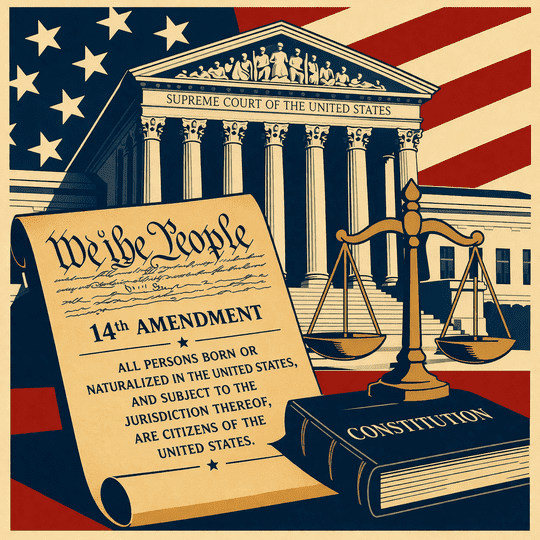
The Supreme Court is now at the center of a major constitutional battle over birthright citizenship. In this episode, Todd Huff breaks down President Trump’s executive order challenging the long-standing interpretation of the 14th Amendment, specifically the phrase “subject to the jurisdiction thereof.” At issue is whether children born in the United States to parents who are in the country illegally should automatically receive citizenship.
Todd walks through the historical context of the amendment, originally passed after the Civil War, and explains how both sides interpret its meaning today. He also highlights key moments from oral arguments, including skepticism from several justices and competing views from government attorneys and the ACLU.
This conversation goes beyond legal theory—it raises fundamental questions about national sovereignty, immigration policy, and constitutional interpretation. However the Court rules, the decision could reshape how citizenship is defined in America for generations.
🎧 Listen to Today’s Episode
📰 Stack Links
Supreme Court Seems Skeptical of Trump’s Bid to Limit Birthright Citizenship
Trump’s Plan to End Birthright Citizenship Faces Legal Hurdles
Legal Experts Clash Over Meaning of ‘Subject to the Jurisdiction’
Why Birthright Citizenship Has Become a Political Flashpoint
Constitutional Scholars Weigh In on Trump’s Citizenship Argument
Want to get Stack links and content delivered to your inbox each weekday?
Subscribe to The Inner Circle. It’s free.
📝 Transcript: Supreme Court Signals Doubt on Birthright Citizenship Challenge
The Todd Huff Show – April 2, 2026
Host: Todd Huff
Todd Huff: Welcome, my friends. Today's episode of the Todd Huff Show. It is a pleasure to be here. We're going to talk today. We're going to talk today about birthright citizenship. The Supreme Court took this up yesterday in the U.S. Supreme Court in Washington, D.C., our nation's capital. And they heard oral arguments for a couple of hours. And there are reports as to what happened, some of the things that were asked, some of the arguments that were made. And I am here to try to make sense of it with you today, my friends. And let me tell you, I know Trump spoke. Trump spoke last night, and I have, at this very moment, I have not had a chance. I've been busy, my friends. It's important. Don't misunderstand me. I am going to watch it and listen to it. But I have not yet seen it, so I can't talk about that today. We'll see if we'll talk about that on tomorrow's program. So, friends, if you have thoughts, questions, feedback, anything along those lines, you can text us and that will go to yours truly. 3177851030 again, 3177851030. You're going to hear us mention that number a lot more frequently. Because that is how we're going to put you in contact. How you can get information about some of the partners here who help make this program possible to get to the links to get coupon codes and that sort of stuff. If these folks provide a product or service that you're looking for that you need.
Todd Huff: And so that's the quickest and easiest way to get to you. I think is the text message. So you'll hear issues and keywords, but that's the same number that you can use to message here and get your questions and thoughts to me as well. And I always welcome those, my friends. So that's where we're headed today, my friends. Let's face it. There are a lot of companies out there that do not share your Christian values. The good news? The good news is that we do not. You don't. I don't. None of us have to invest in those companies. At 48 financial, they specialize in biblically responsible investing. They screen out the companies that go against your faith and your values. They create a plan that's tailored to your specific goals, and they'll handle all that heavy lifting so you can focus on what really matters in life. If you want to see how your current investments align with your values, your beliefs, all you have to do is take a quick and easy assessment at 48financial.com todd that's 48financial.com todd. 48 Financial because your values matter. And friends, of course, so does your money.
Todd Huff: Okay, so article here which you can access if you are a member of the inner circle. It's totally free, just text. Here we go. Text the word TRUTH to 317-785-1030 and you'll be signed up to get the full story if you will. The links that we talk about here as background on the program. Some things that I talk about in the daily Inner circle issue that I'm not able to get to here on the program. That's usually yesterday's. Wasn't. Listen, I'm going through all sorts of growing pains here. We've hired quite a few people, and I just I wasn't able I wanted to, but I wasn't able in yesterday's issue to get to something additional. But typically I do so. That's how you can sign up for that, and it's totally free. But you can get this article. Or if you prefer, listen, we don't do any pressure here. If you don't want to be a member of the inner circle, then fine. Hurts my feelings every time, but fine. You can just go to the Epic Times because that's where I'm reading this. Or you can get it else other stories out there as well. But I want to talk about this particular article specifically because I actually think the Epic Times does a real, real good job of journalism.
Todd Huff: So here we go. Headline here. Supreme Court seems skeptical of Trump's bid to limit birthright citizenship. Trump's stalled executive order seeks to exclude the children of illegal immigrants from citizenship. Okay, so that is what this issue is about. So let's set the stage, I guess, for a moment here. Let's set the stage and make it clear what's happening, what we're doing here. Is Trump, of course, has been trying to what do I want to say? Make right all of the all the illegal immigration that's been happening in this country for decades. Open borders. Promises for to secure the border dating back to Ronald Reagan. Remember, there was amnesty, amnesty offered back in the 1980s. That was half of the deal. The other half was the border was supposed to be made secure, but the problem is, it never was. Not until Trump came along here. And not ultimately and finally until Trump came along in his second term, and we noted on this program that the border was the most secure that it's been in recent history.
Todd Huff: The border was made secure by President Trump doing what amounts to common sense, my friends, and not being afraid of the media narrative. Doing what needs to be done, what any person with common sense would do. And Trump's smart about things, too. Trump Trump's thought about these things. His team has thought about these things. They had a strategy, and within virtually no time at all, virtually overnight we had a 90 plus percent decrease in illegal immigration. It's apt. Listen, we all knew that Trump was going to make tremendous inroads in towards securing the border in his second term. He did great things the first term. But again, I think Trump learned. I said back in 2020, when Biden won the election, I said back in those days, the Democrats may come to regret that Trump gets a four year basic intermission here, a half time of sorts, if you will, to recalibrate, to reprioritize, to let sink in all that he was up against, so that he has four more years of preparation to come into the White House again and to do things much, much more efficiently, much wiser, much smarter. And I think that that's happened in a lot of ways.
Todd Huff: I mean, Trump is not messing around. You know, on the one hand, you can say four years is a long time. Four years is a heck of a long time. If you're suffering, four years is a tremendously long time. If Joe Biden is in the White House, four years is an immeasurable amount of time. If inflation is around 10 percent, four years can be destructive depending upon who's in the White House, how much they open the border, how much they destroy our economy, how much they try to tear apart the foundation of this nation's heritage and history and so forth, the Constitution as written and intended by our founders and so forth. Four years can be a long time. But it's also not that long a time, friends. The older you get, and I'm now 48 years old with, of course, the body of a 47 year old. But I listen. Time, time goes faster and faster, or the perception of time seems to go faster and faster.
Todd Huff: I remember as a kid, I remember as a kid, summer vacations seemed like the equivalent of five years. I mean, that it seemed forever. I remember the last day of school, and I listen, I wasn't I'll be honest with you, I was not. I wasn't a fan of school. In fact, if you would have asked me when I was a kid what my favorite subjects were, I would have said I'm sure I said this recess and gym, PE class. That's what I enjoyed. Now, I had some good teachers along the way, and I've since developed an interest. I have an interest in a lot of things. In fact, I talked to my kids about this. You know, you have to develop an interest in just just a curiosity. This is this universe and this world is just profound, and there are so many fascinating things if you're just open to learning about it, even if it's something that doesn't interest you off the bat. It's certainly something that can be interesting if we simply let it be interesting.
Todd Huff: But now that I've grown and I've taken an interest in a lot of different things, and now that I've grown also, I've seen the passage of time, which of course don't let Kamala Harris talk about that. That will leave you scratching your head every time you hear her talking about the significance of the passage of time. I tell you what the things we're subjected to. But the speed at which time goes, it changes as you get older, and four years to the point here is not as long as we might suspect. Context matters. It matters what's going on. Four years of suffering can seem like an eternity. Four years of living in a prosperous economy, when things are going well, can go in the metaphorical blink of an eye. And so Trump is hitting the ground running.
Todd Huff: He wrote an executive order that basically said as of a certain date, the date of the order, anyone who was born here to someone who was someone in the United States who was not here legally, that person is no longer is not going to be considered a US citizen. Now, this, of course, makes the left, the aclu, all these folks lose their whatever's left of their metaphorical minds here, but they have really gotten upset about this because of this concept of birthright citizenship. Now, let's pause here for a moment. Birthright citizenship is the concept that says if you're born on the soil of a particular country, you are a citizen. Now, there are some who would dispute what these terms actually meant. But while you can understand in one sense the concept of this, especially for countries that maybe are new or expanding or taking territory or whatever, you can also see that when borders have been kind of made in a permanent sense, they become permanent.
Todd Huff: It wouldn't make sense to create loopholes that people could basically take advantage of and game in the system in order to become a citizen. And there's something fundamentally flawed about the concept that says if I can just get to US soil and have a baby, that that baby becomes American simply because I slipped past the defenses. Tell me that that just on a basic common sense level is something that doesn't it doesn't make sense. Tell me that you agree with that, because I think that there is just something obvious about that that says that that was not the intent of what birthright citizenship was. You know, when I talk about the issue here is the 14th Amendment, which was written after the Civil War, which we'll talk about that as we go through this article and talk about the oral arguments here. But I also think it's important to understand, even though the founders didn't write the 14th amendment, that came much later, we also need to understand how the country, how these things would have been viewed by our founders.
Todd Huff: A lot of these things are rooted in common law or the common interpretation of things as they were as these ideas were developed and accepted over the course of times and refined over the course of history of different governments and so forth, things that were commonly accepted. And again, on the one hand, if you're someone who's in a place legally and you're born there, you shouldn't have the right to citizenship stripped from you because of some other requirement or some detail that you weren't able to check a particular box and so forth. But on the other hand, it's clearly obvious that if you're trying to game the system, if you're trying to look for a loophole, that that's not what the concept of birthright citizenship was designed to do. It wasn't designed to protect those who enter a place illegally, have a child, and suddenly they say ta da, this kid is now a US citizen. There's something inherently wrong about that, and I know everybody listening to my voice, if you're being honest with yourself, you know that's the case.
Todd Huff: I mean, just as an example, would you think for a moment that if you could sneak into, I don't know, the royal palace in England and somehow have a child there, or would you suddenly believe that this child is of the a member of the royal family or something along those lines? Of course not. There's more to it than that, and this seems to be an obvious loophole that something needs to be done about while also respecting the concept. There's still something there that should be that should be respected. And so here we have this Supreme Court case. So Trump forces the issue by writing an executive order making this declaration, turning the typically understood concept of birthright citizenship at least in a legal sense in the courtrooms and so forth amongst the legal scholars on its head by saying we're not doing that anymore. This is how this administration is interpreting birthright citizenship.
Todd Huff: And so lawsuits follow, and suddenly you have the Supreme Court hearing this, making sure that this is handled, interpreted correctly, at least ideally that should be what's going on. I don't know. Obviously people have different priorities, axes to grind, different dogs in the fight, whatever metaphor you want to use here. But people are motivated by different things. But ideally we would think let's interpret this the way that it was intended to be interpreted by the people who wrote the amendment and so forth. And so that's where some of these conversations go. So we're going to get into that now. Little breather here, little mini time out, my friends. Let me ask you something. Would you rather spend hours in your doctor's office or would you rather take a couple of soft gels a day when it comes to the issue of cholesterol?
Todd Huff (Sponsor): To me, it's a no brainer. Cholesterol, high cholesterol, if it can be managed by a natural supplement that's been proven to work, science speaks on it, has shown that it has lowered the cholesterol of lots of folks out there, which this product has. If it can do that, it's certainly superior than going and having to have long doctor's visits, expensive bills, prescription medications. And listen, there might be a time for that. I'm not here. That's between you and your doctor. But I'm talking about as a starting point. If you're aging, if you have a history of high cholesterol in your family, if you're just concerned about your heart's health as you age, and of course we all are, then consider taking Soltea. I take the product. You can too. It is very easy to manage this. You take two Soltea soft gels a day. It's very inexpensive. And on top of that, it's incredibly inexpensive because you'll get a discount code if you use my name during the checkout process.
Todd Huff (Sponsor): Go to soltea.com promo code Todd will save you 50 percent off your first three month supply and get you free shipping to boot. Got nothing to lose, my friends, but high cholesterol points. soltea.com promo code Todd. All right, let's look at the article now. The US Supreme Court on April 1, that was of course yesterday, appeared skeptical of President Donald Trump's executive order excluding the children of illegal immigrants and legal temporary visitors from automatic birthright citizenship. During the more than two hour hearing, part of which Trump attended in person, the justices seemed concerned about the lawfulness of the order, which has been blocked by multiple lower courts. Some justices suggested it would be difficult to enforce and could strip current US citizens of US citizenship.
Todd Huff: Justices discussed the significance of the wording of Trump's executive order, which the number of that executive order is 14160, which focuses on the fourteenth amendment's citizenship clause. The clause states, and here's the pertinent information that they are trying to interpret, words mean things, right? Anytime people act like the constitution is living and breathing, it drives me insane. It truly does. Because words were written to communicate an idea. And so what the justices ideally are doing and definitely should be doing is listening or reading these words, trying to get back historically to what this amendment was trying to do, what the debate was around the amendment, how it was talked about publicly or how it was talked about on the chamber floor or whatever to give them the full concept of what was trying to be accomplished here, and look at the wording and see what that wording is trying to accomplish, how it seeks to attain or reach a certain conclusion or an outcome, and then apply it, interpret it and apply it.
Todd Huff: Make a ruling as to whether Trump's executive order is in alignment with the interpretation of that particular clause or how it may have violated it. That's what should be happening here. Here's what it says. All persons born or naturalized in the United States, and then there's a comma and then there's this little part of the clause that says and subject to the jurisdiction thereof, comma, are citizens of the United States and of the state wherein they reside. The article continues here, the executive order states that the amendment has never been interpreted to bestow citizenship universally on everyone born in the United States. This is true, by the way. According to the order, an individual born in the United States is not quote subject to the jurisdiction thereof if that person's mother was unlawfully present in the country and the individual's father was not a citizen or lawful permanent resident at the time of the person's birth.
Todd Huff: This is to me, this is incredibly common sense. This is very basic. You can't be subject to the jurisdiction of the United States if you're not someone who is legally within the United States. It violates reason to me. And so how are you subject to the jurisdiction of a country when you're violating its laws to be there in the first place? It just seems candidly crazy to me. So I want to talk about another part of what I just said, but I just looked at the clock and I have to take a break. Sorry, my friends. The clock has to be followed, and I'm going to oblige here. My friends, quick time out. You're listening to Conservative, Not Better Talk. I'm your host, the one and only Todd Huff. Back in just a minute.
Todd Huff: Welcome back, my friends, talking here about the Supreme Court case yesterday where they heard oral arguments pertaining to birthright citizenship. Trump's executive order trying to change the way, challenge the way that this is typically interpreted or, well, how we, how the courts or the legal experts out there think it should be interpreted. Trump's trying to force the issue and have the court actually say what this particular clause means and why it is, well, why we need to follow what he would say is the correct interpretation, which he, of course, would say is in alignment with his executive order. So we'll get to that, my friends, as we continue talking about this today. But ever wish you had a whole team to help manage your financial life? That sounds nice, doesn't it?
Todd Huff (Sponsor): That's the beauty of family office services at Full Suite Wealth. Their experienced advisors bring together everything from high level investment management, private equity, private credit, option strategies, to complex legal needs, all customized for you, my friends. It's like having a family office just for you, with the people who know your story and they know your goals, they know what you're trying to accomplish, and they are in alignment. They are in support of that. They are part of that team. If you're serious about planning for the long haul, check them out. You can find out more information at fullsuitewealth.com. Again, that's fullsuitewealth.com. Build your legacy. Secure your future.
Todd Huff: Okay, so let us continue delving into this. I said before the break I was going to go back and touch on a part of this. Trump's executive order, as was written here, written about here in the Epic Times, says that an individual born in the United States is not subject to the jurisdiction thereof if the mother, if that person's mother was unlawfully present in the country and the individual's father was not a citizen or lawful permanent resident at the time of the person's birth. Now, this is important to understand because if you are a legal citizen or permanent resident of the United States, that changes things. So, for example, this is, this is why. So two things. Well, if the mother or the father or both are citizens of the United States, then the child is a citizen of the United States. This stands to reason.
Todd Huff: This is true if the family is, you know, living somewhere else or temporarily somewhere else or whatever. Someone can still be born in a foreign land so long as the person, the parent, one of the parents is an American citizen. So this says here if the person's mother, and this is interesting, by the way, the mother, of course, is the female. This is for all the folks out there that try to tell me that men can have babies. You know how they do that, by the way? They say men can have babies, which makes your head want to explode if you live in the world of common sense and logic and science and so forth. Good reason, because men cannot have babies. But they say some men are in women's bodies, and so that's how they try to convince you. Well, yeah, that's a man. He's in the wrong body, so he can have a baby. That's why these are pregnant people now instead of pregnant mothers or women who are pregnant.
Todd Huff: That's how crazy our world has become. But if the, so it's basically saying if the mother is in the U.S., she's the one that's having the baby, so she has to be there legally in order for this to be the case. And, of course, if she's a citizen or a legal permanent resident, she's there legally. But if she's not, and if the father at the time of the child's birth is not a U.S. citizen or a permanent resident, then this doesn't apply. Birthright citizenship does not apply because you found a loophole. This is clearly not part of how, well, how common sense would demand that we look at this particular issue. American Civil Liberties Union attorney Cecilia Wang said upholding the order would call into question the status of many current citizens.
Todd Huff: U.S. Solicitor General D. John Sauer said the order is prospective in effect, meaning that it doesn't affect those born before it was signed. So in other words, it's saying from the moment it is dated, moving forward, it's talking about those folks. It's not talking if you were born the day before this thing was signed and took effect, this would not impact you. But if you were born the day of or anytime thereafter, this would impact your citizenship in the United States. So again, the government, which of course is arguing Trump's, defending Trump's executive order, say that it's incorrect to say that this is going to impact people who have already been deemed citizens, or at least there's a question mark about it, because birthright citizenship, this is saying, look, we're not talking about anything retroactively. This is from this point, this moment forward.
Todd Huff: Justice Elena Kagan told Sauer that the federal government was taking a revisionist approach to birthright citizenship. Sauer, of course, is on Trump's side here since the United States v. Wong Kim Ark in 1898. The federal government has recognized that almost all persons born in the United States are U.S. citizens at birth. Everyone has thought for a long, long time that birthright citizenship was the rule, Kagan said. Sauer said again, Trump's solicitor general here for the government, Sauer said that the citizenship clause was adopted after the Civil War. This is true, by the way. And this is what he said. It was adopted to grant citizenship to the newly freed slaves and their children, whose allegiance to the United States had been established by generations of domicile. Now, the legal concept of domicile refers to the place where a person intends to permanently reside.
Todd Huff: So in other words, you had slaves in this country after the Civil War, right? They were considered property. They were considered three-fifths of a person, all these terrible things historically that had happened in this country. Suddenly you have the end of the Civil War. You have the Emancipation Proclamation. You've got the Fourteenth Amendment. They're trying to, they're trying to put the pieces back together, if you will, the right way moving forward. And so they're trying to say, look, the folks who were slaves prior to the Civil War, prior to the Emancipation Proclamation, these individuals, if they intend to stay American, if they have an allegiance to the country, they're absolutely citizens.
Todd Huff: And so that's what the argument of the administration is now. Sauer said the court recognized in Elk versus Wilkins, that was in 1884, that quote subject to the jurisdiction means owing direct and immediate allegiance. I mean, this is the issue in my mind. I'm not a legal scholar, just from a rational perspective here. This is the entire, this is the centrality of the argument here. So Sauer again, the Solicitor General on Trump's side, says that subject to the jurisdiction means owing direct and immediate allegiance, which in turn means the clause did not extend citizenship to the children of temporary visa holders or illegal aliens. Again, it stands to reason, my friends.
Todd Huff: Chief Justice John Roberts said the examples that Sauer gave to support his interpretation of subject to the jurisdiction thereof were very quirky. This is John Roberts, of course, who it is believed for good reason that he was going to vote initially to rule that Obamacare, the Affordable Care Act, was unconstitutional, but later switched his vote after the, well, after everything was settled basically. Roberts, who again, you know, from a conservative perspective, he's so just we missed the mark so badly here. I don't know if the guy wants to be accepted, if he wants to make friends. I don't know. I just I don't fully understand.
Todd Huff: But he's not a principled originalist. It seems like he's very concerned about the implications in society of a particular ruling. See, that's the job of Congress though. The court needs to say this is what it is. Look, I didn't write it. I didn't make it up. Not even how I would maybe particularly handle a particular issue, a certain issue, if I was, you know, a king for the day, which of course we had these no kings protests out there over the weekend ensuring that America doesn't have a king. Give me a break. But you know that this is this is how a judge, a justice should look at it. Look, it's not how I would do it, but this is what it says, and Congress better fix it if it's creating problems because I can't do it. That's not my job.
Todd Huff: But Roberts, of course, is willing to make it, my friends, his job from time to time. And I just looked, speaking of time, I look down at the clock and it is time for me to take a quick time out. So sit tight, my friends. You're listening to this discussion here about the oral arguments regarding birthright citizenship and the Supreme Court yesterday. We're taking a time out. Back in just a minute.
Todd Huff: Welcome back, my friends. Third final segment of today's program. Lot of confusion out there about kratom. You've probably heard the headlines, read the horror stories. But my friends, most of those are based on synthetic junk that isn't real kratom at all that's being provided by shady sellers in the marketplace. Real kratom is tested, it's natural, it's handled with care, and that's exactly what you get from Christopher's Organic Botanicals.
Todd Huff (Sponsor): Family run company. They partner directly with farmers in Indonesia. They lab test every batch for purity. There's no chemicals, there's no fillers, there's no shortcuts. There's none of that garbage that you find in the synthetic junk. This is a trusted herbal option that's been used for generations, and it is a real alternative for people looking for something that does not come with a warning label a mile long. Do your research. If you decide that this is something that makes sense for you, you can start with their kratom starter pack. Coupon code Todd Huff will save you 10 percent on your first order. ChristophersOrganicBotanicals.com. Again, that's ChristophersOrganicBotanicals.com. Truth. Tradition. Transparency.
Todd Huff: Okay, gonna get to as much of this as I can. Whatever I can't get to, if there's other things I want to say, which I'm sure there will be, we will talk about those in today's issue of the inner circle, which of course you can get for free if you text the word truth to 3177851030. All right, back to it here, my friends. Roberts said, talking about Justice Roberts, said Solicitor General Sauer gave as examples children of ambassadors, children of enemies during an invasion of the country, children on warships, and then expanded it to quote a whole class of illegal aliens who are here in the country.
Todd Huff: The Chief Justice said this, I'm not quite sure how you get, how you can get to that big group from such a tiny, from such tiny and sort of idiosyncratic examples. Justice Sonia Sotomayor said the Wong Kim Ark decision quotes early American statesman Daniel Webster, who said it was well known that by the public law, a non citizen, while he is here in the United States, owes obedience to the country's laws regardless of a domicile, the taking of an oath of allegiance or renouncing a foreign allegiance.
Todd Huff: I mean, that's listen, I don't know, I haven't read the full context of that, but of course if I listen, if I go to another country, I am subject to their laws as a guest. I'm not someone who's permanently bound to their law, to their society. I'm a guest. I'm there temporarily. And candidly, if I'm there without the visa or the, you know, without getting the passport or whatever, then I'm not there legally. And I am, while I certainly still have to obey the laws, which I think is the point here, of course you got to obey the laws. You can't just say, well, the laws in America are this when I'm in France or whatever, right? That's not the way that it works. But that's a different thing to say that you're under the jurisdiction, under this jurisdiction legally as someone who's supposed to be there.
Todd Huff: If you're, listen, I mean, it's pretty simple if you think about it. You go as a visitor, and you have your papers, right? You have your legal documents, your passport or your visa or whatever that tells me how long, you know, how long can I be here? I'm not a permanent citizen just because I'm here as a visitor. If there's an election going on, I can't go vote. It's not the way that it works. And if I'm away, if I'm away from the country, if I'm traveling abroad, I'm still a resident, still under the jurisdiction of my nation. I'm just temporarily out of the state. But if I'm in the country, if I'm in the country illegally, then what have I done? I've basically broken its first law, which I'm not supposed to be there at all.
Todd Huff: This is just crazy talk to me. Wang said the Fourteenth Amendment prevents Congress from adding conditions to the birthright citizenship rule. In response to Wang's assertion, Justice Brett Kavanaugh said, I guess the answer you just gave means they don't have any authority to look at this. Even if they passed it 435 to 0 in the House and 100 to 0 in the Senate, your point is no, they're closed. They're forever. They're frozen forever. And Wang replied, yeah. So basically, if Congress wants, she's saying if Congress wants to change the law, it can't. It can't change the law because it's permanently etched in stone through the interpretation, how she thinks it should be interpreted, of the Fourteenth Amendment.
Todd Huff: So some obviously some diametrically opposed, opposing worldviews here or interpretations of this thing. The Fourteenth Amendment was supported by people who wanted to grow this country and quote make sure the United States had a citizenry to populate the military, to settle the country, the attorney said. They also had an intuition that was consistent with the founding aversion to inherited rights and disabilities. I'm out of time here, so I'm going to have more to say about this in today's inner circle issue, which again you can text TRUTH to 3177851030, you can get that issue. But we'll see where this ends up, my friends. From what I've read, it certainly looks like there's a lot of hesitation on part of a good chunk of the justices to rule in Trump's favor, but time will tell.
Todd Huff: I'm out of time right now, my friends. Have a great day. Thanks for listening. SDG.