
The Stack: The Constitution Was Designed to Slow Government Power
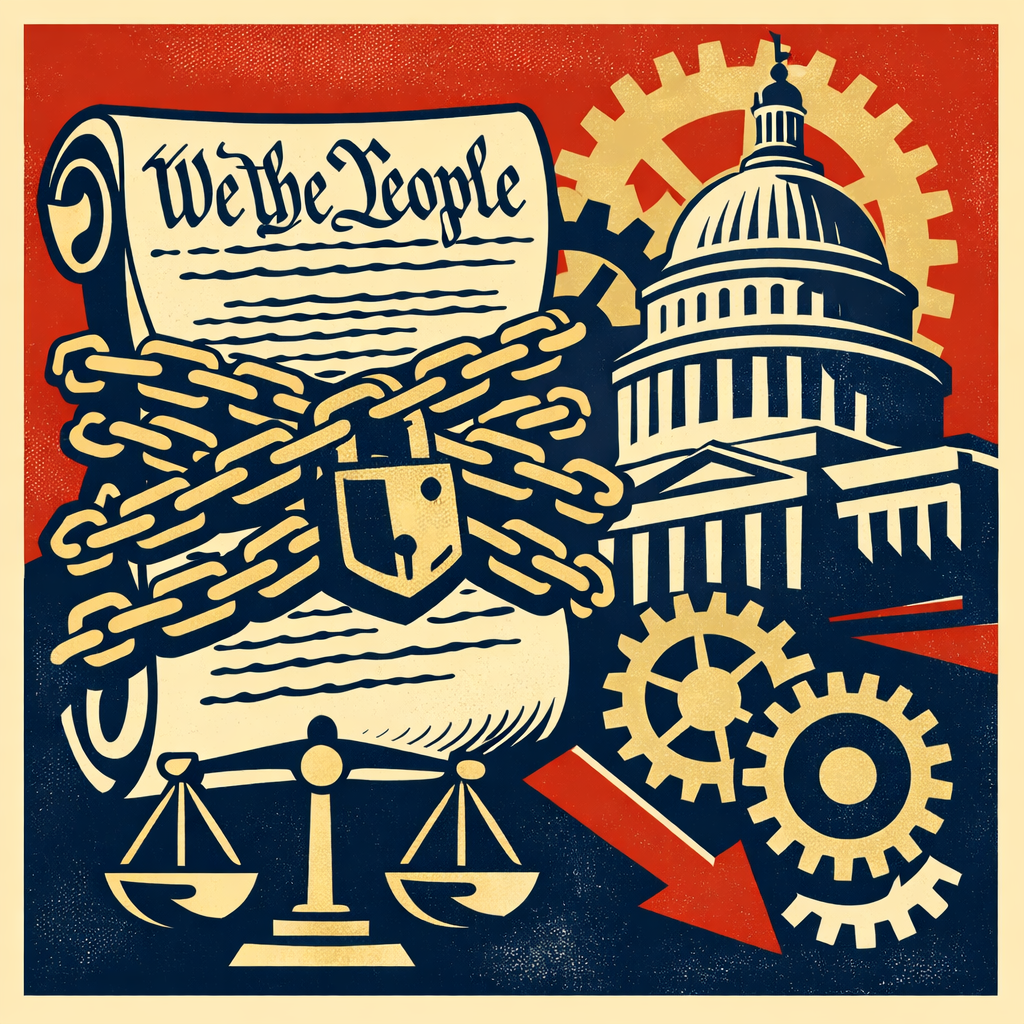
In this fourth installment of Todd’s political framework series, Todd explains why the American system of government was intentionally designed to slow down the exercise of power. While many Americans grow frustrated with gridlock in Washington, the Constitution was built to restrain government authority—not to maximize efficiency.
Todd walks through how good intentions often produce bad policy outcomes. Welfare programs, excessive regulations, and government subsidies frequently create unintended consequences that distort incentives and limit opportunity. The Founders understood human nature and created checks and balances, federalism, and enumerated powers specifically to prevent the concentration of power.
Todd also examines how crises—from financial emergencies to public health events—are frequently used by government leaders to justify expanding authority. Once new powers are granted, they are rarely returned.
The key takeaway: government friction is not a flaw in the system. In many cases, it is a safeguard for liberty. Understanding these principles helps Americans interpret political events through a more informed and constitutional lens.
🎧 Listen to Today’s Episode
📰 Stack Links
Want to get Stack links and content delivered to your inbox each weekday?
Subscribe to The Inner Circle. It’s free.
📝 Transcript: The Constitution Was Designed to Slow Government Power
The Todd Huff Show – March 16 , 2026
Host: Todd Huff
Todd Huff: Well, my friends, I hope you had a wonderful weekend. Thank you for joining me here today. We're going to continue. This will be what day Number four of our series again. I know there's a lot going on out there today. There always is. But the more I've thought about this over the past couple of weeks I just wanted to go through and. Give as many of you and not so much you, obviously, as much as the people that you talk to or deal with, live around, live with, share neighborhoods with your office space with all that stuff. Want to give you the opportunity or the tools to be able to frame these important political discussions that we have. I mean, as I said when we started this series, people have opinions about politics. But those opinions are based on, well, superficial things or emotions. Not all the time. But a lot of the time, because people have never been given a framework within which to think about these things. Or a prism through which to view the things happening in our world. Some very, very important and consequential things that are happening, by the way, my friends. And so that's what I want to talk about today. I want to continue.
Todd Huff: We talked about the nature of truth. We talked about power. And I want to kind of pick up where we left off on Friday, the last time we got together here. And talk about the intentions, intentions of the people who are running our government and how good intentions are not what we should be looking for. We don't want bad intentions, but we want results. We want ideas that actually work. That aren't just something that sounds good or utopian or pie in the sky. Something that works in the real world, where we have people who are living in accordance with their human nature. These things have to be compatible and work together. Otherwise we're all just fooling ourselves and setting up some truly dangerous scenarios. So that's where I want to pick up. It's kind of where we left off the last time we were together. So that's what we're going to do today, my friends.
Todd Huff (Sponsor): And if you're living with discomfort or if you're just tired of living off prescription medications. My friend, you are not alone. You're tired of. Managing those side effects. A lot of folks are looking for something natural that they can trust. That's why I want to have you check out Christopher's Organic Botanicals. It's a family run natural kratom company rooted in truth. Tradition and transparency. Christopher's partners directly with farmers in Indonesia. They lab test everything before it ever reaches your hands. No hype, no synthetics, no funny business. Just the real thing. Done, right. Now. You know, you've probably read or heard me talk about or reference some horror stories about Kratom. And those horror stories, my friends, are the results of shady sellers creating synthetic garbage that isn't even Kratom. It's been so synthesized. And dare I say, polluted with other junk, that it's not even the real stuff. That's not what we're talking about. And that's certainly not what you're going to get from Christopher's. Do your research, though. When you feel comfortable that this is something that you want to try, you can start with. Christopher's Kratom starter pack coupon code Todd Huff will save you 10% on your first purchase. Visit Christopher's Organic Botanicals. Com Again, that's Christopher's Organic Botanicals. Com. True tradition. Transparency, my friends.
Todd Huff: Okay? I mentioned this earlier. Good intentions can still produce bad systems, bad politics, bad political structures, bad governments, bad leaders. A bunch of bad stuff. It's been said before. And I'll say it again here. The road to hell is often paved with good intentions. We have to use. Yes, it's important to have good intentions. But that's not the only thing we have to have. We have to have a brain that understands that just because we want something to be the case does not make it the case. We have to operate in reality. Policies designed to help people. Oftentimes have unintended consequences. Now hear me. Listen. There are specific roles and responsibilities that our government should focus on. And when I say help people, I mean those policies or those programs, those social welfare programs that are designed to help someone in need. It sounds so good. And listen. I don't doubt that everyone who wants those, or at least I should say some people who want those policies. I think they have good hearts. But those good hearts and good intentions are not. Creating the results that we need.
Todd Huff: For example, if you have. Well, if you have welfare policies, just as an example. The structure of welfare discourages work. It doesn't mean that people shouldn't get help. The question is, how do they get it and from whom do they get it? Regulations are another thing. Regulations. There may be a time for a certain regulation, but that's only if it's absolutely necessary. And it's only if there's no other way to mitigate the risk or the danger you're trying to offset. Because regulations oftentimes end up protecting certain industries. And what I mean by that is it prevents there from being new players who enter. A particular market or industry because the cost associated with just simply getting set up is way too high, it's way too complicated. When, for example, There are lots of things that have been introduced as policies. Or ideas, concepts that people want to use around the country. And it's interesting. Sometimes if you pay attention to who's really in favor of these policies, sometimes it's not people who you think. It just doesn't make sense because you think that's going to hurt your business.
Todd Huff: But what ends up happening is, let's say there's a big corporation like Walmart and I'm not picking on Walmart. Or Amazon or someone like that. And let's say, for example, here's a big one. Sales tax policies. You're only supposed to charge sales tax as it currently stands. You're supposed to charge it. For physical items that qualify to be taxable, but you're only supposed to charge it in states where you have a physical presence. Well, what happens when a small business starts to do business across the country? Right. They start sending their goods and services out. Well, they don't have a physical presence. And all these places they don't have to pay to charge and then pay that sales tax.
Todd Huff: Well, what happens when a small business starts to do business across the country? Right. They start sending their goods and services out. Well, they don't have a physical presence. And all these places they don't have to pay to charge and then pay that sales tax. Well, there's been things introduced that would put an end to these sorts of things. In fact, you'll see if you sell something on Amazon or a lot of these platforms like that, they've now got this sort of thing built into this. They'll collect that and then they'll pay it through. Their processes. But if a small business had to do that directly, And if they had to pay no matter where they shipped a product. If they did this on their own, it would be enormously complex. Because there's a whole lot of taxing. There's cities with sales tax.
Todd Huff: And so you look at the complexities of this and you realize that the big corporations often are in favor of these things because it keeps the little guy out of the market. And it's interesting. The little guy always thinks, I'm not the big guy. But the big guy is looking at who are. The innovators who are the people out there who are going to change the playing field just through innovation? And they realize the smaller and more nimble these organizations are, or even in some cases down to the individual, those are the people who actually pose the biggest threat, people who are not trying to be like the corporation. They're competing against, but actually are introducing new ways of doing it or new products, new services. New just ways of doing business. And that's terrifying. And so they keep them out through regulation, this happens. On a regular basis. We just don't see it. We don't see it, we see the results of it. We don't know what products or services or ideas or concepts or innovations might have entered into the marketplace without. These policies that incentivize the opposite, basically. Subsidies that the government pays to things that pays for things that often inflate prices. I'm reminded perhaps the most obvious example here is higher education, the cost of college.
Todd Huff: It's just so fascinating when you think about it. You've got everyone saying, go to school. The government providing all sorts of incentives and loans for people to go to school. And then people get those loans and they realize that that's a lot of money to pay back. I got a degree that wasn't worth anywhere near what I thought it was going to. Be. I'm not even working in the field that I studied in college. Which happens a lot of time. If it sounds like I'm against higher education, I am. For a lot of people, I'll just be candid. But not everybody. Certainly it's appropriate for some people. But not everybody who's going and one ends up happening is since government's paying for it. Even though you have to pay it back, you can still get the money up front. It's part of the system. And that causes the cost of education to go up. There's no mechanism to keep that cost of education down. Government subsidizing these things, even in the form of this easy to get sort of loan, is inflating the cost of education. And there's other things that I could pick as well.
Todd Huff: But systems that we put in place, the systems that we live within our government structure has it absolutely has to. Take into account human nature. And the founders understood human nature. That's why they built institutions that were designed to restrain power. The Constitution created things like the separation of powers. You don't have all the power of our government. Residing in one branch or one person. The founders understood we need to spread this out. To as many people, as many branches as possible. So as to keep in check. The human nature that occurs that we all have witnessed. The old saying again, power corrupts and absolute power corrupts absolutely. There's checks and balances. So all the decisions are not being made by one person. Certainly Trump or any person who's president can make a lot of decisions, but there are certainly things they don't have the ability to make decisions on, and that was by design.
Todd Huff: On top of that, we live in a system of federalism. It's not just the federal government. We spend a lot of our time talking about the federal government, what's happening at the federal level. Because it affects all of us. And it is the biggest, most terrifying government that exists out there. But, my friends, we have state governments. As well. The founders understood this concept, this concept of laboratories of the states. Ideally, what you would have in a system like ours are 50 autonomous. State governments operating. Based upon their own policies and ideas, and they would be testing things. And then they would look around the country and see, well, that didn't work. Well, here, maybe it would work in our state, but we should at least pay attention to the fact that it didn't work in this particular state.
Todd Huff: Maybe that means the idea is totally broken. Maybe it means we need to do it differently. Maybe there are differences in our particular state as to why we would succeed and they wouldn't. But we should at least see those things we don't want a mirror image of across the country. Of everything that each state does mirrored everywhere else. You don't determine a best way of doing something if you don't have alternative ways of trying to figure it out. Now states, I think, should adopt the best practices. They should learn from the tried and true policies and concepts and way of running a state government's budgets and all these sorts of things. And if you want to be out of your mind, absolutely crazy, as some of these states, like California are. Excuse me, the People's Republic of California are, then have at it. But also understand that your people, your citizens, might do exactly what they're doing now, which is leave your state. But the founders understood these sorts of things. They valued these sorts of things. They gave enumerated powers. They said, look, these powers that you have, whether you're a president, whether. You're a member of Congress, whether you're a court, these are what you have.
Todd Huff: We're going to list them. We don't just give you some vague series of bullet points that you can do whatever you want to do with. These are specifically the powers that we have enumerated and listed to give you. And these are the things you should be doing and nothing else. Nothing. Else. So. This, my friends, is, I guess. The teachable moment, the takeaway. The Constitution was designed to restrain power, not maximize either the size or even the efficiency of government. It was just designed to say, this is what the government is allowed to do. Because the people allowed it. That's an important concept too. The consent of the governed. We told the government, we give you our consent to do these things. We've listed them out. This restrains your power. You guys have to figure out the details as to how to manage that properly, especially as things change and evolve over time. But that's how it works. And my friends. Those realities that that creates the inefficiencies or the tension that creates. It often does feel like it's inefficient.
Todd Huff: It feels like it doesn't work smoothly or properly. People talk about having a stalemate or how nothing gets done in Congress, what's happening in Washington, D.C. I think far too much happens. In many cases in our seats of government. But it was intentional, designed. Intentional design. People are frustrated with slow government. They're frustrated when legislation gets blocked or delayed like what we're having right now. With the DHS funding. Democrats are playing Russian roulette with our national security, my friends. It's aggravating. I think it's dangerous. But these checks and balances. Were built into to our system. Now they're being abused, they're being misused. We're not holding these jokers and clowns accountable. But that's exactly the sort of thing that this is how it's supposed to work. It's supposed to be messy. Again, maybe the DHS funding is not the best example, but. It's still within a general universe that says, look, we will have times when we don't agree and. Where when we don't agree, sometimes that creates these inefficiencies or just friction.
Todd Huff: Tension and so forth. You've got courts intervening. Sometimes when they should, sometimes when they shouldn't. Branches fighting with each other. And people say, why can't government just get things done? Well, there's several reasons for that, but at its core, I would say the most fundamental explanation is that the system intentionally slows that process down. Now. It's been made worse over the course of time. And as people have unfortunately learned how to throw the proverbial wrench in the gears when they're not in the position of power. And so I would say that some of it's been manipulated, some of it's been expanded as far as the ability of the minority party to stop things from getting done. But listen, this is still a system that intentionally slows down the process of exercising power. Efficiency becomes dangerous when power is too large. If things are so efficient and they're humming along, but you have people who are using their authority in a way that they shouldn't be. That's a dangerous recipe.
Todd Huff: And truth be told, as much as it aggravates me in many cases, Congressional gridlock or government gridlock can actually serve as a protective measure for liberty. Gridlock can actually protect liberty. Because it protects or it slows the process of people with power from abusing it or using it in ways that they shouldn't be using it. More to say, my friends, on this. And I think as I talk about this, whatever's going on, listen. This will be something that people listen to at different times. You listen to it today when I'm talking on the radio or in our podcast. But some people listen to these things much later. And whatever's happening, whatever's happening at the time you're listening to this, I hope that you can see some of the events through this lens. And realize the truth of what we're talking about here and the importance of what we're talking about here. So when it continued digging into this, my friends, But real quickly, my friends, let's be honest. When your financial world starts getting a little bit more complicated, you need more than one size fits all advice. That's where Full Suite Wealth shines the brightest. Their team specializes in working with families and individuals at your level offering personalized guidance that goes far beyond the basics. From private equity and private credit to options strategies and coordinated legal planning. Full Suite Wealth helps you see the big picture.
Todd Huff (Sponsor): And make confident decisions about your legacy. It's about having a dedicated team guide you each and every step of the way so that you can focus on what truly matters most. Your family, your goals, your future. Want real confidence in your financial life? All you have to do is head on over to fullsuitewealth.com to learn more information. That's fullsuitewealth.com. Build your legacy. Secure your future.
Todd Huff: So when we get back, I want to talk a moment here about. Well, I want to dig a little bit into crisis and power expansion. Which is relevant to what's happening around the globe today. I want to talk why bureaucracies, the nature of government is always to expand. It's just the natural way of doing things. I want to talk about that. And then from there we'll see how far we get down that path. So, timeouts in order, my friends? Sit tight. You're listening here, the home of conservative not bitter talk. I'm your host, Todd Huff. Back in just a minute. Welcome back, my friends. We are just going through again. As I shared off the top, we are going through and giving folks a framework, a prism through which you can view what's happening as it pertains to politics around the world, geopolitical events. But particularly here in the US in your particular state, in your community. We're talking about why things in the American system are structured the way they are, why that matters. Talking about things again. It's been said the person who knows why will always have a job. The person who knows how I should say will always have a job.
Todd Huff: The person who knows why will always be the boss. If you want to lead and be influential, I would encourage you to learn to understand these, and many of you have. But understand these things so that you can communicate them. Communicate them, explain them to folks. You'll be surprised. A lot of people never want to talk about these things. They don't have the capacity or the interest, the inclination to have a genuine discussion about the ideas about these very important matters in our nation today. But some people will. Some people will. They just have never been given the tools because, hey, if you're a lover of big government and you're using what I call the seven pillars of propaganda to churn out little obedient servants of the government, you don't want them questioning any of this. And so a lot of people don't have it. So that being said, my friends, are you tired of spending your hard earned money at businesses that then turn around and support leftist causes or leftist candidates?
Todd Huff (Sponsor): That's exactly why we created Freedom Marketplace. It's a free, searchable directory of businesses that share your values. They love America. They love the Constitution. They love liberty. These businesses, by the way, have vowed not to support leftist candidates or leftist causes. And so all you have to do is go to freedommarketplace.net where you can shop these businesses, you can support these businesses. Now you can create an account of your own, but you don't have to. This, at its core, most basic level, is a simple directory where you can find businesses who are pushing in the same direction you are. Good patriotic businesses. Check it out today. freedommarketplace.net. That's freedommarketplace.net. Liberty and business for all.
Todd Huff: Okay, before the break we were talking about checks and balances and efficiency of government. And now I want to talk about a particular area, which is the crisis. Well, how power expands during a crisis if we're not careful. And this happens and is often used against us. In fact, you'll remember that one of the individuals in the Obama administration, his name is Rahm Emanuel, he is quoted as saying this, and I quote. Never let a crisis go to waste. In other words, when there is a crisis, lovers of big government will seize that as an opportunity to accumulate more power for their particular branch of government. That's often the executive branch. That's the easiest. It's probably the easiest branch for the power. I'd say that. But the judicial branch as well. Where power can accumulate quickly and then use emergencies to justify new powers now. I do want to point out that there are also legitimate powers that say, for example, the commander in chief, the president of the United States, can constitutionally and legally use when difficult decisions and, dare I say, military options have to be on the table. We've gone through this quite extensively, but this is important. Congress declares war, but our president is the commander in chief, and we need to be able to be nimble enough. Declaring war, of course, is a long and tedious process. But that never should be meant to imply that we must not have any ability to handle threats quickly and efficiently. That's a key component, key thing to understand.
Todd Huff: But that doesn't mean that there's no checks and balances still in those particular circumstances or situations. But far too often a crisis appears. The government. It's talked about in media, it's talked about in government. It's talked about as though it's going to end life as we know it. I'm reminded, of course, of the most brazen example was Covid 19. And you look at what our governments did during Covid 19. All, of course, for your health. For my health. Not for any other reason. Wink, wink. I remember talking about this on the program at the time. I mean, government in that particular example was like a three legged stool. You had a public health emergency. At least things we didn't fully know and understand and people were worried about. There were people that died of lots of people who died from Covid 19. So you had the public health side. You also had the costs associated. Government shouldn't just say, whatever it costs, we're going to do it. That's bad to do. You got to think about the cost. How are we going to come up with this?
Todd Huff: I know for a lot of people today, we live in a fantasy world and think that the government can just snap its fingers and just take care of every problem on earth. But eventually, these bills that are stacking up on the American people, they're going to be due. And if they're not stopped, the sheer size and scope of these bills, and I'm talking about the price tag. Not the legislation. Although, of course, these things are directly tied together. They pass legislation with huge price tags. But eventually it's going to be unsustainable. The percentage of the revenue going to pay down the debts is going to be outlandish. It's going to be everything that we've got, just paying down the debt, or not even paying it down, just paying the regular payments. So how are you going to pay for anything else? But that's the path that we're on. But the crisis appears. The government steps in. The third leg of the stool was our liberties. Right.
Todd Huff: So you had the health. Whether you want to say it was an emergency, whatever you want to say about that. But you have the government absolutely has a concern in public health. The cost of things and, of course, our constitutional liberties. Which, of course, they ignored that one completely. They ignored two of those three stools. Legs of the stool, I should say. And only focused on the public health side. Or they looked at it through the lens, through the prism that said this is an opportunity for us to gain power. In the words of Rahm Emanuel, never let a crisis go to waste. It's terrible to say. But certainly that happened. You look at how they changed elections. They did. They changed election law the way that drop boxes and mail in ballots. It was just unbelievable what they allowed to happen without even votes.
Todd Huff: A lot of times this was just done at the discretion of the governor or secretary of state or some person who was in the executive branch. So that's the pattern. A crisis appears, whether it's real or manufactured, the government says that it can solve that problem. But they just have to have a little bit more authority. They don't really argue for it. They tell you, if we don't act now, life as we knew it was going to end. I'm reminded of the 2008 financial crisis. If we didn't act now, life as we knew it was going to end. In fact, Obama and McCain. They went back to Washington to fix the problem. It was so dire, they couldn't even stay on the campaign trail. Right. It had to be done. We had to spend bazillions and bazillions of dollars in order to solve the problem. And that's usually what it takes, at least from the argument of the lovers of big government. It takes more money. And of course, you giving up a little bit more of your liberty, giving them more authority.
Todd Huff: The crisis eventually fades, but of course the power rarely disappears. How many taxes that have been passed have actually been taken away? There is an example of one. In fact, I remember Rush talking about it years ago. I'm drawing a blank as to what that tax was. But my friends, typically, once they get you accustomed to paying a new tax or a little bit more for a tax, they're not going to reverse the trend, because now they're going to say, well, if we don't continue spending that money, we're going to lose it. And when we lose it, we lose our power, we lose our ability to whatever. Maybe they think it's truly solving a problem in their communities, in this country, whatever. But these things rarely get back to the place that they started before the power was, the new power was acquired. When was the last time government voluntarily gave power back? Can you think of a time? I can't. I can think of a time, and the specifics are escaping me, when a particular tax was stopped, but that's so incredibly rare. And crises, my friends, tests constitutional limits and this very framework of our government. So I got to take a break. I list out the clock running long here. Got to take a time out, my friend. Sit tight. Back in just a minute.
Todd Huff: Welcome back, my friends. This is day number four of a series that we've done here. And again, the purpose of this series is not to get away from talking about the events of the day and so forth. We'll do that. In fact, we'll probably do that here soon. But I want to make sure that we get through this, because one of the things, as I've evaluated and thought about what's going on out there. When I hear some of the perspectives that I've seen, when I see the risks, when I see our constitutional system of government truly at great risk. Because it's been gradually, over the course of time, slowly growing. Right? The government has grown. When government grows, your power shrinks, your liberty decreases. And that's a bad thing. Right. And we want to make sure we're staying in alignment with the way our founders set up our government to work. And there's reasons for these things. And that's what I want to get to the reasons. When you talk about truth, when you talk about power, when you talk about the nature of government, which I want to talk about here in this, the last segment of today's program.
Todd Huff: But this is a series. This is part. I guess it's part four. So I'm probably going to interrupt this series and talk about what's happening in the political landscape or geopolitically and so forth around the world. Economy, wars and everything else. But I want to continue to do this with as little interruption as I can possibly have. So that's what we're doing here. I appreciate you being here with us. By the way, if you want the behind the scenes information, if you want the receipts, the links, if you want a more thorough examination with what we're talking about here. All you've got to do is text the word truth 3177-8510-3031-7785, 1030 and you'll sign up to get the inner circle, which we talk about these issues in more depth. There'll be bonus articles and that sort of thing, as well. But it gives you the ability to dig a little bit deeper and learn and to get better at communicating these ideas. And sharing your thoughts directly with me. That's another thing that people use the email for, and I welcome that to happen. So again, text TRUTH to 3177851030 and you'll be signed up to receive the Inner Circle.
Todd Huff (Sponsor): Friends, you know, one of the biggest challenges we have as conservatives is finding a way to ensure our values align with everything we do, the way that we live our lives, including how we invest. That's why I love what the team at 4:8 Financial is doing. They specialize in biblically responsible investing. That means they screen out companies that don't align with our faith, our values. So that we're not funding things that go completely against what we believe in. They do the heavy lifting. All we have to do, my friends, is complete a short assessment, and they will help align our investments with our purpose and goals. The best part is you can find, you can figure out how your current investments align with your values. All you have to do is take a quick and easy assessment. You can find that assessment at 48financial.com/todd. That's 48financial.com/todd. 4:8 Financial, because our money should work, my friends, for our values, and certainly not against them.
Todd Huff: So closing thoughts here. Commentary. Today, the nature of government is to grow. Right. Institutions have self preservation instincts. They seek larger budgets. They continually find ways to justify those larger budgets and the larger authority that comes along with them. There's job security that comes along with that. Prestige, influence, authority, retirement accounts, all of those sorts of things. And government agencies, again, rarely disappear. In fact, it's much more common for them to be added. In fact, we're looking. DHS is one that's relatively, relatively new. It doesn't mean that what it's doing is unnecessary. It's doing a very important function. But its institutions behave like human nature too. And I've said on this program in the past, and I'll say it again. When God created human beings in his image. And we are like him. Not in the perfect sense, but our natured, not the bad part of human nature. But, for example, God is creative, and he made us to be creative. We're created to do work. To do good things, to communicate, to love. All those sorts of things. We've messed it all up. But we're made in his image. And part of human nature, and this is good, is that we build things. We build families. We build careers, we build houses and cities and roadways and airports and all this sort of stuff. Right, bridges. All those things that we talk about when it comes to federal funding?
Todd Huff: We build those things. And that's good. And it's typically good for those things to grow. And you can measure growth in a lot of ways, but a lot of growth we measure by simply the size, how many people. Right. How many people are in a city and so forth. But it's the nature of government to also grow not just a business, but your government. And we understand that growing governments carry risk for reasons that we've talked about throughout the time we spent together in this series and throughout this program. And for reasons that you fully well know. Growing government means less liberty, and so you have to limit it. That's what the Constitution sought to do. Limit it to within a certain framework. So that it wouldn't get too big for its britches. Unfortunately, it has my friends. I gotta go, though. Have a great day, my friends. Thanks for listening. SDG.