
The Stack: Trump Draws the Line on Venezuela While Washington Spends Without Limits
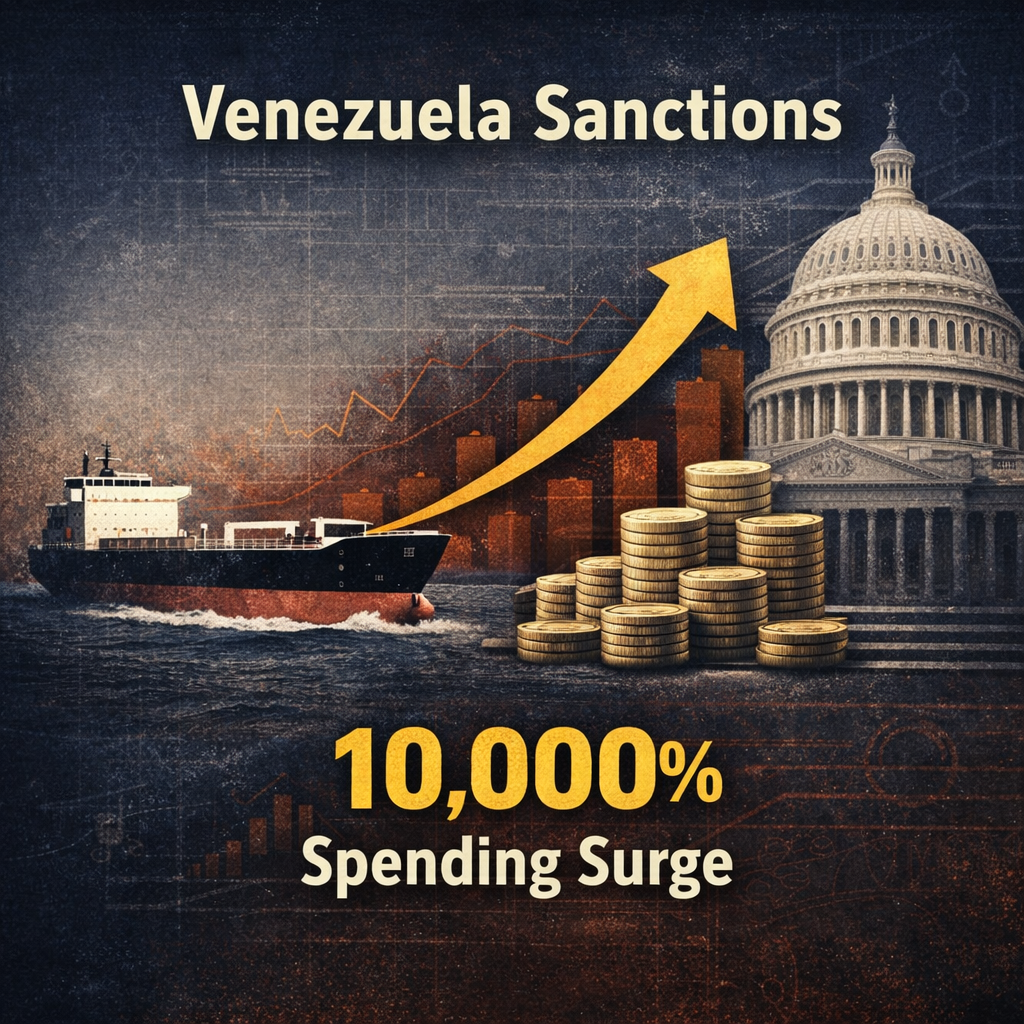
It’s been one of those days—but the facts still matter. Today’s Stack opens with President Trump’s announcement of a total blockade on sanctioned Venezuelan oil tankers tied to the Maduro regime. Despite media panic, this move is to enforce existing sanctions, not start a war. We walk through why Venezuela’s narco-terror ties, election fraud, and criminal exports make this a national security issue—and why sanctions without enforcement are meaningless.
Then we turn inward. A new report shows federal government spending per person has surged nearly 10,000% over the past century, dating back to the Woodrow Wilson era. Despite families being told to “do more with less,” Washington has done the opposite. Entitlement programs now consume roughly two-thirds of federal spending, while interest on the national debt rivals the entire defense budget. If fiscal sanity is ever restored, these realities can no longer be ignored.
🎧 Listen to Today’s Episode
📰 Stack Links
Buried in Debt: Report Finds Government Spending Per Person Soared 10,000 Percent Over Last Century
Trump Declares Venezuelan Regime a Foreign Terrorist Organization, Orders Oil Tanker Blockade
Trump Announces ‘Complete Blockade’ of Sanctioned Oil Tankers to Venezuela
Germany Warns Against Jeopardizing Peace After Trump’s Venezuela Tanker Blockade
🛒 Shop The Official Todd Huff Show Store

Let your lapel do the talking. This 5-button pack features fan-favorite Todd Huff Show slogans and artwork — scratch-resistant, UV-protected, and ready to spark conversations.
Perfect for backpacks, jackets, or gifting to your fellow common-sense conservatives. Wear your values. Start a conversation.
📝 Transcript: Trump Draws the Line on Venezuela While Washington Spends Without Limits
The Todd Huff Show – December 17, 2025
Host: Todd Huff
Todd Huff: It has been one of those days here for me, my friends. But don't worry. Don't fret. We'll deal with it, and we'll have our program come together. And we'll cover these issues and topics in spite of all the stuff that's happening. You've had these days. I'm not going to go through it. I'm not complaining. I'm just telling you. As a matter of fact, it's one of those days that no matter what I seem to do, it's met with resistance.
Todd Huff: I didn't even know it was there. Some days it just happens, and that's okay.
You've been there. I know. And I appreciate you tuning in today.
oday, we spent a lot of time recently talking about redistricting in Indiana, the political fight here. There's a lot of stuff happening around the world.
Todd Huff: One of those things is the heated-up scenario, the relationship between the United States and Venezuela. And I want to talk about that a little bit today, or at least I feel that we need to cover that. So we're going to start there. On top of that, time permitting—and I hope we get there— there is a second thing I want to get to.
Todd Huff: There's an article that I have. It's in the Stack of Stuff. And in the article, it points out that government spending—are you ready for this— is up per person about ten thousand percent in the past roughly one hundred years or so. Ten thousand percent increase in government spending per person, taking us back to the Woodrow Wilson era.
Todd Huff: And I want to talk about that. When I think about big issues in this country, that of course is one of them. This issue of spending, which nobody wants to touch because everybody loves to spend the money. And nobody wants to make the cuts necessary to get us back to fiscal sanity. I want to go through that time permitting as well, but that's where we are.
Todd Huff: That's where we're headed. I appreciate you being here today, my friends. Let's talk about something else that's important: your money. You worked hard for it. But is that money working hard for you? And what you believe in?
Todd Huff: At Four Eight Financial, they specialize in biblically responsible investing. That means they screen out companies that do not align with your faith, your values. And they'll help create a plan that fits your goals and your purpose. The best part is that they'll show you how your current investments—what you currently have today—stack up against your values.
Todd Huff: Do they reflect your values a lot? Do they reflect your values a little bit? Or do they completely stand against your values with what they're funding? Things like abortion, or who knows what else they could be funding. So to find out, all you have to do is take a quick assessment.
Todd Huff: FourEightFinancial.com/Todd. That's FourEightFinancial.com/Todd. Four Eight Financial, helping you align your money with your mission. Okay, that being said, let's talk here about what's happening between Trump and Venezuela. And just what's going on there.
Todd Huff: So President Trump just announced a quote, total and complete blockade of sanctioned oil tankers tied to Venezuela. Trump also said the Venezuelan regime is being treated as a terrorist entity. This is Nicolas Maduro. I will tell you—I will pause here. Well, let me just hit a couple of other points.
Todd Huff: And I'll tell you a very quick story. But the administration—Trump's administration—they are saying that the blockade is the enforcement of sanctions they have imposed on Venezuela. This is about national security. Trump's team says this is not an act of war. This is not trying to increase hostilities.
Todd Huff: This is trying to enforce the sanctions that have been placed on the nation of Venezuela. That's just kind of, in a nutshell, where we are. Let's stop there. Now, I want to tell you this really quickly. I can't remember where we were.
Todd Huff: We had an Uber driver that was Venezuelan. That was Florida, right? Orlando. Okay, so we had an Uber driver in Orlando who was Venezuelan. I feel like we may have had him another time as well. Maybe a little bit further—regardless.
Todd Huff: We started talking about Venezuela. I believe he still had family in Venezuela.
He lives here, and he's lived here for a long time. And of course, doing what I do—talking about politics and that sort of thing— and having some familiarity with what's happening in Venezuela.
Todd Huff: And of course, doing what I do, talking about politics and that sort of thing,
and having some familiarity with what's happening in Venezuela. And of course, I go back to even the days of Hugo Chavez. I remember when Hugo Chavez was the dictator down there years ago.
Todd Huff: I remember when he actually went on television. This is a true story.
I remember hearing about this on Rush, and I looked this up myself. I didn't today, but I did initially when I was understanding what was going on. They had a water shortage, which, of course, is what socialism brings us every time.
Todd Huff: It brings equality, certainly—well, except for the very, very exclusive group of people who are supposed to be acting in our self-interest or our collective best interest. They act in their own self-interest. They create wealth and opportunity for themselves.
And then, of course, the rest of us have inequality and suffering.
Todd Huff: And so there's a need to basically put limits on things, try to ration things, and that sort of thing. And they did that with water. And I remember Maduro going on television or radio, some such thing, all these years ago, talking with the people of Venezuela.
I kid you not—about how long they should be in the shower.
Todd Huff: And I believe it was three minutes. I believe Maduro was telling people, look,
three minutes is all you need for the shower. What's your problem? This is how you do it. I think he was telling them how to take a shower, or at least making the case that you could take one in three minutes.
Todd Huff: And I wonder—do you think Maduro was taking three-minute showers?
Is that how people think that works? I'm also reminded of North Korea, and I know North Korea is communist. But as was pointed out by all the true communists.
Todd Huff: That socialism's end goal, as Marx said, is communism. So the socialist communists in North Korea—you ever notice how if you look at the picture of the Korean Peninsula at night, you can immediately tell where the border is. Between North and South Korea.
Todd Huff: South Korea is not a totalitarian dictatorship like North Korea is. South Korea—again, not to give them a medal for being perfect—but they're welcoming to western ideas. Free markets and that sort of thing. And you can tell at night if you know your geography. China to the north, then the Korean Peninsula.
Todd Huff: You see lights in China. You see lights in South Korea. And if you didn't know better, you'd think North Korea was an island. Because North Korea—which connects China and South Korea—is absolutely dark. Minus Pyongyang, the capital of North Korea.
Todd Huff: Which is lit up probably where Kim Jong Un is located. But anyway, these folks will, of course, give everyone else rules to follow. It's black—completely dark around North Korea—but not where the benevolent dictator lives. Kim Jong Un.
Todd Huff: Hugo Chavez told the people of Venezuela to take three-minute showers. But I can certainly guarantee you that he was in the jacuzzi, taking as long of showers as he wanted to take. Those rules were for the peasants.
Todd Huff: Those rules were for the normal people. They weren't for the great Hugo Chavez.
And the same is true today with Nicolas Maduro. And as we were in that cab—in the Uber, I should say—we talked about this. And of course, there's always some degree of disconnect.
Todd Huff: When you read about things and I read about things, you read about things that are happening around the world, and we try to understand what that may actually be like, especially when it's so foreign to our own personal experiences. We've had some terrible leadership. We've had people who are actively trying to destroy this nation and western civilization. They want to remake America.
Todd Huff: There's radical, radical people out there teaching your kids, by the way.
They go to universities almost certainly if they have any political science class, philosophy class, liberal arts or sciences class. Almost certainly they're being taught by one of these insane, lunatic people. But it's still different.
Todd Huff: The Western civilization and the Judeo-Christian principles upon which this nation was founded, free markets—those things have created a society and a culture that is very powerful and productive. It's hard to just chisel that away, thankfully, or they would have done it by now. So it's still hard to understand how drastically different it can be.
Todd Huff: In other parts of the world where people are dealing with folks like Nicolas Maduro, for example. And this Uber driver was telling us—you could tell the guy really had strong feelings against Maduro. He saw it firsthand. He left the country. I think he said he can't go back.
Todd Huff: He has family that still lives there. And of course, everybody wants to leave.
I asked him about the problems with people being hungry and not having enough to eat. There's stories out there about rats and all kinds of things that I've read over time. So this problem with Venezuela.
Todd Huff: And largely with South America as a whole turning more socialistic—
and of course, in recent elections we've seen that change in places like Argentina and Chile. But there's still a very strong, heavy hand of socialism in South America. Certainly in Venezuela.
Todd Huff: Maduro disputes elections—not just disputes the outcome—but actual interference, silencing, political repression. The economy is totally trashed. The only thing they really have in Venezuela is oil exports. That's all that they have. Maduro is not a good guy. The U.S. has sanctioned Venezuela and its state oil company since 2019.
Todd Huff: They've frozen assets of the regime and designated Venezuela-linked criminal and terror organizations. So that is kind of the background here. Trump is now putting this blockade up. He's just announced this. We don't know exactly what it's going to look like yet. But here's the argument from the Trump administration.
Todd Huff: They've put these sanctions in place because of narco-terrorism,
releasing criminals that have been ushered into this country. A lot of bad things have happened directly coming from decisions made by Maduro. That have affected the people of the United States.
Todd Huff: The dispute is how do we deal with it. Many on the left and weak-kneed folks on the right don't want to address anything. They just pretend it doesn't exist. Then there are people ready to throw hands at the slightest provocation. Reasonable people are in between.
Todd Huff: We've got to have sanctions that protect this nation, and they must be enforceable. Sanctions that cannot be enforced are meaningless. That's absolutely true. Stopping these tankers is enforcement. It's not an act of war. It's enforcing U.S. policy.
Todd Huff: By the way, this regime that we're fighting against down there—that Trump is trying to stop from doing specific things— they've been accused of having deep ties to drug trafficking. Of course impacting the United States.
Todd Huff: Terror networks that can impact the United States. There's calls for jihad around the world, my friends. Especially in the wake of the shooting at Bondi Beach in Australia, which I don't have time to get into, but it's tragic.
Todd Huff: The world is a dangerous place. The world is a very dangerous place. Trump is saying Maduro is one of the people cozying up to and enabling those who make the world a dangerous place—criminal enterprises, terror networks, drug traffickers.
Todd Huff: By cutting off the oil revenue, which is essentially all Venezuela has, it hits the Maduro regime's lifeline. And it does so without committing U.S. troops, which of course we hope to avoid.
Todd Huff: There are steps being taken to prevent harm from being inflicted on the United States by Maduro and the people he enables. Whether you call them proxies or people he works with—drug traffickers, terror networks, criminal enterprises.
Todd Huff: The terror designations create additional problems for shipping, for insurance, and for people doing business with Venezuela. It disrupts things. And Trump says this is firm, lawful pressure. This is neither weakness nor war.
Todd Huff: This is enforcing sanctions on Venezuela. Now, on the other side of the aisle, the case against these actions— and listen, there can be nuance here. I get aggravated because there's no room for nuance today.
Todd Huff: It shouldn't be Trump does it, I'm for it, or Trump does it, I'm against it.
That's way too oversimplistic. Generally speaking, I support Trump. Yesterday I even spent the program criticizing something he did. So let's present the case against these actions.
Todd Huff: People argue that blockades historically are acts of war, regardless of how you label them. If the United States forces ships to stop under threat of force, they say that qualifies as a hostile act.
Todd Huff: They argue the Constitution gives Congress, not the president alone,
the authority to make war. The president is commander in chief—yes—but Congress declares war. There's always been tension here.
Todd Huff: Others raise humanitarian concerns—loss of oil revenue worsening food shortages, mass migration, third-party ships getting caught up in this. They warn of escalation. Those are the arguments against Trump's actions.
Todd Huff: Some even argue that terror designations are a legal State Department process
and not something the president can arbitrarily do. But the State Department is part of the executive branch. The president is the CEO, so to speak.
Todd Huff: Their bottom-line argument is that even a strong president should stay inside constitutional guardrails. I agree with that. But I also agree it's not that straightforward.
Todd Huff: There are statutes. There is precedent. We're not at war, but we're navigating tension. The lines can be blurry. And that's reality.
Todd Huff: The bottom line here is you don't have to hate Trump to worry about executive overreach. But you also don't have to love big government to recognize real threats exist.
Todd Huff: So, friends, if you're curious about kratom or just trying to figure out who to trust, let me introduce you to Christopher’s Organic Botanicals. This is a family-run company that offers natural, lab-tested kratom. Not the synthetic stuff that’s given kratom a bad name. This kratom is responsibly sourced and tested for purity.
Todd Huff: That’s what Christopher’s is all about. They work directly with farmers in Indonesia and follow the same traditions that have been trusted for generations. No gimmicks. No shortcuts. Just a clean, honest alternative for people looking for a more natural way to support their health.
Todd Huff: You can go to their website and do your own research independently. You can research at christophersorganicbotanicals.com if you feel comfortable and think it makes sense. You can start with their kratom starter pack. It’s a great way to begin.
Todd Huff: By the way, use coupon code TODD HUFF—make sure you put my full name there— to get 10% off at christophersorganicbotanicals.com. That’s christophersorganicbotanicals.com. Truth. Tradition. Transparency. Time out for me, my friends. Back in just a minute.
Todd Huff: Welcome back, my friends. I want to shift gears here a little bit. A lot of times we talk about one thing per program. Occasionally a couple. Every once in a while, there might be a third thing.
Todd Huff: But I do want to shift gears today because, as you know, we’ve been spending a lot of time talking about what I think domestically is perhaps the biggest threat we have, which is fighting against the left politically here. And the threats their radical ideology poses.
Todd Huff: We talked a lot about redistricting and how Indiana Republicans, especially in the Senate, were incredibly disappointing in this fight. But that fight is not over. We’re still fighting here in the state of Indiana.
Todd Huff: And there are other fights out there, other redistricting fights that may be happening as well. But there are stories and other things we haven’t addressed because we’ve spent so much time on that issue. And I recognize that.
Todd Huff: And I know many of you aren’t in Indiana. But again, it wasn’t—or isn’t—just a fight in Indiana.
It’s a fight in Indiana that impacts this entire nation. It impacts the midterms in 2026. So there were a lot of things I didn’t get to that I wanted to.
Todd Huff: One of the things I want to get to here is an article at The Federalist.
This will be on our website, toddhuffshow.com, at The Stack if you want to read it. Or you can go directly to The Federalist. I can’t give you the URL because it’s about nine million characters long.
Todd Huff: But you can search The Federalist.com for the headline, “Buried in Debt: Report Finds Government Spending Per Person Soared 10,000% Over the Last Century.” This was written by M.D. Kittle. It’s dated today, December 17.
Todd Huff: By the way, Christmas Eve is a week from today.
That’s wild stuff to think about. Time flies, my friends, especially when you’re having fun. Let me interject here really quickly about MyPillow. This past year has been a tough year for MyPillow.
Todd Huff: As you know, I’ve shared this before. We had the interview with Mike Lindell the other day. It’s been one of the hardest years in MyPillow’s history. They’re not complaining, but they’ve dealt with a lot of opposition. A lot of political opposition.
Todd Huff: Because Mike Lindell is a supporter of Trump and has been out there fighting for election integrity, he’s dealt with a lot of things. He shared some of that with you on this program. They’ve been deplatformed, debanked, de-everything.
Todd Huff: But they appreciate you. Many of you have purchased from them, and they say thank you.
Some of you haven’t yet, and regardless, they thank you. They thank you for being a conservative supporter who loves free markets and a free nation.
Todd Huff: You’re standing on the right side of this.
You’re standing on the side of sanity. And as a thank you, you’re getting some Christmas specials.
You can find them at MyPillow.com. Including the children’s Bible story MyPillow five-pack starting at $29.98.
Todd Huff: My slippers, by the way, now come with a free bottle of leather protectant spray for $39.98. Some of these items make great Christmas gifts too.
If you order quickly, you may still get them in time for Christmas. Whatever the case, MyPillow.com is the website.
Todd Huff: Use promo code TODD to get these special prices. There are all sorts of savings you’ll get with discount code TODD. Check it out at MyPillow.com. That’s MyPillow.com, promo code TODD. All right, let’s look at this article here really quickly.
Todd Huff: “While American families and businesses find a way to do more with less,
the government does less with more.” That quote is from Seton Open Books’ John Hart. Boy, that’s a good quote. You’re asked to do more with less because of inflation.
Todd Huff: Because of the high taxes we’ve seen accumulate over the years, the government, we expect them—because we don’t hold them accountable— to do less with more. I think about all the stuff DOGE uncovered and how people act like that was no big deal.
Todd Huff: Or that Elon and the young interns at DOGE were making this stuff up, or that it really wasn’t a big deal. These are real problems, my friends. They affect your liberty, your livelihood, your prosperity, your children’s future.
Todd Huff: Looking at the article here, it says,
“Arguably the height of hypocrisy for the American left
is the audacious ‘Make America Affordable Again’ campaign
launched by congressional Democrats ahead of next year’s midterm elections.”
Yeah, good luck with that.
Todd Huff: They’re going to try to tell you Democrats are on the side of affordability.
My goodness, it is absolutely mind-boggling to suggest such a thing.
But he continues here. The idea is to hammer Republicans, particularly President Donald Trump, early and often on pocketbook issues.
Todd Huff: So the same people that brought you the ill-named Inflation Reduction Act,
which, even by the CBO’s estimates, had little to no effect on inflation. In fact, those estimates showed it would raise inflation slightly in the short term and over the full ten-year period. They want you to believe they’re fighting inflation.
Todd Huff: It’s just a game.
It’s semantics. As the article points out, it raised inflation.
And it did. That was estimated in the short term.
Todd Huff: The same party whose tax-and-spend policies unleashed 9% inflation
on Americans are now going to tell voters that 3% inflation is a crisis only they can fix.
You bet they are. Talk about the audacity of hope.
Todd Huff: Of course, if Democrats really cared about affordability, they would have long ago ended their addiction to big government. Then again, too many Republicans struggle with the same affliction. Again, this is from an article at The Federalist.com. It’s linked on our Stack page if you want to read it.
Todd Huff: Per usual, it’s the American taxpayer picking up the tab for the government junkies. In a new deep dive into the ever-growing monster that is the federal government, Public Spending Tracker Open the Books explores how the leviathan has feasted on taxpayer money over the last century.
Todd Huff: Plus, here we go. You ready for this? Federal spending per person has exploded nearly 10,000% since 1916, according to the analysis. That was 109 years ago.
Todd Huff: That was the year President Woodrow Wilson campaigned
for a second term on the slogan “He kept us out of war.” Within five months of Wilson’s second electoral victory,
that slogan proved to be just another politician’s broken promise. America entered the First World War.
Todd Huff: The war to end all wars, by the way. And Wilson and his fellow Democrats began spending like there was no tomorrow. Wilson presided over a national debt that soared more than 700% during his tenure, from $2.9 billion to $23.97 billion. Now listen, that sounds quaint compared to today.
Todd Huff: Those debt figures seem almost laughable next to the $38 trillion obligation currently saddling the federal government. That debt is rising by about $70,000 every second. But I’m not going to read this whole article to you. I want to hit the highlights.
Todd Huff: We spend a little over seven trillion dollars a year now.
And we’re adding to the debt at a rate of about $70,000 per second. Federal spending has increased by nearly 10,000% per person over the past 109 years. Ten thousand percent.
Todd Huff: It’s absolutely unbelievable. I remember not that long ago when federal spending was around four trillion dollars. This is not tied to just one administration. This has been a centuries-long ratcheting up of the problem.
Todd Huff: There have been times where the rate of increase slowed, times where it sped up, but overall it has been on a consistent upward trajectory for the past century. That’s important to understand.
Todd Huff: It’s also important that we understand where the money goes. So let me tell you how this is broken down.
Entitlement spending—which is how this is classified— makes up nearly two-thirds of all federal expenditures.
About 60 to 62 percent.
Todd Huff: Social Security accounts for about 22%. Medicare is roughly 13 to 14%. Medicaid, which includes CHIP, is around 10%. Other entitlements account for another six to seven percent. That’s the bulk of federal spending.
Todd Huff: Now, defense often gets the blame. Defense spending is somewhere in the vicinity of twelve to fourteen percent of all federal dollars going out the door.
And by the way, it’s also a constitutional requirement. The amount can be set by Congress, of course.
Todd Huff: But this is one of the only clear and obvious obligations
the federal government actually has. Friends, defense spending is roughly equivalent
to what we’re now spending on net interest on the federal debt. That should get your attention.
Todd Huff: Interest on the federal debt is now ten to thirteen percent
of total federal spending. Let that sink in for just a moment. We are spending roughly the same amount on interest as we are on national defense.
Todd Huff: And what do we get for that interest?
Nothing. We get absolutely nothing. We are simply carrying the burden of past irresponsibility.
Todd Huff: Everything else—the remaining twelve to fifteen percent—includes education, transportation, law enforcement, veterans’ services, federal agencies, the alphabet soup, and infrastructure. That’s the rest of the pie.
Todd Huff: So it’s obvious, if you’ve had anything to do with business, if you know anything about economics, there is absolutely—listen, you can say at some point if we stopped growing the rate at which we’re spending federal dollars and if we were able to grow the economy at a very healthy clip.
Todd Huff: It’s theoretically possible that at some point you could grow your way out of this problem. Especially if you factor in tariff revenues. By the way, tariff revenues I think equaled about $200 billion in 2025 from what I saw.
Todd Huff: But again, we’re spending seven trillion dollars. Two hundred billion is noticeable, but it doesn’t dramatically change the picture. It’s not going to fix the problem. It might help a little.
Todd Huff: If you factor in tariffs, you might say it’s like spending six point eight trillion instead of seven. It moves the needle slightly, but it does not fix the underlying issue. Economic growth can help if government gets out of the way.
Todd Huff: But it’s simply not feasible to think we don’t have to touch these entitlement programs. And that can mean a lot of things. It can mean uncovering waste, fraud, and abuse, which is exactly what’s happening now to a point.
Todd Huff: That means finding people—whether American citizens or people here illegally or otherwise— who are taking advantage of these programs unlawfully.
Some of that is happening. But these numbers are so big, my friends, that it’s impossible to fix this problem without addressing entitlements.
Todd Huff: I wanted to point that out, because to me the big takeaway is this. Look at the percentage of money spent on entitlement programs. Second, defense is always blamed as unnecessary spending.
But even cutting all defense—which is impossible—doesn’t fix this.
Todd Huff: And I would never recommend that anyway. But even if you did, it wouldn’t solve the problem. When you look and see that interest on the national debt is equal to defense spending, that should be mind-blowing and eye-opening to everyone.
Todd Huff: We now spend as much on interest as we do on national defense, and we get nothing for it. Nothing.
We are simply carrying the burden.
Todd Huff: We’re carrying the burden because this Congress, this government, and the politicians we’ve elected would rather shake hands, kiss babies, and give stump speeches about anything than fix these actual problems.
Todd Huff: So I wanted to share that with you today.
I am out of time, my friends. Thank you so much for listening. Have a wonderful day. We’ll talk again soon. SDG.