
The Stack: Trump’s Constitutional Authority to Strike Iran and the War Powers Debate
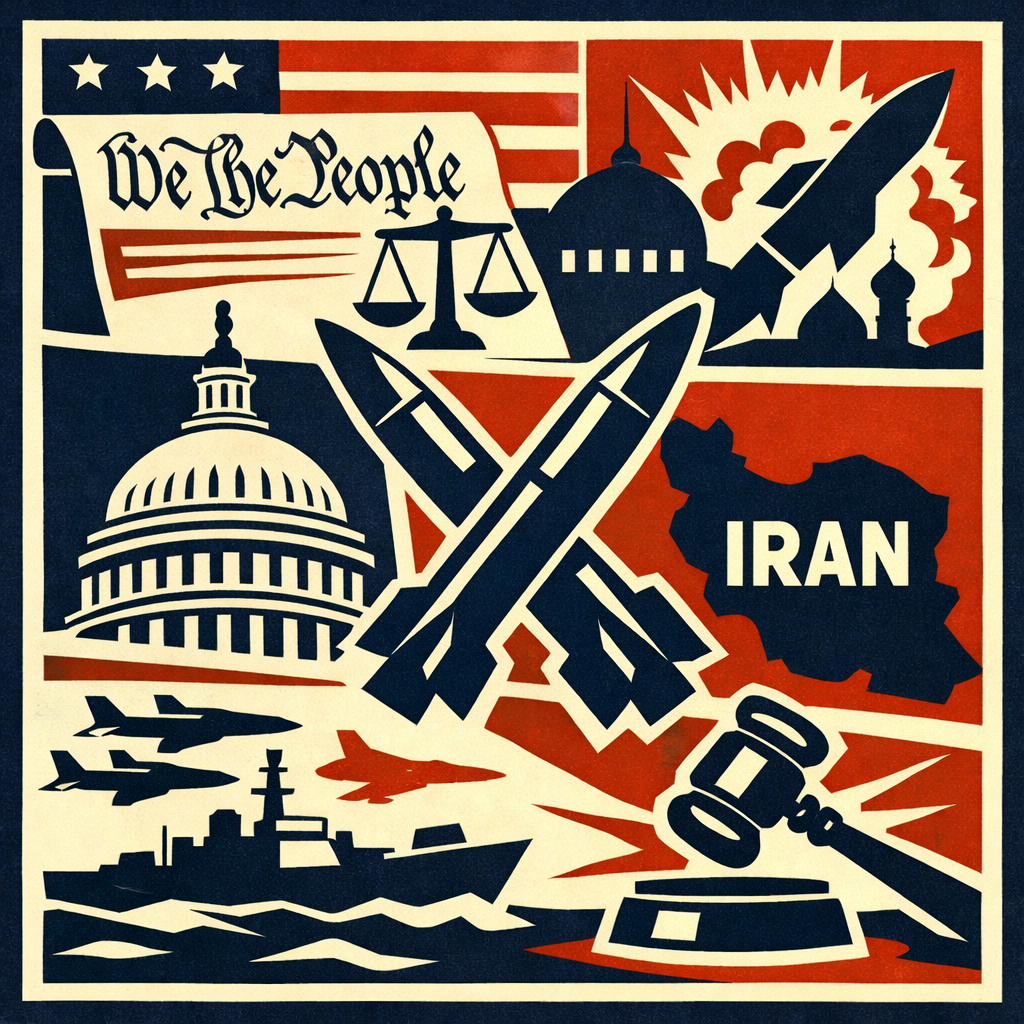
Did President Trump have the constitutional authority to strike Iran? That’s the central question today. Critics claim the action was unconstitutional without a formal declaration of war from Congress. But history, precedent, and the War Powers Resolution tell a more nuanced story.
Todd walks through Article I and Article II of the Constitution, explaining the tension between Congress’s power to declare war and the president’s role as commander in chief. Referencing legal analysis from Jonathan Turley and historical examples dating back to Thomas Jefferson and the Barbary pirates, the argument becomes clear: presidents have long exercised defensive military authority without formal declarations of war.
Todd also examines polling data showing mixed public reaction — and explains why many Americans misunderstand the scope and duration of the Iranian threat. This isn’t a sudden conflict. It’s the culmination of decades of escalation.
🎧 Listen to Today’s Episode
Want to get Stack links and content delivered to your inbox each weekday?
Subscribe to The Inner Circle. It’s free.
📝 Transcript: Trump’s Constitutional Authority to Strike Iran and the War Powers Debate
The Todd Huff Show – March 3, 2026
Host: Todd Huff
Todd Huff: It is good to be back here behind the microphone, my friends. You know that we were out last week. Of course we were in return yesterday for the show. But still, getting back in the routine here after being out a week, it's a good thing. And I got a new piece of equipment. It's not a big deal coming here to the studio today, which always intrigues and entertains me whenever I get something new set up here. But anyway, it's a pleasure to be here. Yesterday we spent a lot of time talking about Iran. We're going to spend a lot of time talking about it again today. Yesterday, if you want to go back and listen, we talked about kind of the historical framework of what is happening in Iran. We talked about the shah prior to the 1979 Islamic Revolution. We talked about the ayatollahs. We talked about the Islamic Republic and how that has totally oppressed the people in Iran. And not only that, it has caused havoc on people outside of Iran. They fight proxy wars. It's a mess, my friends. It is truly an evil empire. I cannot emphasize that enough. Some people are not capable of hearing those words because they think, oh my goodness, you're implicating an entire group of people. No, I'm implicating the people who are ruling and leading that nation. Those people are absolutely evil.
Todd Huff: And according to reports, at least 49 of them are no longer here on this planet to do the damage that they have been doing. That's what we talked about yesterday. Today I want to talk about the constitutional authority, the War Powers Act or the War Powers Resolution, the parts of the Constitution that are relevant to the discussion about Congress’s constitutional authority to declare war and the president's constitutional authority to be the commander in chief. How this works and how courts have interpreted that. I've got a piece here by Jonathan Turley, who's often on Fox News. You know, I met Jonathan Turley, and I think I've shared this before, some time ago when I was a student in college. I attended Butler University here in Indianapolis, but I spent a semester when I was thinking about going to law school. It was still part of my undergrad through Butler, but it was an exchange program.
Todd Huff: So I went to another university. This was at American University in Washington, D.C. It was a pre-law program. And I remember Jonathan Turley came to our class, and specifically he talked to our class about the Exxon Valdez oil spill in Alaska. I remember that conversation. I've always thought he's, I don't know, center-left maybe, somewhat liberal perhaps, but not a leftist lunatic. He's reasonable. Anyway, he's written a piece about Trump's authority, the Constitution, and all of that. I want to use that today as kind of our central hub of where we go and what we discuss. But that's the direction we're headed, my friends. I appreciate you joining us here today.
Todd Huff (Sponsor): Friends, if you're dealing with discomfort or if you're just tired of living off prescriptions and managing the side effects, you are not alone. A lot of folks are looking for something natural they can trust. That's why I want you to check out Christopher's Organic Botanicals, a family-run natural KRATOM company rooted in truth, tradition, and transparency. They partner directly with farmers in Indonesia. They lab test everything that they produce before it ever reaches your hands. There's no hype. There's no synthetics. There's no funny business. There's no shady sellers. That's what's happening out there. There are a lot of people selling things that aren't even real Kratom. It's synthetic, and it gives the natural product a bad name. You can start with their Kratom starter pack. Use coupon code ToddHuff and you'll save 10% on your first order. Visit https://christophersorganicbotanicals.com. That's https://christophersorganicbotanicals.com. Coupon code ToddHuff. Truth. Tradition. Transparency, my friends.
Todd Huff: That being said, I referenced an article here, an opinion piece written by Jonathan Turley posted at Fox News. This is in our stack of stuff, my friends, on our website. Also, if you want more background, a deeper dive into what we discuss on this show, including getting links to the stack of stuff—which are things that we've talked about or background for things that we're discussing here on the program—I encourage you to sign up to become a free subscriber to the Inner Circle where you'll get this email each day about 5:00 p.m. Not only that, there's some additional content. We never have time to get to everything on the program, and so I usually either take something a little bit deeper, something I didn't get to articulate or talk about fully, or we just talk about another component that we didn't really have time in the format to do so.
Todd Huff: You can sign up for that on the website at https://toddhuffshow.com. In fact, we're about to launch where you can sign up for this stuff by text, which should be easier for you. But anyway, that's where you'll find this material. Or you can just go to Fox News if you want to find Turley’s article directly. The headline here is, “Trump Strikes Iran: Precedent and History Are on His Side.” Trump called the military action a war and said it will not be a limited operation. So here's what Turley says. With the launch of attacks on Iran, some have already declared the strikes unconstitutional. That includes the immediate condemnation of Representative Thomas Massie. By the way, Massie is a Republican from the Commonwealth of Kentucky.
Todd Huff: The precedent, however, favors the president in this action, though the attack triggers obligations of notice and consultation with Congress. Turley says he is highly sympathetic to those who criticize the failure to seek declarations of war from Congress before carrying out such operations. Indeed, Turley writes, “I have represented members of Congress in opposing such wars. We lost.” The courts have allowed presidents to order such attacks unilaterally. Pause there for a moment. You know, this is how the rule of law works. We can all have differences of opinion, but at some point these things have to get tested. There is tension built into the Constitution, and I think the founders knew that these sorts of tensions would arise.
Todd Huff: They may not have predicted every specific circumstance that would ever exist from the time of the writing into the future, but they understood that there would be uncertainty given certain details of events that would happen in the future where lines would need to be drawn. So courts hear the cases. Of course judges and Supreme Court justices can be incorrect. They were incorrect, by the way, in the Roe v. Wade case, which is interesting because that case didn’t interpret anything. They simply made it up. That’s where the real danger lies. This, however, is actually the courts trying to make sense of constitutional separation of powers, the reality on the ground, and the precedent that has been set over time as our country has grown and evolved.
Todd Huff: But when the courts decide, we can still say we disagree with the decision. However, to say that the law absolutely says the opposite of what the court says it does—especially when the court gives legitimate explanations—is not a fair assessment of reality. Nonetheless, Turley continues here. Article II, Section 2 of the Constitution states that the president shall be the commander in chief of the Army and Navy of the United States and of the militia of the several states. However, the Constitution also expressly states that Congress has the power to declare war under Article I, Section 8, Clause 11.
Todd Huff: Our last declared war was World War II. That was 1941. Since that time, Congress and the courts have allowed resolutions to supplant the declaration requirement. They have also allowed unilateral attacks on other nations. President Trump has referred to this action as a war and said that it will not be a limited operation. The attack will result in calls for compliance with the War Powers Resolution, which was passed by Congress in 1973. The resolution requires, in the absence of a declaration of war, that the president report to Congress within 48 hours after introducing United States military forces into hostilities.
Todd Huff: Reading here from Turley’s opinion piece, the War Powers Resolution mandates that operations must end within 60 days absent congressional approval. Notably, there was a recent secret briefing of the Gang of Eight that may have included a foreshadowing of this operation. Secretary of State Marco Rubio confirmed that he has given notice to those senators under the War Powers Resolution. The resolution states, “The president, in every possible instance, shall consult with Congress before introducing United States Armed Forces into hostilities… and after such introduction, shall consult regularly with the Congress until the Armed Forces are no longer engaged in hostilities.”
Todd Huff: It’s wordy. The War Powers Resolution limits such authority to hostilities or situations where imminent involvement in hostilities is clearly indicated by circumstances. There are specific things within the War Powers Resolution that define what Congress is telling the president he can do and what obligations he has back to Congress. President Trump has cited the documented attacks of Iran and its proxies on U.S. forces and its allies. He has said, look, we’ve effectively been fighting Iran anyway for some time. They attack our military bases, sometimes directly. Of course you could say that’s in retaliation, but they have been fighting through proxies for decades.
Todd Huff: A proxy, of course, is a group that gives you plausible deniability. Hezbollah, for example, is a proxy of Iran. Iran funds them, equips them, and lets them do the dirty work. Because they’re not sending troops with Iranian flags on their sleeves, they can say they’re not directly involved. But the fact is they are involved. They use a third-party intermediary who shares the same ideological convictions of the regime running the Iranian government. U.S. military personnel have been injured or killed by roadside bombs and IEDs planted or created by these proxy armies, and Trump has pointed that out.
Todd Huff: Turley writes that Iran is also a state sponsor of terrorism and has continued to seek nuclear weapons in defiance of the demands of the international community. That is an obvious threat. They’ve been fighting us through proxy armies. They fund groups like the Houthis, Hezbollah, and Hamas. They have continued to seek nuclear weapons. I saw Benjamin Netanyahu being interviewed by Sean Hannity last night, and Netanyahu said we dropped bombs and took out nuclear capabilities in three locations last June, but they’ve resumed operations. They’re rebuilding. We cannot allow this regime—openly calling for the death and destruction of Israel and the United States—to obtain a nuclear weapon.
Todd Huff: You cannot allow them to have a nuclear weapon. This should go without saying. What, are we losing our ever-loving minds here? These are the sorts of things that factor into this decision. Recently, Turley writes, the IAEA—that’s the International Atomic Energy Agency—announced that Iran had again barred it from these sites. So they started rebuilding sites that we have no doubt are going to be used to create weapons-grade nuclear capabilities, and they told the IAEA, whose job it is to inspect and make sure that they’re not building toward nuclear weapons, that they could not inspect them. We’re supposed to play this game of charades and patty-cake here and pretend that they’re really trying to deliver nuclear energy to their citizens, which is a laughable and ridiculous assertion.
Todd Huff: But they were blocking the IAEA from inspecting these sites. Turley continues, there has historically been deference to presidents exercising such judgments under this vague standard. That was certainly the case with the attacks in Bosnia under President Clinton and the attacks in Libya under President Obama. They were given the ability to exercise these judgments. Even with the highly deferential language referencing the War Powers Resolution, presidents have long chafed at the limitations of the War Powers Resolution. Nixon’s veto of the legislation was overridden. Past Democratic and Republican presidents, including Obama, have asserted their inherent authority under Article II of the Constitution to carry out such operations.
Todd Huff: So the point here is that there is a pretty clear path. It’s pretty clear where we are today. The president, as commander in chief, has the ability to carry out these operations. Now, there are steps that are supposed to be followed. There are supposed to be briefings of Congress, consultations with Congress, which has happened at least to some degree. There’s supposed to be a limit of this being a 60-day operation before Congress says, listen, it’s time to wrap it up. But Congress can give the president additional authority. They can create what’s called AUMFs—Authorizations for Use of Military Force.
Todd Huff: So they’re not going to declare war on a particular country like Iran. They’re simply going to say, hey, what you’ve been doing, we authorize it. We’re not going to go through the process of declaring war, but you’re free to keep doing that to the extent that these authorizations allow it. The other thing is that there have been authorizations on the books dating back to 2001 regarding Afghanistan and 2002 regarding Iraq. Some of these resolutions that were used back in those days are still being cited because they are still existing law. If you can find language in those AUMFs that applies to a particular situation, until it gets repealed, a president can cite that authority as well.
Todd Huff: Turley writes about this. For example, he says the 2001 AUMF authorized the president—of course at the time that was President Bush—but the document remains on the books until repealed. It authorized the president to “use all necessary and appropriate force against those nations, organizations, or persons he determines planned, authorized, committed, or aided the terrorist attacks that occurred on September 11, 2001.” You can see how this opens up a significant opportunity for future use because what if someone can be connected to 9/11 in 2026? Does that at least open the door? You can make the case that it does because of the way that it is worded.
Todd Huff: The 2002 AUMF authorizes the president to use necessary and appropriate force to defend the national security of the United States against the continuing threat posed by Iraq. Turley says past presidents have interpreted these AUMFs to extend to new threats and beyond countries like Iraq. The bottom line is that there is a lot of legislation on the books. You’ve got the Constitution that says Congress can declare war, but the president is the commander in chief. There is tension there, but there is also precedent. The president has authority to act, particularly in defensive or preemptive situations where threats are imminent. I want to talk more specifically about that tension between Congress’s power to declare war and the president’s constitutional authority to be commander in chief. This matters. So I want to go back in history. You might remember this from your days in school, or maybe you’re a history buff. There was a president named Thomas Jefferson. Of course, Jefferson was the writer of the Declaration of Independence and the third president of the United States. He ran into a problem with the Barbary pirates.
Todd Huff: After the American Revolution, the United States lost the protection of the British Navy around the world. There were pirates operating around the waters near Libya, and in order to guarantee safe passage through that part of the world, there was essentially a fee imposed. At first, the United States paid this fee. That’s always a bad idea, by the way, to go along with shady characters on this sort of roller coaster ride. But when they raised the fee, Jefferson said he was not going to pay it. They basically declared war on us for not paying, and Jefferson preemptively sent United States naval forces to the area to protect our ships. There were skirmishes. Jefferson said we’re there for defensive purposes. We’re not there for offense. He struggled with this because being one of our founding fathers, he understood the separation of powers. He wrote that he was unauthorized by the Constitution, without the sanction of Congress, to go beyond the line of defense. So he acted defensively and avoided offensive escalation, and he deferred to Congress for broader war powers. But he did all of this without initial approval from Congress because there were Americans in danger.
Todd Huff: So that was in the early 1800s. We’re talking roughly 225 years ago. Now we’ve got a different world, but the same principles apply. The principle of separation of powers is the same. The commander in chief is clearly the president of the United States. In 1800-whatever this was, when Jefferson was president and this happened, he could deploy the Navy. He was in charge of the Navy. He was not in charge of declaring war. That was Congress’s job. But he also understood that some decisions have to be made quickly. You cannot go through a long debate in Congress, dealing with recesses and procedures and whatever else might factor into getting something decided when people are in immediate danger. This is reasonable to me, especially when you read the Constitution and see that the commander in chief is the president of the United States. The principle is the same now. I hear this argument a lot in regard to the Second Amendment. Now this is just analogous, just to give some context here. People who don’t like the Second Amendment will say that when the founders wrote the Constitution and the Second Amendment, all they knew about were muskets. They didn’t know anything about semi-automatic or automatic weapons. Therefore, the weapons of war have changed and the amendment should somehow be reinterpreted.
Todd Huff: They certainly didn’t know about semi-automatic or automatic weapons. But they also weren’t idiots. They knew there weren’t always firearms in the history of the world. They understood that the ways war was waged in the American Revolution were not the same as the ways war was waged in ancient times. The weaponry changed. The methods changed. But the principle remained the same. The principle of the Second Amendment is that you have a right to protect yourself against tyrannical force or against an intruder, up to and including justifiable homicide if your life or your family’s life is at risk or you are at risk of serious bodily harm. Likewise, the founders didn’t know that there would be something like a nuclear bomb. They knew there would be technological advancements. Even we today know that whatever exists technologically right now is going to be different tomorrow afternoon, certainly different in six months, a year, five years, ten years, fifty years. We know there will be advancements and changes. We don’t know exactly what those are going to be, but we know they’re coming. That doesn’t change the principles embedded in the Constitution.
Todd Huff: Nuclear weapons change the calculus of conflict. The speed of conflict changes things. Having weapons that can strike from Tehran or elsewhere in Iran and reach U.S. sites within minutes matters. That changes how quickly decisions must be made. It does not change the principle of separation of powers. It highlights the importance of having a commander in chief who can act decisively, and a Congress that can rein the president in by withholding declarations of war or limiting authorizations. These are completely reasonable structures built into the system. Just like Jefferson said he was acting defensively by sending the Navy to protect our ships around Libya, presidents today argue that when they act preemptively, they are doing so for defensive purposes. That’s what President Trump has said here. We had to act because if we allowed these operations to continue—these nuclear facilities to be rebuilt—then we would be putting not just ourselves but the world at risk. So he argues that this was a defensive move designed to prevent something catastrophic from happening.
Todd Huff (Sponsor): Friends, let me tell you, if you’re concerned about your cholesterol, if you’re concerned about your heart’s health, if you have a family history of these things or you just want to stay ahead of the game as you’re aging like the rest of us are, consider taking Soltea. Soltea is an all-natural, clinically proven dietary supplement that has been shown to lower cholesterol for lots of folks. It may be able to do the same for you. It’s affordable. It’s not a drug. It’s natural. Check it out at https://soltea.com. That’s https://soltea.com. Use promo code Todd and you’ll save 50% on your first order and get free shipping as well. Again, soltea.com, promo code Todd. Quick timeout for me, my friends. Back here in just a minute.
Todd Huff: Welcome back, my friends. Just going through here the case—I don’t even know that it’s the case. It’s just the established facts that the president of the United States is well within his constitutional authority to do what he did. So we’re going to continue to talk about that. There’s a lot I want to get to here, of course. But before I do that, think about this for just a moment. Your investments are like seeds. Seeds that you plant. They grow, they multiply. But are they bearing the kind of fruit that you want?
Todd Huff (Sponsor): At 4:8 Financial, they believe your money should reflect your values. Your money definitely shouldn’t work against your values. They specialize in wealth management and biblically responsible investing, screening out companies that do not align with your faith. It’s all part of their purpose-centered financial planning. They help you live a life of meaning, a life of purpose. If you want to see how your current investments—what you currently have right now—align with your values, or to what degree they align with your values, all you have to do is head on over and take a quick and easy assessment. You can do that at https://48financial.com/todd. Again, that’s https://48financial.com/todd. 4:8 Financial—they’re here to worry about your money, my friends, so you don’t have to.
Todd Huff: Okay, so we’ve gone through Turley’s piece, which again will be in today’s Inner Circle email, along with deeper dives into some of this stuff. There’s just a lot of content and context that we try to go over here, but it’s more comprehensive in the email. If you want to get that, it’s free on our website, https://toddhuffshow.com. But now I want to talk specifically about this tension between Congress’s power to declare war and the president’s authority constitutionally to be the commander in chief. This matters. It matters because people are saying this is unconstitutional. They’re saying this was reckless. They’re saying this was too quick. But you have to understand the framework. Congress declares war. That is explicitly stated in Article I. The president is commander in chief. That is explicitly stated in Article II. Those two things are not mutually exclusive. They exist in tension, yes, but also in cooperation.
Todd Huff: Congress can declare war. Congress can refuse to declare war. Congress can limit funding. Congress can pass authorizations for the use of military force. Congress can revoke those authorizations. The president, meanwhile, must be able to respond to imminent threats. If intelligence shows that a hostile regime is rebuilding nuclear capabilities and has openly called for your destruction, are we really saying the president must sit and wait for weeks while Congress debates? That makes no sense. That’s why the War Powers Resolution exists. It acknowledges that presidents will act. It requires reporting within 48 hours. It limits operations to 60 days absent congressional approval. That’s not eliminating presidential authority—that’s regulating it. That’s saying you can act, but you have to come back and consult us. That’s exactly how the system was designed to work.
Todd Huff: And this idea that somehow this was rushed or too quick ignores decades of proxy warfare. It ignores decades of Iran funding terrorist organizations. It ignores decades of Iran chanting “Death to America” and “Death to Israel.” It ignores the rebuilding of nuclear facilities. This wasn’t spontaneous. This wasn’t impulsive. This was the culmination of a long-standing conflict that many Americans simply haven’t been paying attention to. I know some of you disagree with me on this. That’s okay. I think there are principled disagreements to be had about foreign policy. But to claim that there is absolutely no constitutional authority here—that just doesn’t hold up when you look at precedent, when you look at the text of the Constitution, and when you look at how courts have ruled over the years.
Todd Huff: I want to shift gears here and talk about polling because, of course, that’s how Washington operates. Congress looks at polls. Politicians look at polls. That’s how they decide what they think half the time. Reuters and Ipsos conducted a poll asking Americans whether they approve of the president’s actions in striking Iran—taking out military capabilities, targeting leadership, disrupting nuclear rebuilding efforts. The numbers are interesting. Twenty-seven percent of Americans approve of Trump’s use of force against the Iranian regime. Forty-three percent disapprove. And roughly thirty percent said they were uncertain. Fifty-six percent said it was too quick to use force. Too quick. That’s the part that just jumps off the page at me. Too quick? This has been brewing for half a century.
Todd Huff: I know the average American doesn’t see it that way. I understand that most people are living their lives. They’re raising their families. They’re going to work. They’re not studying Iranian foreign policy. But the idea that this is sudden or impulsive just doesn’t line up with reality. This regime has been hostile to the United States since 1979. That’s not hyperbole. That’s history. Republicans in the poll, I believe, were around fifty-five percent approving of the president’s actions. Democrats were overwhelmingly opposed. That’s not surprising. But this idea that it was too quick to use force—that suggests people think this came out of nowhere. It didn’t. It’s the result of decades of escalation, decades of proxy warfare, decades of threats.
Todd Huff: And look, I get it. War is serious. Military action is serious. We should not rush into it lightly. But we also shouldn’t pretend that doing nothing is neutral. Doing nothing in the face of a regime openly pursuing nuclear weapons while chanting for your destruction—that’s not a neutral position. That’s a decision. That’s a risk. I think sometimes Americans view these moments as isolated events. They see a headline—“Trump Strikes Iran”—and it feels dramatic. It feels sudden. But what they don’t see is the years of intelligence briefings, the satellite imagery, the inspections blocked, the proxy attacks, the injured soldiers, the killed soldiers. They don’t see the full picture. And I’m not saying every military action is justified. I’m not saying presidents can never be wrong. But I am saying that we have to evaluate this based on facts, on precedent, and on constitutional structure—not just emotion or partisan reflex.
Todd Huff: The average person on the left today thinks the greatest threat to liberty on planet Earth is Donald Trump. Meanwhile, there are regimes that imprison dissidents, execute political opponents, suppress women, fund terrorist organizations, and pursue nuclear weapons while threatening genocide. Perspective matters. The ayatollahs believe they are on a religious mission. They believe they are divinely ordained to establish a global caliphate. That’s not rhetoric. That’s part of their ideology. When someone tells you who they are, you should probably believe them. When they chant “Death to America,” we shouldn’t interpret that as abstract poetry. So when I see a poll saying it was too quick, I can’t help but think that many Americans simply don’t understand the scope of the threat. And that’s not necessarily their fault. Media coverage often lacks depth. It lacks historical context. It lacks ideological analysis. It reduces everything to partisan talking points.
Todd Huff: This has been brewing for decades. For decades. In the case of the Iranians, for half a century. Nothing has fundamentally changed about the nature of that regime. Different leaders, perhaps. Different headlines. But the same ideology. The same hostility. The same pursuit of nuclear capability. The same funding of terrorist proxies throughout the Middle East. We have kicked the can down the road time and time again. And sometimes when action is finally taken, it looks dramatic. It looks sudden. It looks like an escalation. But in reality, it’s the result of years—sometimes decades—of inaction, appeasement, negotiation attempts, sanctions, warnings, inspections, and violations. You can only stretch that rubber band so far before it snaps.
Todd Huff: I mentioned earlier that President Trump reportedly said this operation could take about four weeks. He said they eliminated 49 leaders on day one and that originally it was expected to take weeks to accomplish that. We’ll see how this unfolds. We know the War Powers Resolution sets a 60-day clock absent congressional approval. So Congress has its role to play here. They can debate. They can authorize. They can restrict. That’s how the system works. But to suggest that the president had no authority whatsoever to act in the initial strike just doesn’t align with constitutional interpretation or historical precedent. Presidents from both parties have taken similar actions. Clinton did. Obama did. Bush did. This isn’t new. The only difference is who is sitting in the Oval Office when it happens.
Todd Huff: And let’s also be clear about something else. The president is not declaring total war in the traditional sense. Congress hasn’t issued a formal declaration of war since World War II. That doesn’t mean the United States hasn’t been involved in military conflicts. It means that modern conflict has evolved, and Congress has chosen to use authorizations rather than declarations. The founders gave Congress the power to declare war because they didn’t want one individual dragging the nation into prolonged offensive campaigns. They also made the president commander in chief because they understood the need for unity of command and swift action. Those two provisions must be read together, not in isolation.
Todd Huff: If Iran had successfully rebuilt nuclear facilities and achieved weapons-grade capability while we were debating parliamentary procedure, what then? What would the critics say? That we should have acted sooner? That intelligence warnings were ignored? Leadership sometimes requires making hard decisions before it’s politically comfortable. Now, I understand the fear of escalation. I understand the fear of broader regional conflict. Those concerns are legitimate. But there’s also risk in passivity. There’s risk in signaling that red lines are meaningless. There’s risk in allowing hostile regimes to believe that American warnings are just rhetoric. Ultimately, this debate is not just about Iran. It’s about constitutional structure. It’s about executive authority. It’s about congressional responsibility. And it’s about whether we understand the threats that exist in the world as it actually is, not as we wish it to be.
Todd Huff: I want to close with this. We can disagree about policy. We can debate foreign intervention versus restraint. Those are fair conversations to have in a constitutional republic. But what we cannot do is pretend the Constitution says something it does not say. The Constitution clearly grants Congress the power to declare war. It also clearly designates the president as commander in chief. Those provisions coexist. They have always required interpretation in light of real-world events. Courts have consistently allowed presidents to act unilaterally in limited military engagements, particularly when framed as defensive or preemptive actions in response to imminent threats. Congress has reinforced that structure through mechanisms like the War Powers Resolution and AUMFs. You may not like that reality. You may wish Congress had reclaimed more authority. But the legal and historical precedent is not ambiguous.
Todd Huff: The American people deserve honest debate—not partisan outrage that ignores precedent when it’s inconvenient. If someone opposed Clinton’s actions in Bosnia or Obama’s actions in Libya on constitutional grounds, at least there’s consistency. But if the argument only appears when a president from the other party acts, that’s not constitutional concern—that’s politics.The Reuters and Ipsos polling suggests many Americans think this was too quick. I would argue the opposite. I would argue that the United States has exercised remarkable patience over decades of provocation. Sanctions. Diplomacy. Inspections. Agreements. Withdrawals. Reimposed sanctions. Warnings. Red lines. All of it. At some point, deterrence requires credibility. This regime has openly called for the annihilation of Israel. It has openly called for the death of America. It has funded and armed terrorist organizations across the region. It has sought nuclear capability while blocking international inspections. Those are not abstract concerns. Those are documented realities.
Todd Huff: So when critics say this is reckless, I ask: What is the alternative? Allow nuclear facilities to be rebuilt? Wait until a weapon is tested? Hope that rhetoric is only symbolic? Leadership involves risk. But so does inaction. And sometimes the greater risk is pretending that evil intentions will somehow moderate themselves over time. Congress now has its role. If members believe this action exceeds authority, they can restrict funding. They can pass new legislation. They can revoke authorizations. That is how checks and balances function. But the initial authority for the strike is firmly grounded in constitutional interpretation and longstanding precedent.
Todd Huff: We are living in a dangerous world. Technology has accelerated conflict. The speed at which threats can materialize is unprecedented. The founders could not have imagined ballistic missiles and nuclear weapons, but they absolutely understood the need for structured power—energetic executive action balanced by legislative oversight. I know we covered a lot today. I know these issues are complex. But they matter. The Constitution matters. The separation of powers matters. And understanding the nature of threats we face matters. We cannot afford shallow analysis in moments like this. Anyway, my friends, I’m out of time. I thank you so much for listening. Have a wonderful day. SDG.