
The Stack: Truth, Power, and Propaganda Shaping the Way We See Politics
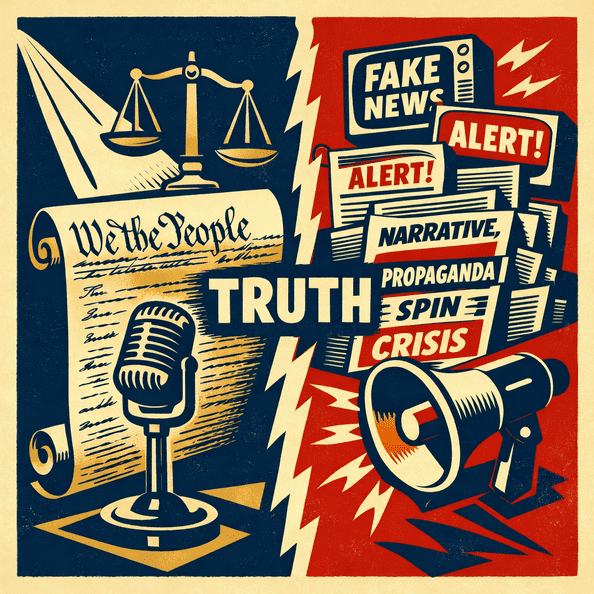
Political debates rarely begin with policy. They begin with deeper beliefs about truth, power, human nature, and liberty. In this episode of The Todd Huff Show, Todd begins a multi-day conversation exploring the foundational ideas shaping today’s political conflicts.
Todd explains that politics is not simply “downstream from culture,” but from even deeper assumptions about reality itself. How someone defines truth, understands human nature, or views the role of government will ultimately shape how they interpret political events.
Through a powerful story about a listener named Doug, Todd illustrates how honest conversations — free from labels and partisan attacks — can challenge assumptions and even reshape someone’s worldview.
The episode also explores how propaganda influences modern political discourse. By framing issues emotionally, selectively presenting facts, and controlling language, propaganda often distorts the public’s ability to recognize truth.
If Americans want healthier political conversations, Todd argues, we must first understand the deeper philosophical foundations that drive political thinking.
🎧 Listen to Today’s Episode
📰 Stack Links
Want to get Stack links and content delivered to your inbox each weekday?
Subscribe to The Inner Circle. It’s free.
📝 Transcript: Truth, Power, and Propaganda Shaping the Way We See Politics
The Todd Huff Show – March 11 , 2026
Host: Todd Huff
Todd Huff: All right, my friends, thank you so much for tuning in to this, the Todd Huff Show. It's a pleasure to be here, as always. You know, my friends, every once in a while, I just have this, I don't know, this hankering or this need. To, I guess, dig deeper than. The issues even at hand. And what I mean by that is I look out there at the political landscape in this country today, and I see that we have problem after problem after problem. And we all know that it certainly is a political problem, but it doesn't start at politics. Starts way deeper. Than that. And as I was thinking here, and I'm going to do a couple of days on some core issues that I think are important to help give people. A proper framework through which to see these events. Now, I know that for the vast majority of you, These are things that you already know, understand. You like to elaborate on them. You like to be challenged intellectually and all that sort of stuff. Sometimes there's new perspective and fresh perspective I think that I can bring. Sometimes you just want to have some additional depth or angle of seeing it or whatever.
Todd Huff: And some, of course, you got to put yourself in my shoes for a moment. We have listeners who some have been following politics longer than I have. Some have been following for a couple of years. Some may have literally just realized that we have some problems in the country. Over the past couple of years. And they're trying to learn. And I welcome every single person, no matter what your background or level of familiarity, and I think this is helpful. I think this is helpful to any person who tunes in here. And listens to what we're going to talk about here. Over the course of the next few days, most political arguments. In fact, I would go as far to say all political arguments. Are downstream. From deeper beliefs. Now, you might have heard me say on this program, You might have heard other people say on this program, other programs. That politics is downstream. From culture. And I certainly, certainly agree with that. I think that culture. Is how we view politics stems from how we view culture.
Todd Huff: But it's not just culture. I think that that's a little bit deceiving. Let me tell you what I mean. I mean the way that we look at the nature of truth. The way we view the concept of power. How we view and understand human nature, what we think liberty is and who should have it and how that came to be and all those sorts of things. How someone answers those questions. Certainly is impactful in how they. How they interpret things that happen in politics today. Now, most people today, most people out there react emotionally to the headlines, to the news, to the things that happen in a given day, a given week, a given hour, whatever given month, given political campaign. And the politicians know this. The media, they know this. And politics, as a result of this, is often reduced to mere feelings. Based upon what our personal preferences are. Based upon what we like. We say things like, wow, that sounds compassionate. Or, yikes, that seems unfair. Or I like that policy because I like the thing that they have made the law, made the law to be the case.
Todd Huff: So if I like puppies, I want people to have puppies. And so if we're going to give away free puppies, Then. I like that. That just sounds good. And a lot of people live in that world. I don't understand. How they stay there. I understand. As a child, how you could get there. In fact, from time to time. You might hear children say things like, if I was president for a day, I would blank. And it's usually things that are good or entertaining or whatever, they would do them. But that's not necessarily the way that a society should function now. When we lived this way, though. And I would say Americans have lived this way for a long time. What ends up happening. What ends up happening is that our feelings become the standard for governing and for legislating. There's no consistent framework upon which we can rely and scrutinize things and build things. And hold up a template and say, this fits or this doesn't or whatever. Policy debates become emotional reactions. And that's largely what politics is. Today.
Todd Huff: Unfortunately, not for the vast majority of you. Certainly not for yours truly here behind the microphone. But this is what it's become today. And here's where I want to start with this exploration, this study. This concept that we're going to be building upon here in the next couple of episodes. Before we start arguing about policies, we need to have a way to think about politics now. Far be it for me to tell you that you don't. I'm simply saying that my observation. We all know that there are lots of people. Out there who don't have a way to think. About politics, and you may be one of them. And by the way, let me stop and say that's okay. If we're all being honest, we all, at some point, didn't have. A didn't have metrics or guiding principles or whatever upon which we made political decisions, political choices. We have learned, we have grown, we have developed hecked. In some cases, we have changed. My friends. And that's a good thing.
Todd Huff: So wherever you are, I welcome you on this journey. That we're about to take together, and let's really try. Let's really try to establish the proper lens through which we look at the world so that we can have a clearer understanding of politics. A clearer understanding of how to articulate these things. A clearer idea on how to advance our policies and beliefs and all that sort of stuff. So that's where we're headed. My friends before we get there, though. I know that there's a lot of confusion out there about Kratom. You've probably heard the headlines. And most of those headlines you read that are negative are based on synthetic junk. And garbage and shady cellars. In fact, most of that isn't real kratom at all. Real kratom is natural. It's tested. It's handled with care. And that's exactly what you get from Christopher's Organic Botanicals. They are a family run company. That partners directly with farmers in Indonesia.
Todd Huff: Every batch they provide to their customers is lab tested for purity. There's no chemicals. There's no fillers. It is not synthetic. There are no shortcuts. This is a trusted herbal option that's been used for generations, and it can be a real alternative for people looking for something that doesn't come with a warning label. That's as long as a cvs receipt. So do your research. If and when you come to the point where you realize this is something you want to try. You can start with Christopher's Kratom starter pack. Use coupon code Todd Huff and you're going to get 10% off your first order. The website is Christophersorganic botanicals.com. that's Christopher's Organic Botanicals. Com. Truth. Tradition. Transparency, okay? Now, for those of you who have listened to this program for any length of time, You will remember a conversation I shouldn't say any length of time because this goes back several years.
Todd Huff: This goes back to the summer of 2020, which now it's hard to believe is almost six years ago. But you may have heard me talk about this because. It was a bit of an enlightening experience. For me. I had a gentleman call in. His name was Doug. His name is Doug. This may come as a surprise for you. I've recently heard from Doug again recently, I'm going to say. I'm going to say the past four to six months. I heard from doug. But doug lives. Or lived. I don't know where he lives currently, but he at the time lived. In the western u.s. we'll say that. And Doug had some friends. And you might be those friends listening to this program. You had Doug as a friend, and you listened to this program and you would argue politics. With doug.
Todd Huff: And there was a friendly wager that was made between Doug and his friends who listened to this program. Doug thought in 2020 that Donald Trump was going to be impeached and removed from office. Doug's friends, undoubtedly, because they listened to this program, knew that that wasn't going to happen. They knew that he was probably going to be impeached, given the realities in the house. But removal from office. We weren't quite there yet with the number of senators that were needed. Anyway, a bet was made. And the two parties basically made a bet as to whether or not that would happen. And the loser of the bet. So you had a couple of Trump supporters against a Democrat or a Biden supporter. And the loser had to do things like shave his head, paint the opponent the opponen. T's political campaign in his head.
Todd Huff: So, for example, Doug was going to have to paint Trump2020 in the back of his head, things like this. And his buddies were right. Wright. In suggesting this, they said, Doug, as part of your punishment. We would like you to call Todd because we think this would be something Todd would enjoy. Now, Doug's buddies must have listened to this program for a while because this is right up my alley. I enjoyed this. So I got a message from Doug. Back in. I don't remember exactly when. I'm going to say the summer of 2020, saying that he had lost the bed and all this sort of stuff. And as part of the bet, he had to do the things that I told you, and so he had to reach out to me. And I could be one that we could talk about it if we wanted to. And I was skeptical at first.
Todd Huff: You know what? You do this sort of thing for a long time. You never know what you're going to encounter out there. My friends, I've been hissed at when I spoke at the Indiana State House. By some leftist in the balcony. Of the Indiana State House, and you just never know what you're going to run into. But after some initial research, I reached out to Doug. We had this conversation, and I said, doug, listen to me. I said, let's establish a couple things. Number one, you made the bet, not me. So you're paying your bet, and paying what you owe is exactly what you should be doing. Number one. I said number two. Well, I didn't make the bet, so you can't blame me. But number two, I said we're going to have fun with this, as we should. But I said I'm not going to humiliate you.
Todd Huff: This isn't about. I don't know. Just being kind of tasteless and classless and just trying to humiliate you. I said, who knows where this will end up at the end of this conversation and into this experience together. So we go through the experience, and Doug's talking with me in all sorts of stuff over the course. This probably lasted, I don't know, a few weeks. I'm guess I'm going for memory. And at the end of our time together. At the end of our time together, we decided we were going to have an interview because it was an interesting experience, and I just wanted Doug to just share with the audience and have a little bit of fun with it.
Todd Huff: So we arranged for the interview. It was a pre recorded interview and I spoke with Doug and we agreed that it would air the next morning and all this sort of stuff.
Todd Huff: Well, a couple of things. Number one, once we finish the interview, The portion that was for live consumption or over the air radio or on the podcast. Off the air. Doug told me a couple things that really. Meant a lot to me. Number one. He told me. He said this went nothing like I expected. And this makes me a little bit. I'm hesitant to say this. I just want you to hear. We all have stories. I have stories. Hear me say this. I have stories that don't have a good ending like this when it comes to discussing politics. But I have this one, and I want to share it because I think that any of us can have this sort of outcome. Doug said this went nothing like I expected. He said that I treated him in a Christlike way and that he was considering changing his worldview and going back to church. And I was kind of floored because, honestly, I mean this sincerely. I didn't do very much. To try to sway Doug.
Todd Huff: I listened a lot. If he said something that I thought was ridiculous or borderline ridiculous, I would push back a little bit. Often using questions. And I'm not accusatory, not angry, none of that stuff. Doug, are you sure about that? That's not how I see that sort of thing. But I didn't do much. I didn't sit down to persuade him. I just sat down to have an experience with him and just see what happened. And so for him to say that it had caused him to change his entire worldview, it was quite an eye opener for me. Even someone who had pretty strong feelings about these things. Going back long before I even started this show. I think that the average person, if we can get them to talk about the issues, to talk about some of these things I laid out at the beginning of the program, the nature of truth. What's the proper role of power in a government or a society? Human nature? Liberty.
Todd Huff: I think there's a lot of agreement. On those things. But we get into the politics of personalities. We get into the names. I'm a conservative, he's a liberal, he's a this, he's a that. Democrat, Republican. Trump, Biden, right? And we largely avoided that. You can't avoid it completely. But I just refuse to have a conversation through that lens, whether it's attacking Trump or defending Trump. I understand there's times I defend Trump, but when you're really trying to. Get to understanding between people. Sometimes it's just best to leave all the nomenclature, the labels. The personalities out of it. And we did that. So I was amazed that he said these things. But he also said this, which is what I want to get to in this program today. He said after he said. He's rethinking his entire worldview. He's going to start going to church. Praise God. For that, my friends.
Todd Huff: He also said that he's starting to think that the media is lying to him. And I said, you don't say duck. Really? You think they might be just a little bit. And it's interesting because he had that moment of an epiphany or an epiphy, as Michael Scott says. And you can. See that I wasn't as his friends or the sources he had in media. I wasn't the person, the demon that he was led to believe I was by the people in the media. And we had a good conversation, and it just causes these series of thoughts and questions. To arise. And I think, to be clear, I think anybody can do this. I did not do anything special. I'm not trying to make that about me. I'm just trying to share a story. Trying to share a story and get to the point here, which is the last thing I said before telling that story.
Todd Huff: Before we begin arguing about policies or focusing on who's right and wrong and all this sort of stuff winning the argument. We need to have a way to think about politics. And sometimes it's so clouded by all these other things. That any of us can't see clearly what we're really looking at. And so Doug realized that there was a moment. When he realized that something doesn't add up. I think if we're all being honest, we all had those moments or a series of little moments. I distinctively remember as a young man listening to Rush Limbaugh on the horse farm circa 2000. That was between 1999 and 2002. I remember. I remember listening to Rush. Nodding in agreement the vast majority of the times. And sometimes he would say something and I would think, man, I just can't believe that.
Todd Huff: But over time, As was always the case. Or at least quite usually the case, Rush was right and I was wrong. And that media narrative that had been pounded into my head subconsciously, even suddenly became questionable. And I realized maybe I haven't been getting the full story. Likewise, Doug. Found himself saying the same thing. Maybe I haven't been getting the full story. So I want to talk about truth. That's where we're going to head next, my friends. I want to talk about propaganda, which is something that we're subjected to, and information where I want to talk about power. I'm going to talk about those things that we laid out. Why do people react emotionally to politics? Media narrative control. That's where we're headed. My friends.
Todd Huff: Now. I'm going to do my best. Listen, I've got notes, but I don't know how long we're going to establish our roots on any of these topics. This is going to be something we talk about and continue talking about is we have a lot more than this to get to. Over the next several days. In fact, this is probably going to become something that you'll read more about in the Inner Circle. As you get additional background information and dig deeper with me. In the program or after the program. You can join that. By the way, it's totally free. You can join that email list by texting the word Truth to 3178-510303-17785 1030. So we're going to build on these and we're going to talk about some fundamental things that I think need to. Need to kind of be core components or foundational.
Todd Huff: I hate to use the word pillars, because we've got the seven pillars of propaganda. But these are things we can turn to. To try to give ourselves clarity and to give clarity to those whom we're trying to speak with or persuade about these issues. So that's where we're headed. My friends and I thank you for taking this journey alongside me here today. Let's talk about something important. Your money. You worked hard. For your money, just like the song says. But is that money? My friends working hard for what you believe in. At 48 financial, they specialize in biblically responsible investing. That means they screen out companies that do not align with your faith, your values.
Todd Huff (Sponsor): And they at 48 financial, will help create a plan for you that fits your goals, your purpose. The best part is that they will show you how your current investments. You don't have to change a thing. All you have to do is take the assessment and they will show you how your current investments stack up against your values. They do the heavy lifting. You just have to answer a couple of questions. All you have to do is head on over to 48financial.com todd. Again. That's 48Financial.com Todd. 48 Financial helping you align your money. With your mission.
Todd Huff: That, my friends being said, I'm going to take our first time out of the day. You're listening here to the home of Conservative. Not bitter. Talk. I'm your host, Todd Huff. Back in just a minute. Ah, yes. Welcome back. My friends, before the break, I kind of set it up to tell you we wanted to talk about some core underlying principles so that we can give first ourselves a framework through which we see politics, but also others. Friends, I've said this before, and I will say it again. We are in an ideological battle. We are in a cold civil war in this country, and it's rooted in ideas.
Todd Huff: There are people who love the ideas upon which America was built. That would include me and the vast majority of you. And there are people who hate that. There are people who find themselves diametrically opposed, diametrically opposed to, well, the United States of America as founded. And they will do everything in their power. To change this country from what it was originally intended to be.
Todd Huff: And there's a lot of reasons for that, but I think one of the core reasons is that they just don't like truth. Now, that's easy for someone to say, like me, but what does that mean? The way that I think about truth. And I like to think about things. I have a buddy who says, todd, you have a way of putting the cookies on the bottom shelf. And as a lover of cookies, I tell you what, that's a good place for the cookies to be so that we can all get to them. But truth, my friends. Is simply this. What is. I'll say that again. Truth. Is. What is it is reality. As it actually exists. And let me say this too. Truth. This may step on some toes. I don't really care, because it's true. Truth exists independent of agreement. Truth does not need your vote. Truth, my friends, doesn't need my vote.
Todd Huff: Truth stands on its own. Whether the entire world acknowledges it. Whether the entire world denies it. Or anything in between. Truth is what is it does not change. Because people don't like it. It can't be changed because people want to alternate. They want an alternate version. Of what truth is. Amended or whatever. It doesn't. It is an immovable force. Truth does not require a vote. Truth does not require majority. Which, by the way. By the way, is why it matters. That we are a constitutional republic. And I'm just going to dip the very tip of my toe into this and say, when we acknowledge that our rights come from God, that is the truth. That is a truth. That's not my truth. That drives me nuts. My truth? Your truth. That stuff is insane.
Todd Huff: Truth is truth. I don't own it. You don't own it. It's not different for different people. Certainly. Of course, when it comes to what's true about my life in particular. I'm a talk radio show host and podcaster. It would not be true to say that I drive a big rig for a living. Likewise if you're a stay at home mom. Or if you are a small business owner, Or an employee or whatever. And you said you're an airplane pilot. That wouldn't be true. We're talking about truth. We're talking about universal truth here, not something that is true of the circumstances surrounding an individual. We're talking about bigger truths. What is what is objectively true, how the universe is, what made it come about, how it's managed, who runs it, all those sorts of things.
Todd Huff: Doesn't require a vote. For truth to be determined to be true. Truth is true, even when people say it's false. And that's why it matters. That's why it matters that we have a constitutional republic, a minority, the smallest minority that it can possibly exist, the minority of one. Of an individual, that person's rights are protected by the Bill of Rights. Protected because it's given to them by God. Bill of Rights simply acknowledges that and recognizes that no one else is going to try to take those rights away. Even if every other person on the face of the planet or every other person who's an American votes to say Billy can't exercise his right. The truth is that Billiard has those rights from God and is not the job of government to interfere with those rights.
Todd Huff: Now, we've ventured into the framework. We've already started assessing and analyzing the actual framework. I think it's inevitable. This is why the talk about separating God and religion and politics at some point is an effort in futility. I am fully on board with the idea that we do not have, and we should not have a theocracy. I believe that fully in my core. However, I also believe that there has to be some moral standard upon which we stand, or otherwise we will never gain our footing, either as individuals or as a society as a whole. So we have to have a framework, my framework. By the way, is the one I think is true. Not because I think it's true, but because I believe it is true. I think it's objectively true.
Todd Huff: That God, the God of the Bible, Yahweh himself, is the source of truth. God is the great I am. That's his name, in fact. And so when he says I am, in a way, he is basically saying, remember I said earlier, truth is what is. Truth is ultimately God. Truth reflects reality as God created it. To be. Humans simply recognize truth, we don't develop it. Again. I'm talking about the larger issues of truth. I'm not saying that we can't do something. Complete a task and then say, I'll tell you the truth. I did it. Of course we can have a role in truth like that. I'm talking about unchangeable. Timeless, objective truths.
Todd Huff: We have nothing to do with it. We didn't create it. All we do is recognize it. And in many cases, it has to be revealed to us. Maybe even in all cases. I don't know exactly all the ins and outs of all these things. But truth must be discovered. It can't be manufactured. I'll say that again. Truth is something that is discovered. Not manufactured. That's why it doesn't make any sense. For a society to say, we're going to build upon these truths, and, oh, this culture over here has these truths, there certainly can be differences in preference. Right. Someone likes vanilla ice cream. Someone likes chocolate. Someone likes mint chocolate chip, as Michael Scott would say.
Todd Huff: Somebody likes carrot cake. Somebody like devil's food cake. Whatever. Right. Chocolate cake. I don't know all the types of cakes. Not a big cake guy. My family is my family. I got a bunch of bakers. And then I'm a guy that just eats the stuff that they bake. But they bake cakes for each other for their birthdays. The kids do. My wife does as well. And it's remarkable. The artistic expression and just the quality. They do a really good job. But it's one thing to have a preference on something that we like versus saying something is true.
Todd Huff: Now, the political implication is here. Now you begin to see. Okay, you got truth. Truth is discovered, truth is revealed. Truth can't be manufactured. We. Didn't create this universe. We don't get to determine the values in this universe. Now we can argue about what those values should be from different worldviews. But I'm saying objectively, these things must have their source somewhere. Otherwise, you're forced to then conclude that your rights come from government, which is a terrible, an absolutely terrifying place to find ourselves.
Todd Huff: Along comes an understanding and a communication about what is, what's going on and everything else. And reporting in the media and getting information out and educating our children. And there are people out there who are pushing lies and propaganda. Propaganda tries to distort people's ability to recognize truth. Propaganda sometimes has use a selective facts. Incomplete information. Repeated language or. They'll soften the language to make something that's truly repulsive sound more acceptable. Or something that's pretty benign sound Absolutely. Like a malignant tumor.
Todd Huff: And so they frame things emotionally. They omit certain context, they deny that there's nuance. They shape the narrative before the facts are known. They turn people into, well, bleeding heart liberals before they get the facts and think they get them to feel so strongly that they can't react in another way and before they know it. People are swallowing up the propaganda hook. Line and sinker.
Todd Huff: So gotta pause there. My friends. Many of you have reached that stage where managing your money feels more like juggling. Feels like you're juggling more, I should say. Than just numbers. There's tax planning, estate work, investment choices, a whole lot more. That's when family office services can really make a difference. Full Suite Wealth brings all those pieces together. Into one cohesive strategy. Their family office services give you access to a coordinated team with advanced options strategies, private equity, private credit and legal expertise. All those things, my friends, under one roof. It's about simplifying your financial life, planning for the future, and making sure your legacy stays strong for generations. Ready for that next level of Support, visit FullSuite Wealth.com that's FullSuite Wealth.com. build your legacy. Secure your future.
Todd Huff: My friends. Quick time out for me. Back in a minute. Welcome back, my friends. I hope you're enjoying this. By the way, if you want to get the. What do you want to say? All the information, the background. You want this in written format with the receipts and the links and the other articles. Just text the word truth. To become a member of the inner circle. It's totally free. It sounds like it's something that's not free. But it is free. There's no charge. You'll get an email every day. Text TRUTH to 317785. 10:30. Sorry about that. It's a new number I had to pause. 317-785-1030. Just text the word truth. There.
Todd Huff: And I want to say to you too, friends, if you're tired of spending your hard earned money at businesses that turn around and support leftist cause as well, Check out Freedom Marketplace. Freedom Marketplace was created by us here at the Todd Huff show to give you options. Options to find businesses that have vowed not to support leftist candidates and leftist causes. It's a free, searchable directory that share your conservative values. Head on over to Freedom Marketplace. Net. That's freedom marketplace. Net. Liberty and business for all, okay?
Todd Huff: So in conclusion today, now this is going to be again a multi day sort of thing here, but we were talking about propaganda before the break. We were talking about the nature of propaganda sometimes. Listen. I know that it's tempting to think propaganda has to have some basis in fact, and I would say a lot of times that is true. But, friends, sometimes there's a belief out there that says the more radical and extreme the idea, the easier it is to sell. Because there's almost this point where someone says, that's what's the old saying. That's too crazy to be made up or some such thing, right? You can't make this stuff up.
Todd Huff: We often say. I've often joked that one of my first books would be called you can't make this Up. And I think that there is a degree of truth in that. Some things are so crazy it has to be true. And so sometimes they just swing for the fences. Now, at other times, they know that people won't accept. Won't accept. Some degree of what they're trying to communicate. And so they'll couple it with other facts and they'll make it look like it's part of the overall narrative, but in reality, They're just kind of. Pushing us slowly and subtly. Toward believing something that isn't true.
Todd Huff: So it's rare that it invents everything, but sometimes it does. And it mixes truth with distortion. It's designed to mislead us and to fool us. So when we hear things, when we hear things in the media, and I know many of you do this already, but we have to ask ourselves what facts are missing? What language keeps getting repeated? What are the terms they come up with? Right, to make me more susceptible to find one side of this argument. Appealing. What are the subtle little things concerning the way that this whole discussion is framed? How is that being handled and managed? Because that is very important.
Todd Huff: I remember I've shared this story on here before as well, that when I was a student at Butler University, I spent a semester. At American University in Washington D.C. it was a pre law program back when I was thinking I was going to get a law school, but I know the world has one too many attorneys as it is. I remember having a debate about abortion and one of the female students in my class called me anti choice. And typically, what happens. Is when someone gets called a label like that, they get defensive. I'm not anti choice and all that.
Todd Huff: I just looked at her and I said this. I said, you know what? I'll allow you to call me anti Choice when you allow me to call you Anti life. And it was interesting to me because I don't think she even thought about that. Because you could see the look on her face, like. That is at least a fair point to raise. I'm not saying I converted her, because I certainly, certainly didn't. But that language matters. What part of the story are we not hearing? What are they leaving out? What are they not telling us? Who benefits if people believe their version of events?
Todd Huff: Think about some of the language, right, that's out there today. Migrant encounters humanitarian challenge. Border surge instead of saying things like illegal crossings, border crisis. Criminal, illegal aliens, things like that. My friends make a big difference. My body, my choice sounds a lot. More appealing to people than to, say, somebody else's body, I'm killing it. That doesn't sound as good. And this is done. I realized in college, back in those days that the person who sets the terms for the debate often wins because they've set the rules in such a way that it gives them an unfair advantage.
Todd Huff: And people think that they're actually judging the merits of the debate. When in reality, what they're doing is they're judging the merits of the debate through the lens of those who have a vested interest in how you determine which side of the debate you fall on. They set the rules, they set the terms. And isn't it amazing? That they often quote, unquote, win the debate. Because all the terms favor the way that they frame. The issue.
Todd Huff: Numbers may be accurate if there's numbers of things, but the interpretation of how we see things, the number of abortions, for example, the number of illegal aliens in this country, The way that we view what those are is shaped by the narrative. So I've got to stop there. There's more than I want to get to today, but I can't. In fact, I'll tell you what I wanted to get to. It's in my notes here. I wanted to talk, and I will tomorrow. What power is. What's the role of power? Why are people emotionally reactive to politics? There's a lot of things I want to get to my friends over the course of the next few days, but I've got to go.
Todd Huff: Thank you so much for listening. Have a great day. SDG.