
The Stack: Why Liberty Requires Informed Citizens
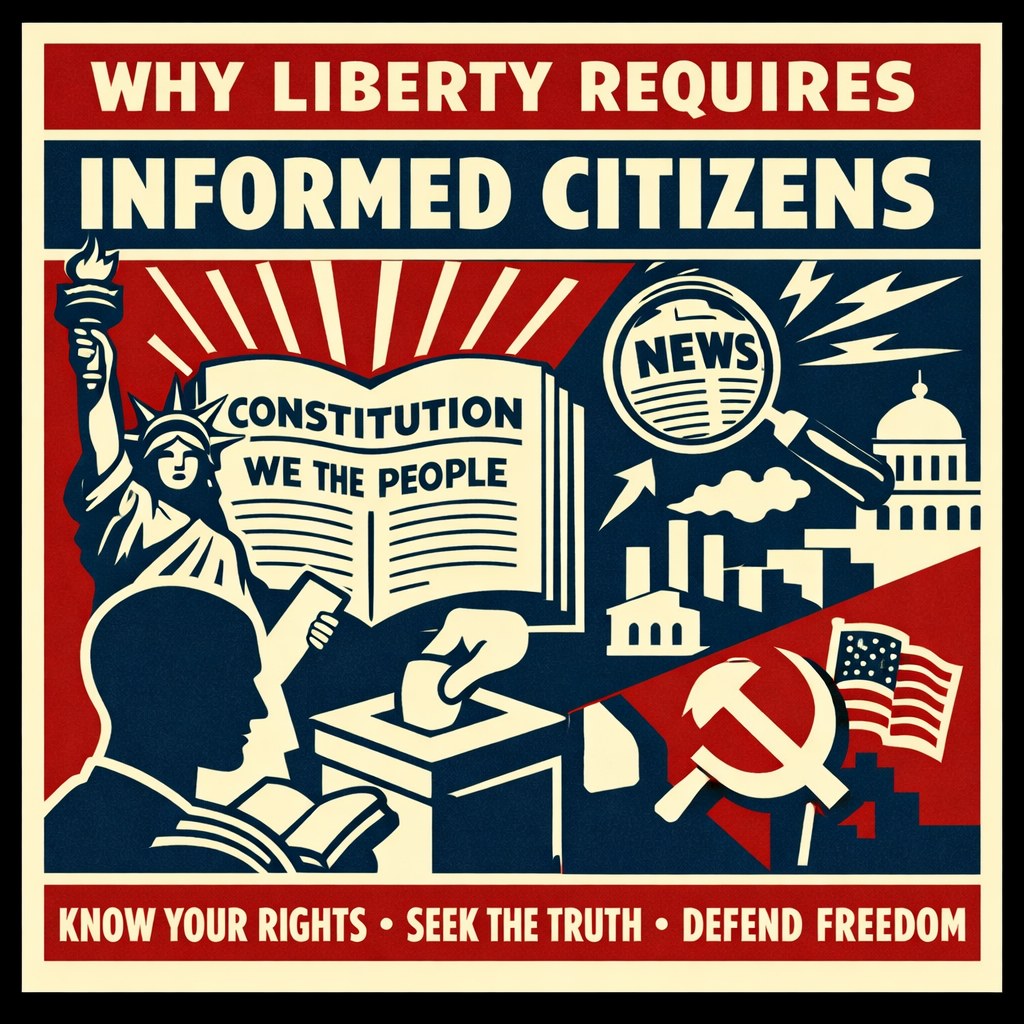
Liberty doesn’t sustain itself—and the Constitution alone isn’t enough to preserve it. In this episode, Todd Huff explains why a free society ultimately depends on informed, engaged, and truth-seeking citizens. Without that foundation, even the strongest institutions begin to erode.
Todd explores how modern culture—driven by entertainment, distraction, and algorithm-fed tribalism—has weakened our ability to think critically and engage meaningfully in civic life. While Americans are more politically aware than ever, many remain misinformed or passively consuming narratives rather than actively pursuing truth.
He also highlights the dangers of complacency in a prosperous society, where comfort leads to disengagement and allows government overreach to expand quietly. Drawing on history, culture, and personal experience, Todd makes the case that liberty must be intentionally passed from one generation to the next.
The bottom line: freedom survives only when citizens take responsibility for understanding, defending, and living out the principles that sustain it.
🎧 Listen to Today’s Episode
📰 Stack Links
Want to get Stack links and content delivered to your inbox each weekday?
Subscribe to The Inner Circle. It’s free.
📝 Transcript: Why Liberty Requires Informed Citizens
The Todd Huff Show – March 20 , 2026
Host: Todd Huff
Todd Huff: Conservative, not bitter. Indeed, my friends, it is an absolute pleasure to be here today. This will be day number eight. Day number eight of going through what I consider to be a pretty important framework for the development, the expression of a political prism through which we can see the world of politics. It gives us something—some sort of a standard, some sort of, again, a framework or a system—that we can analyze and discuss the political issues of the day. As I said, dating or going all the way back to the first program in this series, too many people—and I know you know these folks, and some of you in the audience would say that you are these folks or you recently were these folks.
Todd Huff: Certainly many of you are not anywhere near this. But a lot of people are very knee-jerk reaction or emotional when it comes to the issue of politics. And they don't have a standard or some sort of a guide by which to make political decisions. And these things matter tremendously. And I've gone through this over the course of the past—now counting today—eight episodes of the Toddcast. If you want to get all the information that we've talked about, the easiest way to do that is to text the word TRUTH to 317-785-1030. Again, text the word TRUTH to 317-785-1030 and you'll become a free subscriber to the Inner Circle. It is totally free, and you'll get the background, the links, explanations emailed to you where you can listen to the program in its totality if you missed it. Also get access to other articles that I don't talk about here, aren't able to get to on the program. So that's what you do. It's a pleasure to be here. Today we're going to talk about informed citizens and why liberty requires that citizens be informed and engaged. That's what I want to talk about today.
Todd Huff (Sponsor): My friends, do you know, though, where your money goes after you spend it? If that answer makes you cringe, it's time to check out Freedom Marketplace. We built this platform to connect conservatives like you with businesses that share your values—businesses that refuse to support leftist causes. It is totally free to use, and it's all about helping you keep your dollars aligned with your principles. Very straightforward, very simple. FreedomMarketplace.net. Check it out there today. It's totally free. Freedom Marketplace—liberty and business for all, my friends.
Todd Huff: All right, so what do I want to discuss today? I mentioned off the top we want to talk about the importance of liberty—I should say the importance of being informed as citizens when it comes to liberty, having liberty in our nation. The Constitution alone cannot preserve liberty. I think we've discovered that over the course of time. The Constitution does some wonderful things. It's a fantastic document. But we have to have an engaged and an informed citizenry to make the Constitution actually go to work. If people ignore it, as they often have, if they try to replace it, if they try to manipulate it, if they try to rewrite it—all these things have happened over the course of time. It turns out, shockingly, surprisingly, that it depends upon the individuals who are running said institutions. That's what matters. Having a free society—and this can be borderline terrifying—but having a free society ultimately hinges upon, depends upon having an informed, engaged group of responsible citizens. Yikes. That's terrifying when you think about what many Americans do today, my friends. Are they informed? Are they engaged? Are they responsible? No, not in many instances. In many instances, they're more concerned about—I don't know—who's going to win American Idol, who's the latest contestant on The Bachelor or The Bachelorette, who's going to win the Super Bowl, who's going to be the number one draft pick in the NBA.
Todd Huff: Listen, any of these things—it’s fine to pay attention to. Well, maybe not The Bachelor or Bachelorette. But any of these things is fine to have a personal interest in. The problem is—the problem occurs when these things become more important or when they accumulate. We all can't be experts in all of these things. If we are, we're probably utilizing our time the best way possible. And so what ends up happening is we have an entertainment culture. People want it now. People want to be entertained. Of course, human nature, which we've talked about, fuels this sort of thing a lot. So has—things that have come along recently, right? Things like microwaves, fast food, drive-ups. Things like social media, right? If you're bored—if you've been bored for any length of time at all—you pop your cell phone out and you start scrolling through whatever social media app, or you start texting friends, or you go to a website. Again, nothing wrong necessarily with any of these things, but we've lost the ability—many have anyway—to just sit and be with your thoughts, be alone, be quiet, just sit and embrace the silence, the solitude, and just chew upon, dwell upon some of these important questions in life.
Todd Huff: Of course, the most important—is there a creator? What—if so—what does He expect of me? And if He does exist, which, spoiler alert, He does, and He does have expectations—unfortunately for us—but that's just part of the story. We've all messed up. We've all fallen short of those expectations. But there is a way to be reconciled to Him. Those are things that we should be thinking about. And by the way, that way to be reconciled to the creator of the universe comes through Jesus Christ. So that's the most important question to wrestle with. But also, how do we live this side of heaven? And a lot of things that we talked about on this program today—well, over the course of these last now eight episodes—but also even before that, when you look at some of the things that we've discussed just over the course of—it'll be 11 years, my friends, that we've done this program in August—but over the course of time, just talking about these things and just developing some of these ideas. We talk about issues that matter, and it's almost as though many people don't have the capacity to have these sorts of conversations or even just the solitude and the thinking..
Todd Huff: I've shared before that after graduating from high—excuse me, from college—I didn't know what I was going to do with my life. I shared—I’m not going to go through the whole story—but I went through a period of time when I had no idea. And it wasn't because I was lazy and trying to find myself. I was actually always been a pretty driven guy. But my first desire, at least I thought at the time, was to go into the military. I was medically disqualified from doing so. So my second option after college was to go to law school, and I went to a pre-law program. I loved the larger debates and conversations we had. I loved being the guy who had to defend conservatism or even Christian values in class on a regular basis.
Todd Huff: But I realized that law school was not for me, and I didn't know what to do. And I remember I ended up on a 200-acre standardbred horse farm. It's where I started listening to talk radio. And it was during that time there that a lot of the things that we talk about today on this program were kind of built into my way of thinking. Some things I guess discovered or learned or whatever through those moments of solitude. Some of them I learned by listening to the late, great Rush Limbaugh, who I listened to on a regular basis out there. But some of the things I learned just from the solitude and the thinking. There weren't smartphones in the day. In fact, I had a pager. Can you believe this? I had a pager back in the day so that I could be reached. Didn't know what sort of urgency there was for me to be reached back in those days, but I had a pager. But I didn't have smartphones. I didn't have social media. I had my thoughts. I had some, of course, some books. I would chew on the things that I learned, things that I'd heard on talk radio and other radio programs as well. I remember listening to programs by some great preachers like Adrian Rogers and Charles Stanley, and I remember Chuck Swindoll, listening to these programs, the Bible Answer Man, Hank Hanegraaff, on and on.
Todd Huff: I listened to these programs, listened to different sorts of things, and you think and you learn. And I feel like that's lacking today. And I just think we fill the silence with some sort of noise and distraction, and at some point that becomes a dangerous thing. And what we have today—and we had back then too, I'm not going to say that everything was perfect back in those days—but what we have today is disengagement from people. Now, in some respect, we have more engagement today than we did even 20 or 30 years ago because you no longer have the option. It has gotten so politically intense in this country, you basically have to pick a side. You can't just sit it out now. Some people still do, but it's becoming harder and harder. Everything, as I've said, has become political. What you eat, what you drink, what you wear, what's your favorite sport or activity, what you do for entertainment—all these things, right? Everything is political. Where you work, what you do for a living—everything has become political. And there's disengagement. Sometimes people think it's too confusing. Sometimes people think it's a lost cause. Sometimes people are just distracted by the shiny objects that are out there across the fruited plain that get our attention and so forth.
Todd Huff: We also have tribal thinking. I remember—and I've shared this before—but I remember when the internet really started to get a foothold, and people started looking to the internet for information. And I remember—keep in mind, I grew up in the era where the mainstream media controlled virtually everything that was discussed in coordination and collusion with the Democrat Party. They controlled what was discussed. And I thought, finally, finally we're going to be able to get information out to people. And we certainly have through the internet. I'm not saying that we haven't. But I didn't stop to, I guess, calculate or understand just how much propaganda, lies, deceit, self-serving interests, conspiracy theories—and yes, my friends, some conspiracy theories are true—but a lot of them serve as nothing more than entertainment because they just create this sort of fantasy for us in our minds where it's almost like a movie plot or some sort of extreme series of events that we're trying to find out who-done-it sort of thing. And again, I'm not poo-pooing all conspiracy theories, but you know what I mean, right? Everything on this planet is not a vast right-wing or left-wing conspiracy.
Todd Huff: And there certainly are powerful players and people who have interests. That's always been the case. But what the internet has created—especially algorithms on social media and so forth—is it has created a tribal thinking even worse than we had previously because it feeds you the things that you consume. It feeds you more of it. It begins to identify that this person likes to consume CNN or Huffington Post or MoveOn.org, and they just feed you more and more of the insanity. So much so that unless you intentionally go looking for the other side—even left-wing, incredibly crazy news out there as we do on this program—you won't find it. Because the algorithms, if you're getting your news just from social media, basically keep feeding you the things that, I don't know, align with your thinking or your preferences or however you want to look at that. And so we've got tribal thinking. And then we've got this passive consumption of information.
Todd Huff: I think that this is a huge thing. I think it's been said—and I don't know who said it, maybe I'll look it up during the break—but it's been said that if you were given the opportunity to change the laws of a society or the music and art and culture, the safer bet to change the way of thinking of the people is to change the art and the music and the culture and the fashion—that sort of stuff. Because the laws, my friends, the laws come from that. It's like advertising. I remember learning about—I've been in the world of marketing and advertising—and I remember hearing years ago that advertising is basically holding up a mirror to the audience. If you hear an ad, if you see an ad, if you read something online, it's the advertiser wants to connect with you, wants to find commonality with you. They're not trying to move you. Now, sometimes you've got extreme groups that try to use advertising to shape the thinking of people. But the left hasn't had to do this. They've had entertainers in their pockets—the people who create music and influence our culture and our thinking and the things that we consume and listen to or watch on television or online or whatever today.
Todd Huff: When that filter is off, I've often said on this program, if you go up to somebody and you say, “Hey, I want to have a discussion about this divisive issue, and I'm going to try to change your mind on it,” well, what you've unintentionally done—or maybe intentionally, I don't know—but often unintentionally, what you've done is you've created a massive defense mechanism for the person that you're going to speak with. Because they're coming in ready for you to try to change their mind, and of course it's human nature to say you're not going to change my mind on anything, right? Salespeople are trained, for example, they're trained to understand that if the prospect says something in a conversation, then it's the truth. But if the salesperson says it, in the mind of the prospect, it's a lie. That's why skilled salespeople will ask a lot of questions to get basically the buyer or the prospect to say something—to say the things that naturally lead to them purchasing your product or your service or whatever. But far too often when it comes to the way we think about culture, the way we think about how we live our lives, it's subtly influenced when the filter is off. I've gotten to the point now—I've gotten to that day, I don't know if it's my age, if it's just my interest—but I don't listen to too much. I’ll listen to maybe Pandora, find a channel that I like, I'll listen to when I'm doing some work, classical music, or I'll listen to—there's some apps that play just kind of instrumental music in the background that's designed to help you focus and all this kind of stuff, think and relax. But I don't spend a lot of time listening to pop music. And man, oh man, if you turn it on and you haven't been listening to it, it is sometimes shocking. I read some of the lyrics of songs—I’ve done that a few times over the course of the history of this program—and I’m censoring what I say to you because these songs are so—not even provocative—just absolutely vulgar, wicked, vile, just some terrible stuff. And that's the stuff that's fueling the subconscious of people because that defense mechanism is down. We don't have a filter up, and we're just consuming, just consuming information and entertainment passively, and it is dangerous.
Todd Huff: And I say all of this to get to the bottom line here that says liberty survives only when—and only if—its citizens stay informed and engaged. And I would add—I would add one other thing to this. I would say informed and engaged, absolutely, but I would also say earnestly seeking truth. So it's not just that we want to know what's happening. It's not just that we want to stay on top of it so that we hold these jokers and clowns accountable. We also want to be in line with truth. We also—the things that we talked about over the course of these past eight episodes now—we want to be aligned with what is actually true and good and to put first things first, because that's what really matters. Liberty can survive only when citizens do this. If citizens become corrupted and evil and don't focus on first principles and things that are true, if they don't stay informed and engaged, liberty, my friends, crumbles. It absolutely has throughout history, and it can do it again. It's amazing to me how some people think America could never crumble. And I think, my oh my, you need to pick up a book and read history. I know it's always someone else's problem. It's always reading about something else that happened in a land far, far away or something many, many years ago. But my friends, those people thought the same exact things.
Todd Huff: And their culture—they thought that they could not fall, that they were above even a suspicion that they were going to collapse. But this has happened before, and it can happen again. It's a dangerous thing to play with. So we're going to have to move towards our first timeout. Friends, you've worked hard, you've made smart choices. Now it's time to make sure that effort counts—not just for today, but for the future as well. Full Suite Wealth helps forward-thinking people with a coordinated approach to wealth, legacy, and legal planning, including private equity, private credit options, strategies. They'll help you see the big picture, help you plan ahead, and make your success truly matter for the people you care about the most.
Todd Huff (Sponsor): The goal is a plan that stands the test of time. Visit FullSuiteWealth.com for more information. That's FullSuiteWealth.com. Build your legacy. Secure your future.
Todd Huff: Welcome back, my friends. By the way, if you want the full story, the full scoop, all the information, the receipts, the background, everything that we discuss—including some things we don't have time to get to here on the program—sign up for the Inner Circle. It is totally free. Text the word TRUTH if you want to do that to 317-785-1030. Again, text TRUTH to 317-785-1030 and you'll be a member of the Inner Circle. It is absolutely free. Okay, so citizens—we're all citizens. Well, that's a whole—that opens up a whole other talking point here—but let's presume we're all citizens here of this great nation. And citizens matter. Republics depend—which is what we have, a constitutional republic—depend on voters, constituents. Voters choose their politicians. Voters influence policy. And of course, it's dangerous if uninformed citizens are so uninformed, so naive—or dare I say stupid? Rush used to say low-information voters—but if that's prevalent in a society, people can be easily manipulated. That's why propaganda works when people cannot identify truth. I talked about truth early on, back in the first or second episode of this series. Propaganda works when people can't identify truth. It's really pretty simple if you just stop and think about it.
Todd Huff: Freedom requires responsibility. You've heard me quote Ronald Reagan on this program before. One—I have many candidates for my favorite Ronald Reagan quote—but in the mix, some of the ones I like: the seven most terrifying words in the English language are “I'm from the government and I'm here to help.” I love that. I love “Mr. Gorbachev, tear down this wall.” I love that. And I love this one. Reagan said freedom is always—or only—a generation away from extinction. We do not pass it along in our bloodstream to the next generation. They do not naturally inherit it. We have to pass that torch. That torch of liberty is burning. It's been burning brightly in this country for nearly 250 years. It's certainly dimmed over time, and I don't want to get into that, but it's burned brightly in comparison to how the vast majority of the world lives today and candidly how the vast, vast majority of people have lived on this planet throughout the course of history. It burns brightly. And the only thing that allows it to be handed to the next generation is the current generation explaining it, articulating it, presenting it in such a way that the next generation accepts it, embraces it, and prepares to do the same for the generation that follows.
Todd Huff: That is our responsibility. Freedom requires that we take responsibility for this. And we're complacent. Now, I know I'm preaching to the choir, but I'm sure I've got some complacent people out there listening today. I'm sure that there are. And I'm sure if we're all being honest, we would all say at some point we've been complacent about maybe these very things or at least something in our lives. Comfort leads to disengagement. When things are easy, when we're living in a prosperous society—and that's what's happened—we've lived in such a prosperous society for so long, we've gotten so comfortable as a people. We're so financially blessed, we have such a high standard of living. I've tried to illustrate this sometimes. When you have this job that I have, you try to think of as many ways as possible to communicate the message. And one of the ways I try to do it is I say, listen, just think about this for a moment. We have an entertainment culture. Let's take the NFL, for example. I used to be a huge fan of the NFL. They've done a lot of damage to the NFL from a true football fan's perspective. But be that as it may, we've gotten to a point where we are prosperous enough as a nation that we can pay people quite handsomely to be athletes full-time, to where they make much, much more than the average American taxpayer.
Todd Huff: To the point where they're making millions of dollars a year—many of them, most of them in fact in many of the major sports. And in some of these contracts, it's getting to the point—you may know this—they get paid per game. So they don't get checks like normal jobs. For example, there are NBA contracts where players make tens of millions per year. You break that down per game, per minute—it’s staggering. And I'm not criticizing that, but I'm pointing out how much value we place on entertainment. And it doesn't stop there. We have entire industries built around talking about the people who are entertaining us, and even fantasy sports layered on top of that. The point is, this nation has been incredibly prosperous, to the point that some people produce things that are three layers removed from just us being entertained. And because of all this distraction, the confusion, the lack of interest, government can expand quietly. That's what's interesting to me. Government has been expanding for decades, and only recently have average Americans really begun to push back in large numbers. Liberty erodes gradually over time. It requires a disengaged and distracted population. It doesn't disappear overnight—it fades when people stop paying attention.
Todd Huff: So our culture, my friends, needs to be focused on making sure—not just that we have civic understanding—but that we are grounded in faith, family, education, truth. These are the things that sustain a free society. We can't simply trust institutions. We have to hold them accountable. And if we don't understand truth, if we don't understand human nature, if we don't stay informed and engaged, then we are setting ourselves up to lose the very liberty that we claim to cherish. That is why this matters. That is why we've spent eight episodes laying this groundwork. And if you want all the information—everything we've discussed—text TRUTH to 317-785-1030. I appreciate you joining us. You can text your thoughts, your questions, your opinions as well. But I've got to go. Have a great day. SDG.